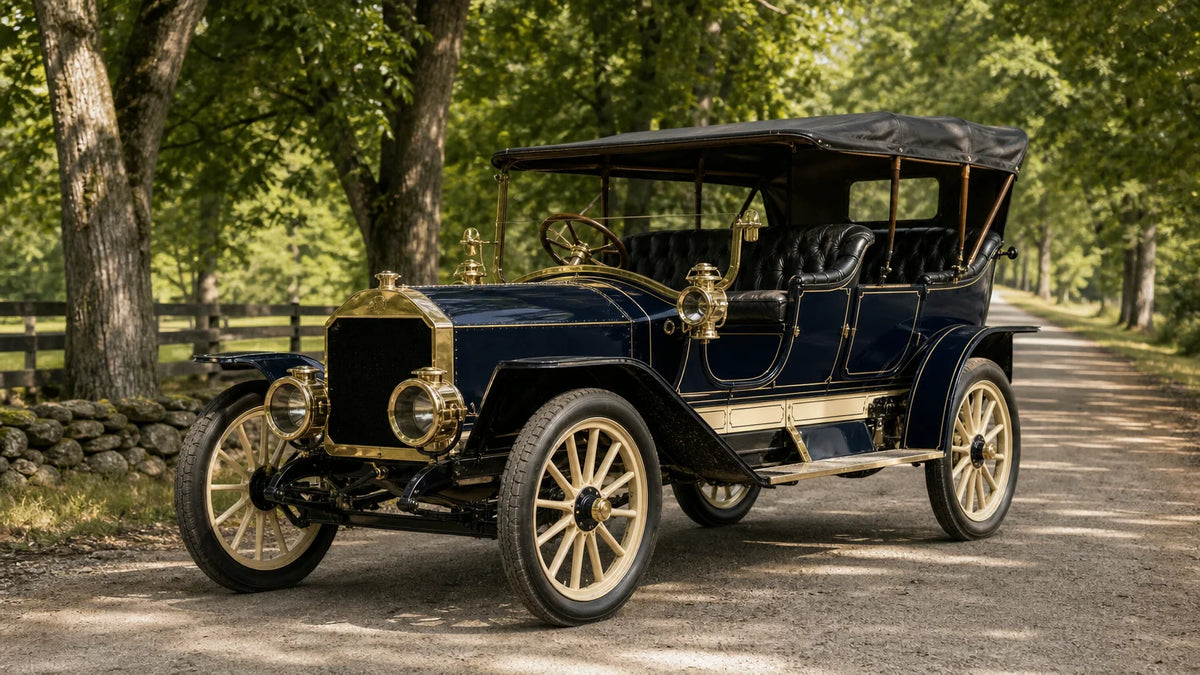
1905 Buick Model C: History, Specs and Collector Guide
What makes the 1905 Buick Model C important is not modern speed or convenience, but its place at the beginning of Buick’s production history. It represents a period when open touring bodies, exposed mechanical systems and carriage-inspired design shaped the public idea of the automobile. If you are comparing early Buick design with later expressions of the marque, our feature on the 1937 Buick Special offers a useful contrast.
The Model C also rewards careful research. Surviving examples are scarce, specifications can vary between references, and restoration quality has a direct effect on historical value. A serious assessment should therefore combine factory specifications, surviving-car research, chassis documentation, mechanical inspection and evidence of previous work.
Why does the 1905 Buick Model C matter?
The Model C occupies a particularly important position in Buick history because it followed the company’s first production model, the 1904 Model B. None of the original 1904 Model Bs are known to survive, making the 1905 cars the earliest surviving production Buicks identified by General Motors’ heritage collection.
General Motors identifies 14 surviving Model Cs and records the original base price at $1,200. Its heritage description also lists a 159 cubic inch, inline two-cylinder engine producing 22 horsepower. The same source records several 1905 performance achievements, including a five-mile record for two-cylinder cars completed in 6 minutes and 19 seconds. These details show that Buick was already using performance and endurance to establish its identity in the early American market. Read the GM heritage record for the factory-level overview.
That context changes how the car should be evaluated today. The Model C is not simply an old open automobile. It is an early production artifact connected to Buick’s rise, to the development of overhead-valve engineering and to the transformation of carriage manufacturing into motor-vehicle production.
What did the Model C bring to early motoring?
Its mechanical specification was modest by modern standards, yet technically meaningful for 1905. The engine used two horizontally opposed cylinders, a cast iron block and valve-in-head architecture. Power was sent to the rear wheels through a simple two-speed transmission, with the car’s driving experience shaped as much by its light construction and open body as by its engine output.
The Buick Heritage Alliance describes Buick’s early valve-in-head engine as a foundational innovation and notes that assembly moved briefly from Flint to Jackson, Michigan, in 1905. This matters to collectors because the Model C belongs to the formative stage of Buick’s manufacturing story, before the company reached the larger industrial scale associated with its later success. The Buick history record provides additional context on that transition.
| Specification | 1905 Buick Model C |
|---|---|
| Model year | 1905 |
| Engine | 159 cubic inch inline two-cylinder |
| Engine block | Cast iron |
| Power | 22 horsepower |
| Transmission | Two-speed transmission |
| Drive layout | Rear-wheel drive with chain drive |
| Body character | Open touring design with carriage-inspired proportions |

The Model C’s importance is also visual. Its tall wheels, open passenger compartment, brass details and exposed mechanical character make it immediately legible as an early automobile. For collectors, however, visual appeal should support research rather than replace it. A convincing appearance does not prove that the body, engine, frame, controls or running gear belong together.
How should you judge rarity and provenance?
Suppose you are reviewing a Model C offered for sale. The first question should not be whether the brass is bright or the paint is attractive. Ask whether the car has a coherent identity supported by chassis numbers, ownership history, period photographs, restoration invoices and mechanical records.
Early cars often survived through decades of repair, adaptation and parts replacement. Components may have been exchanged between cars, reproduced because originals were unsafe, or restored using historically correct parts from another early Buick. That does not automatically make a car undesirable, but the work should be documented and described precisely.
A strong provenance file should identify the chassis, engine and significant components wherever possible. It should also distinguish between original material, period replacements, accurately reproduced parts and later modifications. When these categories are clear, you can judge whether the car is best suited to preservation, touring, display or further research.
For collectors building a focused garage, our guide to rare vehicles offers a broader framework for weighing scarcity, identity, engineering and provenance. Those criteria are especially useful for an automobile where survival numbers are low and originality may be difficult to establish at a glance.
What should you inspect before purchasing one?
A proper inspection should begin with the car’s identity and proceed toward its mechanical condition. The goal is not simply to find faults. It is to understand what you are buying, what has been preserved and what future work may be required.
- Verify the identity: Compare frame, engine, flywheel and casting numbers with the history file. Record any discrepancy instead of assuming that every number refers to the same component.
- Study the structure: Inspect the wooden body, frame, spring mounts, steering components and wheel construction. Repairs should be assessed for safety, craftsmanship and historical compatibility.
- Review the engine: Confirm that the two-cylinder engine turns freely, holds appropriate compression and shows no unexplained damage around the block, valve gear or cooling system.
- Examine the transmission: Test engagement of both forward ratios and reverse where possible. Ask whether gears, shafts, bands or clutch components have been repaired or replaced.
- Assess the restoration: Separate cosmetic presentation from mechanical quality. Fresh paint and polished brass cannot compensate for weak woodwork, incorrect components or incomplete running gear.
- Read the records: Look for restoration invoices, photographs taken during disassembly, specialist correspondence, show documentation and evidence of regular maintenance.

Documentation is particularly valuable when purchasing through an international network. Import history, registration status, transport arrangements and local operating requirements may differ by country, so you should clarify those practical matters before committing to a car. Our classic car marketplace provides a natural starting point for collectors who want to explore unusual vehicles while keeping the acquisition conversation focused on the machine itself.
What do 2026 market signals tell you about value?
There is no single price for a 1905 Buick Model C. Condition, originality, body style, mechanical usability, documentation and presentation can move an individual car far beyond what a simple model average suggests.
A publicly available valuation record lists a 1905 Buick Model C with chassis or VIN 18903 as sold for $39,200 on August 13, 2026. That transaction is useful as a current reference point, but it is still one result rather than a universal valuation. The 2026 sale record identifies the car as a touring model with a two-cylinder engine and 22 horsepower.
Earlier sales or estimates should be treated as historical evidence, not as direct predictions for September 2026. A well-documented restoration may justify a stronger price than a mechanically incomplete example, while a highly original but unrestored car may appeal to a different collector. The most reliable approach is to compare cars with similar provenance, condition and intended use.
When you broaden your research beyond one model, our selection of classic cars can help place the Model C within a wider history of design, engineering and collectible automotive culture. The comparison should remain analytical, with attention to the qualities that matter most to your collection.
Which collector profile suits the 1905 Buick?
The Model C is best suited to a collector who values historical importance over effortless daily usability. It can serve as a display centerpiece, a research subject, a concours vehicle or a carefully prepared participant in appropriate early-car events. It is less suitable for someone seeking modern comfort, high-speed touring or straightforward maintenance.
You should also decide whether your priority is preservation or presentation. Preservation favors original materials, visible age and careful intervention. Presentation may involve more extensive restoration, brighter finishes and reconstructed components. Neither approach is automatically correct, but the chosen philosophy should be stated clearly in the car’s documentation.
Most importantly, the purchase should be based on a complete understanding of the individual automobile. Two Model Cs may share the same model year and engine specification while differing substantially in surviving material, restoration history and collector appeal.
A measured approach to an exceptional survivor
The 1905 Buick Model C deserves attention because it combines early American production history, distinctive engineering and exceptional scarcity. Its 22 horsepower engine is only one part of the story. The decisive questions are whether the car’s identity is coherent, whether its restoration is documented and whether its condition matches your intended use. Treat every surviving example as an individual historical object, and value evidence as highly as appearance.
Explore Rare Automotive Machines
If the Model C has sharpened your interest in historically significant and unusual automobiles, you may want to explore a wider selection before defining your next acquisition. We help collectors investigate rare, design-led mobility objects through a curated international marketplace and direct conversations with our team.

Our classic cars collection offers a focused way to continue your research across distinctive automotive designs. For a high-value acquisition, you can also contact us to discuss provenance questions, sourcing requirements and the characteristics that matter most to your collection.
Frequently Asked Questions
What is the 1905 Buick Model C?
The 1905 Buick Model C was an early Buick production automobile with an open touring design and a horizontally opposed two-cylinder engine. It is regarded as one of the earliest surviving production Buicks.
How powerful was the Model C?
The Model C used a 159 cubic inch two-cylinder engine rated at 22 horsepower. Its period performance depended on lightweight construction, simple gearing and road conditions rather than modern acceleration standards.
How rare is a 1905 Buick Model C?
General Motors identifies 14 surviving Model Cs in its heritage material. Individual cars can still differ greatly in originality, provenance, restoration quality and mechanical completeness.
What should you check before buying one?
You should verify identification numbers, ownership history, restoration invoices, body construction, engine condition, transmission operation and the authenticity of major components. An inspection by a specialist familiar with early automobiles is advisable.
Can TheArsenale help with a classic-car search?
Yes. TheArsenale connects collectors with curated rare and future-oriented mobility objects and provides direct sales assistance for sourcing and high-value acquisition questions.