The 1932 Roadster: Why the Ford Deuce Rules Hot Rodding
Fewer than 13,000 roadsters rolled out of Ford's plants in 1932, yet this single body style became the cornerstone of American hot rodding. Its blend of clean styling and mechanical simplicity turned a Depression-era economy car into a lasting object of desire. On our classic car marketplace, collectors continue to pursue these machines with genuine devotion. The appeal of the 1932 Ford roadster has never truly faded.
What began as affordable transportation evolved into a canvas for mechanical creativity. Returning servicemen after the Second World War stripped these cars down, tuned their engines, and raced them across dry lakebeds. That movement shaped a distinct culture, and the humble Ford roadster sat at its very center. Understanding why requires a look at the car, the era, and the market that surrounds it in 2026.
Why the Deuce Sits Atop Hot Rod Culture
The 1932 roadster occupies a singular place in automotive history. Enthusiasts affectionately call it "the Deuce," a nod to the "2" in its model year. Its stature is not simply a matter of nostalgia; it is woven into music, film, and popular memory. According to a J.D. Power profile, the car inspired a cultural phenomenon that helped define the youth culture of the 1960s.
The Beach Boys immortalized the model with their 1963 hit "Little Deuce Coupe," and it featured prominently in the 1973 film "American Graffiti." Few mass-produced products of any kind have achieved such widespread recognition. For many builders, the Deuce roadster is not merely a car; it is a statement of craft and heritage.
What Made the 1932 Ford Different
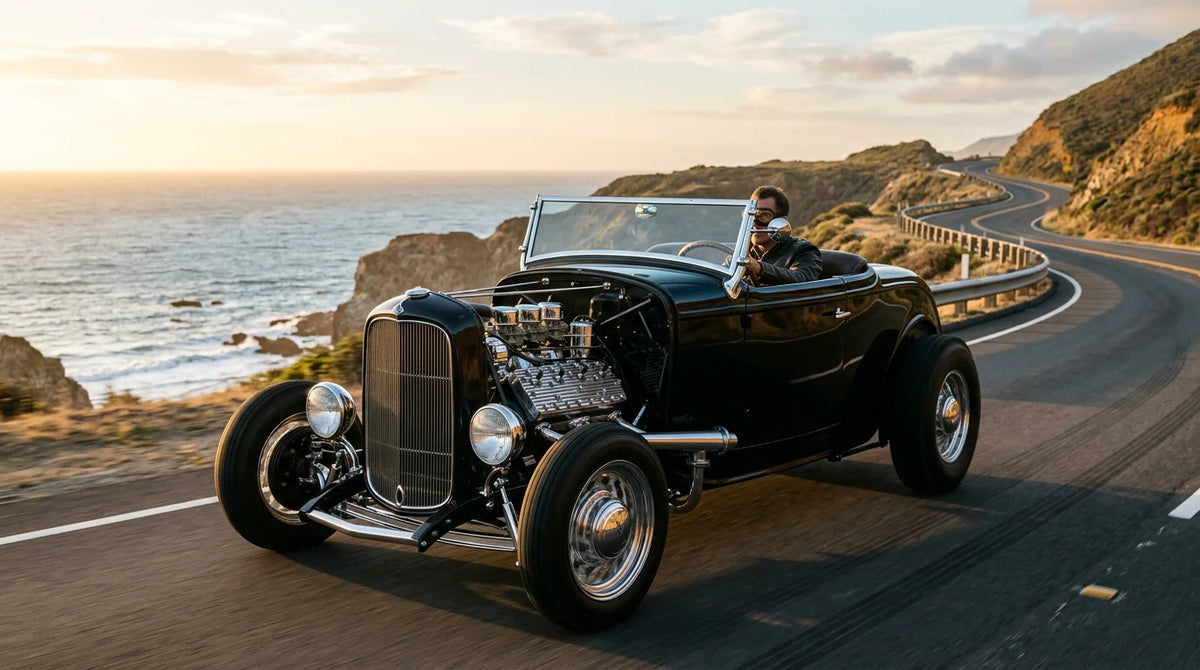
Rather than simply updating the Model A, Ford launched an entirely new vehicle for 1932. The most significant advance was the flathead V8, the first low-priced, mass-marketed engine of its kind. Rated at 65 horsepower in its first year, it brought eight-cylinder power to ordinary buyers for the first time.
The car also introduced a longer wheelbase and an elegant, double-dropped chassis. The fuel tank moved to the rear of the vehicle, requiring an engine-driven fuel pump in place of gravity feed. These refinements gave the roadster a lower, more graceful stance than its predecessor. That clean body mass, especially once fenders were removed, became the foundation of the classic highboy look.

From Factory Floor to Salt Flats
Why did this particular Ford become the hot rodder's default choice? A large part of the answer is availability. In the 1940s and 1950s, the model was a relatively inexpensive, widely available used car equipped with a capable V8. According to a Fuel Curve history, it is difficult to name any vehicle more influential to the birth and growth of hot rodding.
Builders stripped weight, hopped up the engines, and swapped in more powerful drivetrains. The sport of drag racing grew directly out of dry lakes competition. Slang, surfing, and a distinct visual style raised the intrinsic value of these cars. That culture elevated the Ford roadster to a position it has held ever since.
A Stamp, a Song, and Lasting Fame
Cultural recognition of the Deuce reached an official milestone in 2014. The United States Postal Service dedicated its limited-edition Hot Rods Forever stamps, and both designs depicted the 1932 Ford roadster. According to the Postal Service, the stamps marked the beginning of America's fascination with customizing fast cars.
One stamp showed a black roadster with orange flames; the other, a red example. The first-day ceremony took place at a National Street Rod Association event, a fitting venue for a car so tied to enthusiast culture. Such formal recognition underscores how deeply the model is embedded in national identity. Very few production cars have earned a place on a postage stamp.
What a 1932 Roadster Costs Today
Prices vary widely, and condition, provenance, and build quality drive the spread. Based on data compiled by Conceptcarz auction records, the average sale value of a 1932 Ford hot rod sits near $51,781, with the highest recorded result reaching $700,000. One of the more recent transactions, in October 2025, closed at $55,000.
These figures reflect a broad market rather than a single standard car. Entry-level or fiberglass-bodied builds can trade well below the average, while show-quality steel cars with period-correct parts command a premium. A quality collector-grade roadster can readily reach six figures. When you are ready to compare listings, our Browse classic cars resource offers a useful starting point.

Building or Buying: What to Consider
Acquiring one of these cars can follow several paths, and each carries different trade-offs. Genuine steel 1932 bodies are scarce, so many modern builds use reproduction steel or fiberglass panels. A careful buyer verifies the frame, the engine, the documentation, and the quality of the fabrication before committing.
The route you choose shapes the experience as much as the price. The table below outlines common acquisition channels and where a curated marketplace fits.
| Acquisition route | Curation | Early access before public listing | Buyer support |
|---|---|---|---|
| General auction platforms | Limited | No | Self-directed |
| Local dealers | Variable | No | In person only |
| Private sales | None | No | Buyer beware |
| TheArsenale (us) | Curated selection | Yes, via Private Membership | Responsive sales team |
For buyers who value curation and discretion, our Private Membership provides access to vehicles before they are listed publicly. If you would rather explore available inventory directly, our Shop cars section brings the selection together in one place.
Final Thoughts on an American Icon
The enduring status of the 1932 Ford roadster rests on a rare combination of engineering, timing, and culture. Its flathead V8, its clean proportions, and its postwar availability made it the natural choice for a generation of builders. Nearly a century later, that legacy still governs the collector market. If you intend to buy, prioritize provenance and honest documentation over surface shine. A well-built, period-correct example will reward both your driveway and your patience for years to come.
Take action with TheArsenale
If the history and craft of the Deuce have captured your attention, the next step is finding a car that meets your standards. We curate high-end mobility and collectible vehicles for buyers who expect discretion, quality, and genuine expertise. Our team understands the difference between a headline price and a sound purchase.

Through our Private Membership, you gain access to vehicles before they are listed publicly, along with a responsive sales team available around the clock. Explore our featured 1932 Ford roadster pickup build to see the level of detail we champion, and let us help you source a machine worthy of the legend.
Frequently Asked Questions
Why is the 1932 Ford called the "Deuce"?
The nickname refers to the "2" in the model year 1932. Enthusiasts adopted the term decades ago, and it remains common today. It applies to the roadster, the coupe, and other body styles from that year.
What engine came in the 1932 Ford roadster?
Buyers could choose an improved four-cylinder Model B engine or the new flathead V8, which produced 65 horsepower in its first year. The V8 proved far more popular. It became the defining powerplant of early hot rodding.
How much does a 1932 roadster cost in 2026?
Values vary considerably with condition and build quality. Auction records place the average around $51,781, while exceptional cars have sold as high as $700,000. Entry-level and fiberglass-bodied builds typically trade for less.
Are most 1932 roadsters original or reproduction?
Genuine steel bodies from 1932 are scarce, so many cars on the road today use reproduction steel or fiberglass panels. Original, unmodified examples are especially rare. Careful inspection of the frame and documentation is essential.
Where can I find a curated 1932 roadster for sale?
You can browse our curated selection of classic and collectible vehicles online. Our Private Membership also grants access to cars before they are publicly listed. This approach suits buyers who value discretion and quality assurance.