1934 Oldsmobile Coupe: A Collector’s Guide to L-34 Cars
The appeal of a 1934 Oldsmobile coupe lies in its combination of streamlined styling, prewar engineering, and genuine model variety. A six-cylinder F-34 offers a different ownership experience from an eight-cylinder L-34, while a restored original differs significantly from a modified custom car. For useful period context, you can also explore our 1934 Packard convertible feature.
The phrase “1934 Oldsmobile coupe” is therefore a starting point, not a complete specification. Before discussing value or availability, you should establish the series, body style, engine, chassis identity, and level of originality. Those details determine whether you are considering a practical six-cylinder survivor, a rarer Eight, or a car whose modern modifications have changed its collector character.
What does “1934 Oldsmobile coupe” actually describe?
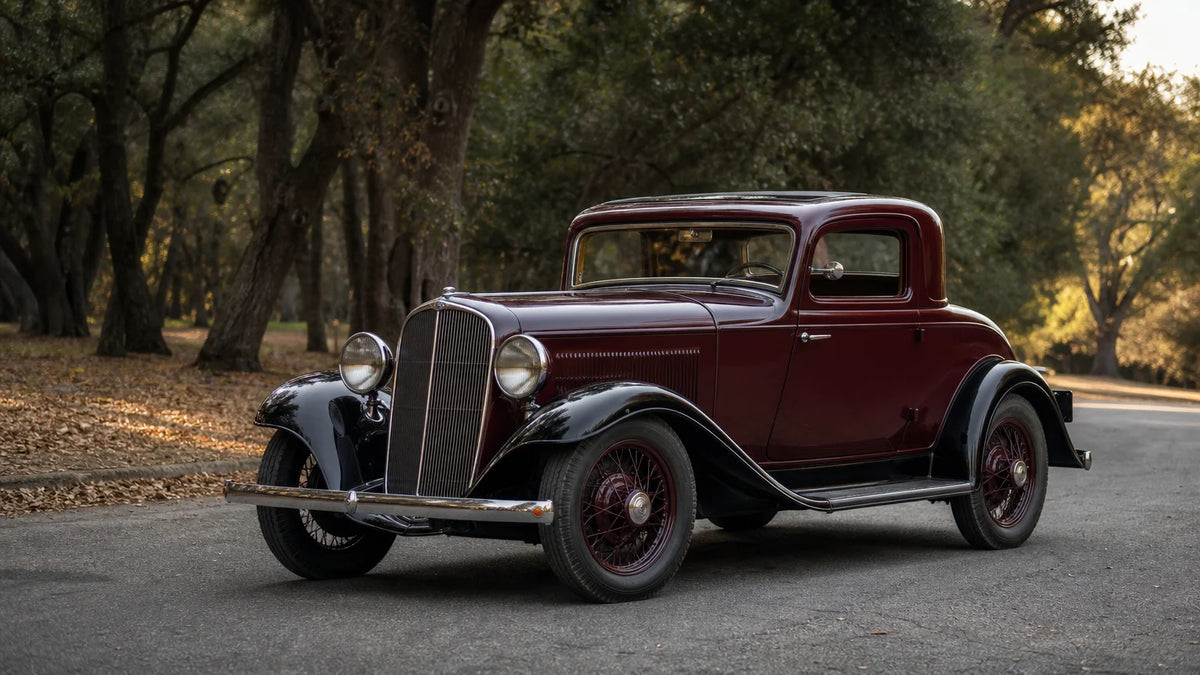
In 1934, Oldsmobile offered more than one interpretation of the coupe body style. The F-34 belonged to the six-cylinder range, while the L-34 represented the larger Eight series. Within those families, period records distinguish between business coupes, sport coupes, touring coupes, and convertible coupes.
This variety reflects the broader American market of the period. The April 1934 April 1934 survey from the Bureau of Economic Analysis noted that coupes represented nearly one quarter of passenger cars produced in the referenced production data. The body style was not a niche curiosity. It was part of the mainstream design vocabulary of the early 1930s.
For a collector, the distinction matters because two cars may both appear in listings as “1934 Oldsmobile coupes” while having different wheelbases, engines, passenger capacities, production totals, and original prices. The first step is always to request the model number, chassis identification, engine information, and period body description.
Our classic cars editorial collection can provide additional context when you are comparing the design language of prewar American automobiles across different marques and body formats.
Why the L-34 Eight remains especially significant
The L-34 is the version that most strongly captures the appeal of a full-size 1934 Oldsmobile Eight. Its period specification combines a 240.3 cubic inch inline eight-cylinder engine with approximately 90 horsepower, rear-wheel drive, a 119 inch wheelbase, and a three-speed manual transmission.
The available L-34 specification sheet identifies the sport coupe as a two-door body for two to four passengers. It also lists 1,272 examples and an original base price of $880 in 1934. These figures describe the historical production and new-car price, not a current valuation.
The Eight’s importance is not based only on engine size. Its long proportions, formal grille, sweeping fenders, and period interior create a more substantial presence than the smaller six-cylinder cars. A surviving example with its original body configuration, correct mechanical components, and authentic trim can offer a particularly coherent representation of Oldsmobile’s design direction in 1934.
However, rarity should not be confused with automatic quality. A poorly restored Eight may require more attention than a sound six-cylinder car. Mechanical completeness, structural condition, and documentation should remain more important than cylinder count alone.
For collectors studying the evolution of American design, our feature on a 1935 classic car offers a useful next-year comparison. The styling changes between model years can help you identify whether a car retains its correct 1934 details.
F-34 versus L-34: the first identification check
The most important distinction is between the six-cylinder F-34 and the eight-cylinder L-34. Their silhouettes can appear related, but their mechanical specifications and collector profiles are not interchangeable.
| Model family | Typical coupe identity | Engine and output | Wheelbase | Recorded production | 1934 base price |
|---|---|---|---|---|---|
| F-34 | Two-door, five-passenger coupe | 213.3 cubic inch six-cylinder, 84 horsepower | 114 inches | 4,675 | $670 |
| L-34 | Sport coupe, two to four passengers | 240.3 cubic inch inline eight, 90 horsepower | 119 inches | 1,272 | $880 |
The F-34 figures come from the period model record for the F-34 coupe specification. The difference in wheelbase, engine configuration, passenger capacity, and original price shows why a generic listing title is insufficient. A seller may use “coupe” correctly while still omitting the information that determines the car’s identity.
When reviewing photographs, look for clues rather than relying on the engine badge. The wheelbase, front-end proportions, dashboard layout, firewall details, frame number, and engine casting can help confirm the series. If the drivetrain has been replaced, the body and chassis may provide more reliable evidence than the current engine bay.
Originality or customization: which approach suits your collection?
A 1934 Oldsmobile can appeal to two different types of collector. One may seek factory-correct originality, while another may prefer a reliable driver with discreet mechanical improvements. Neither approach is automatically superior, but the intended use should be clear before you buy.
An original or carefully restored car preserves the qualities that make the model historically important. These include the correct body proportions, period hardware, interior materials, dashboard arrangement, wheels, lighting, and mechanical layout. Such a car is usually easier to place within a documented collection because its identity remains legible.
A modified car can provide easier starting, braking, cooling, steering, or touring performance. The trade-off is that customization may reduce historical authenticity and narrow the pool of collectors interested in the vehicle. Chopped roofs, non-period interiors, replacement engines, modern transmissions, and altered suspension systems should all be recorded clearly.
Before making an offer, decide whether you want a display-standard reference car, a showable driver, or a usable custom. Do not pay an originality premium for a car that has not been carefully documented. Conversely, do not reject a well-executed custom simply because it no longer follows factory specification, if its condition and purpose match your priorities.
How should you inspect a 1934 Oldsmobile coupe?
Inspection should begin with the structure rather than the paint. Examine the frame, body mounts, floor sections, door alignment, running boards, firewall, and areas where previous repairs may be concealed beneath undercoating. Surface gloss can be renewed quickly, but correcting structural distortion is expensive and technically demanding.
Next, verify the mechanical identity. Record the engine number, casting marks, transmission type, axle configuration, carburetor, and brake system. Compare those details with the claimed F-34 or L-34 specification. A car that combines a correct body with an incorrect engine is not necessarily undesirable, but the description and valuation should reflect the change.

Cooling and braking deserve particular attention because prewar cars are often driven after long periods of storage. Inspect the radiator, hoses, water pump, fuel lines, brake cylinders, wheel cylinders, drums, and hydraulic lines. Check whether electrical components were replaced cleanly, and ask whether the wiring remains compatible with the vehicle’s voltage and charging system.
The interior can reveal whether restoration work was comprehensive. Look at the dashboard finish, instrument faces, steering wheel, window hardware, seat frames, door panels, and floor coverings. Correct materials and accurate patterns support authenticity, while mismatched trim may indicate that the restoration focused mainly on exterior presentation.
Finally, review the paperwork. A useful file may include old registration records, restoration invoices, photographs taken before disassembly, ownership history, engine documentation, and show awards. Documentation cannot correct poor workmanship, but it can explain what has been changed and reduce uncertainty during a high-value purchase.
How do rarity and provenance affect collector-market value?
Production figures provide a useful starting point, but they do not determine the value of every surviving car. A low-production body may be less desirable if it has extensive rust, incomplete trim, weak documentation, or an incorrect drivetrain. A more common body can command strong interest when it is unusually original, exceptionally restored, or connected to a compelling history.
For historical context, the United States Census Bureau’s 1934 statistical abstract preserves contemporary tables covering the country’s economic and industrial environment. Resources like this help place an automobile within its original period, but they should not be used as direct evidence of a specific vehicle’s current market price.
The original price of $670 for an F-34 coupe or $880 for an L-34 sport coupe is a 1934 historical reference. It should not be converted mechanically into a 2026 appraisal. Modern value depends on survival rate, restoration quality, provenance, body style, originality, location, and the strength of demand when the car is offered.
Documented provenance can be especially valuable for a rare prewar car. A continuous ownership history, period photographs, concours recognition, or evidence of a known restoration may support confidence in the vehicle. The strongest files explain both what remains original and what has been replaced.
When records conflict, treat the contradiction as part of the investigation. Production totals may differ because one source counts a specific body code while another groups related bodies together. Model names can also vary between factory literature, registration records, auction descriptions, and restoration documents.
When can a specialist marketplace help?
Finding an appropriate 1934 Oldsmobile may require more than browsing a single listing. The right car can appear through a private collection, a specialist dealer, an estate, a builder, or a network of enthusiasts. A collector may also need help distinguishing a genuine opportunity from a car whose description is incomplete.
Our marketplace brings together more than 250 builders, designers, and brands across rare and future-oriented mobility categories. We also provide high-value acquisition support for collectors seeking unusual machines. That assistance can be useful when you need to clarify specifications, request additional documentation, or define the type of vehicle that fits your collection.
Our reported marketplace scale includes more than 11,000 completed transactions since 2017. That figure does not guarantee that a specific 1934 Oldsmobile will be available, but it reflects an established environment for exploring high-value mobility objects and requesting personalized guidance.
Private Membership can provide access to vehicles before public listing. Membership terms and availability vary, so you should confirm whether a particular prewar car is included before relying on early access. The same principle applies to pricing, transport, registration, financing, and after-sales support, which should be discussed directly for each machine.
For collectors who appreciate the visual language of the period, our editorial feature on a 1936 Chrysler can also help place the Oldsmobile within the wider development of American automotive design.
What should you decide before making an offer?
Begin by defining the experience you want. If you want a historically faithful show car, prioritize originality, documentation, and restoration quality. If you want regular touring use, place greater weight on cooling, braking, steering, electrical reliability, parts support, and the quality of any mechanical upgrades.
Then establish a clear inspection sequence. Confirm the model family, verify the chassis and engine identity, inspect the structure, evaluate the mechanical systems, review the restoration file, and obtain an independent specialist opinion where necessary. This process reduces the risk of paying for rarity that the car cannot substantiate.

Finally, separate the car’s historical appeal from its immediate ownership cost. A modestly priced project may require extensive bodywork and missing trim. A higher-priced restored car may still need careful examination if its documentation is weak. The soundest decision is the one that matches the vehicle’s condition with your intended use, budget, and tolerance for future work.
A clearer path to the right prewar Oldsmobile
The 1934 Oldsmobile coupe is best understood as a family of related cars rather than one uniform model. The F-34 and L-34 differ in engine, dimensions, production, passenger capacity, and collector appeal. Once you verify those fundamentals, originality, structural condition, mechanical integrity, and provenance become the decisive factors. A disciplined inspection will help you choose a car that is valuable not only because it is rare, but because its story and condition are credible.
Explore Curated Mobility for Your Collection
If you are searching for a rare machine, you may need more than a standard listing. You may need a knowledgeable route through unusual vehicles, builders, documentation, and acquisition questions.

We connect collectors with a curated international network of mobility objects and provide personalized support for high-value acquisitions. Explore our classic cars collection, then contact our team if you need help defining the right direction for your collection.
Frequently Asked Questions
How many 1934 Oldsmobile coupe versions were available?
The term covers several body styles and at least two major model families, including the six-cylinder F-34 and eight-cylinder L-34. Business, sport, touring, and convertible coupe descriptions can refer to different specifications.
Is the L-34 better than the F-34?
Not necessarily, because the better choice depends on your collection and intended use. The L-34 offers an eight-cylinder character and greater rarity, while the F-34 may provide a simpler and more accessible ownership experience.
What is the most important inspection point?
Start with structural condition and model identity before judging the paint or interior. Confirm the chassis, engine, body configuration, frame, floors, and previous repairs before assessing cosmetic quality.
Should you buy an original or modified car?
An original or accurately restored car is usually preferable for historical collecting and concours presentation. A modified car can be appropriate for regular driving, provided the alterations are documented and reflected honestly in the price.
Can TheArsenale help locate a rare prewar car?
Our high-value acquisition support helps collectors explore unusual machines and clarify their requirements. Private Membership may also provide access to vehicles before public listing, although availability, pricing, and terms must be confirmed for each specific vehicle.