1956 Eldorado Biarritz: A Collector’s Guide to Cadillac
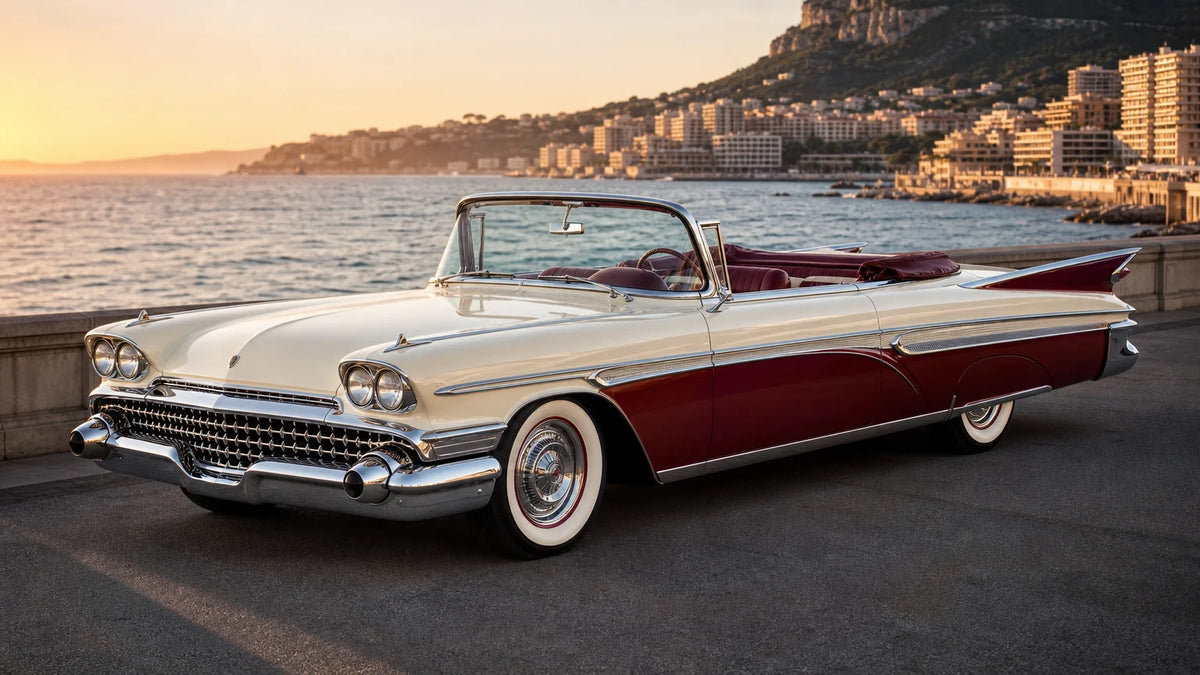
With its long body, chrome details, pointed rear fins, and open cabin, the 1956 Eldorado Biarritz represented American luxury at its most confident. It was not merely a decorated Series 62 convertible. Cadillac gave the model a specific identity, a higher-output engine, distinctive trim, and an unusually generous equipment list.
For perspective, Cadillac’s 1956 Eldorado belongs to the same design lineage explored in our article on the 1964 Cadillac Eldorado, although the 1956 Biarritz remains a rear-wheel-drive icon of the classic Harley Earl era. Its importance today comes from the combination of limited production, dramatic styling, and a specification that still defines post-war American luxury.
What was the 1956 Eldorado Biarritz?
The 1956 model year introduced a clearer division within the Eldorado range. Cadillac used the Biarritz name for the convertible and introduced the Seville name for the new two-door hardtop. This distinction gave the open car a stronger identity instead of treating it as only another body style.
The Biarritz was a two-door luxury convertible with rear-wheel drive, a 129-inch wheelbase, and a body stretching 222.2 inches. Its proportions were unmistakably American, with a broad stance, extensive chrome, skirtless wheel openings, and pronounced rear fins. The result was a car designed to make an entrance before the driver even turned the key.
Production remained limited by Cadillac standards. Only 2,150 Biarritz convertibles were built for 1956, while total Eldorado production reached 6,050 units across the Biarritz and Seville body styles. The limited volume helps explain why complete, well-documented examples attract sustained attention from collectors.
Which specifications defined the Biarritz?
The mechanical specification gave the 1956 Eldorado Biarritz more substance than its appearance alone suggested. Cadillac enlarged its V8 to 365 cubic inches and fitted Eldorado models with twin four-barrel carburetors. In this configuration, the engine produced 305 horsepower, a notable increase over the standard Cadillac V8.
The car also came with a four-speed Hydra-Matic automatic transmission and extensive power assistance. Power steering, power brakes, power windows, a power convertible top, and a power antenna were part of the model’s luxury character. The original Cadillac specifications document records the Biarritz’s dimensions, wheelbase, tire specification, and body designation in detail through the 1956 Cadillac archive.
| Specification | 1956 Eldorado Biarritz |
|---|---|
| Body style | Two-door convertible |
| Engine | 365 cubic inch overhead-valve V8 |
| Induction | Twin four-barrel carburetors |
| Rated output | 305 horsepower |
| Transmission | Four-speed Hydra-Matic automatic |
| Wheelbase | 129 inches |
| Overall length | 222.2 inches |
| Model-year production | 2,150 examples |

Why does its design still matter?
The visual appeal of the 1956 Biarritz comes from the way several design ideas work together. Its twin-blade hood ornament, sharply drawn rear fins, chrome beltline molding, and Sabre-style wheels create a unified expression rather than a collection of isolated decorations.
The convertible roof changes the car’s proportions when lowered. Without a fixed roof interrupting the beltline, the body appears longer and more theatrical. The open cabin also reinforces the car’s original purpose, which was effortless travel, social visibility, and comfort rather than discreet transportation.
Inside, the Biarritz continued Cadillac’s emphasis on presentation. Leather upholstery, power seats, a large instrument panel, and bright metal detailing supported the feeling of a flagship. For collectors, the correct interior matters because upholstery patterns, trim finishes, hardware, and switchgear can reveal whether a restoration follows the original specification.
That visual completeness is part of the car’s appeal. The Biarritz is valuable not only because it is rare, but because its design communicates a specific moment in American automotive history. It reflects the optimism of 1956, when larger engines, more elaborate styling, and effortless power were treated as evidence of progress.
What should collectors inspect before buying one?
A strong example begins with its body and structure. Inspect the floors, rocker panels, lower quarters, trunk area, body mounts, and the metal surrounding the windshield and convertible mechanism. Rust repair can be expensive on a large convertible, particularly when previous work has concealed corrosion beneath thick filler or poorly aligned panels.
The next priority is Eldorado-specific trim. Missing badges, moldings, ornaments, wheels, interior components, and convertible hardware may be difficult to replace. A car with an older but complete restoration can therefore be a better starting point than a cheaper project missing important original parts.
Mechanical inspection should include the 365 V8, both carburetors, the Hydra-Matic transmission, cooling system, steering, brakes, and electrical accessories. The engine may be fundamentally robust, but age affects seals, hoses, wiring, fuel systems, and adjustment points. Power windows, seats, antennae, and convertible mechanisms also deserve individual testing.
Documentation is equally important. Look for a chassis history, restoration invoices, photographs taken before restoration, ownership records, build information, and evidence of correct finishes. A collector should distinguish between a car that is cosmetically attractive and one with collector-grade provenance.
For a broader view of the category, our guide to classic cars provides useful context for evaluating rarity, design, engineering, and long-term ownership appeal across significant vehicles.

How should you assess a Biarritz in 2026?
In 2026, the most useful approach is to assess each car individually rather than rely on a single headline value. Condition, originality, restoration quality, documentation, color combination, mechanical readiness, and the quality of the convertible top can produce major differences between otherwise similar cars.
Valuation references identify the 1956 Biarritz as a 305 horsepower, 365 cubic inch, twin four-barrel convertible with a shipping weight of approximately 4,880 pounds. The current condition of a specific car remains more important than a general market category, as shown by the model details in Hagerty’s valuation guide.
Originality does not always mean that every component must remain untouched. A carefully restored car may be more usable and mechanically dependable than an unrestored example. The key question is whether the work is documented, sympathetic to the original specification, and supported by sound structure.
Collectors should also separate show quality from driving readiness. A car may present beautifully while still requiring attention to brakes, cooling, carburetor synchronization, electrical systems, or transmission operation. A professional inspection before purchase can clarify those risks and support a more realistic ownership budget.
For international collectors, additional questions may include export documentation, transport, import duties, registration, insurance, storage, and access to specialists. These factors are not included in a general vehicle valuation, so they should be confirmed for the specific country and car.
Why the 1956 Biarritz remains significant
The 1956 Eldorado Biarritz brings together limited production, unmistakable styling, a powerful dual-carburetor V8, and the comfort features expected from Cadillac’s most prestigious convertible. Its appeal is strongest when rarity and condition are considered together. Before buying, prioritize structural integrity, complete trim, mechanical inspection, and documented history over superficial presentation alone. The right example is not simply an old luxury car. It is a carefully preserved expression of American automotive design at its most ambitious.
Explore Rare Cars and Collector Vehicles
If you are researching a significant classic automobile, the next step is often broader than locating one specific model. You may need help comparing rarity, design, engineering, provenance, and the practical realities of acquisition.

We curate rare and future-oriented mobility objects from a global network of builders, designers, suppliers, and brands. Our marketplace and sales team can help you explore classic cars and collector vehicles, while high-value acquisition assistance can support a more informed search. Availability, pricing, delivery, registration, and import arrangements should be confirmed for each vehicle.
Frequently Asked Questions
What is a 1956 Eldorado Biarritz?
It is Cadillac’s premium two-door convertible for the 1956 model year. The Biarritz name distinguished the open car from the new Eldorado Seville hardtop.
What engine does the 1956 Biarritz use?
The car uses a 365 cubic inch overhead-valve V8 with twin four-barrel carburetors. Its Eldorado specification was designed to provide stronger performance than the standard Cadillac V8.
Is the 1956 Eldorado Biarritz suitable for regular driving?
It can be driven regularly when properly restored, serviced, and adjusted. Its age, size, drum brakes, electrical systems, and automatic transmission require more planning than a modern vehicle.
What matters most when buying one?
Prioritize structural condition, complete Eldorado trim, mechanical health, restoration documentation, and originality. A professional inspection is especially valuable for verifying rust repairs, drivetrain condition, and convertible hardware.
Can TheArsenale help locate a rare classic Cadillac?
Yes, we help collectors browse and source rare mobility objects through our marketplace and sales team. A specific 1956 Eldorado Biarritz listing, price, delivery arrangement, and import requirements must be confirmed for the individual vehicle.