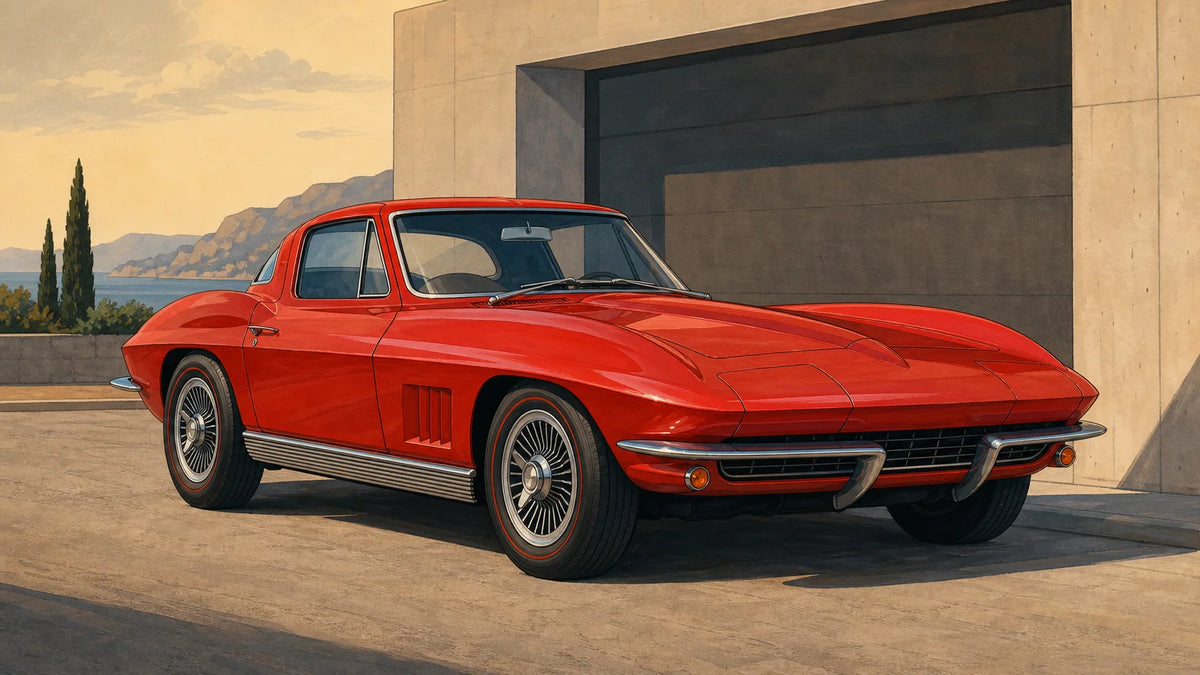
1963 corvette z06: A Collector's Guide to the Original Race Car
A rare Corvette can be beautiful, fast and historically important, but the most valuable examples tell a documented story. The 1963 model remains especially significant because it introduced the first Z06 package and the only split-window coupe design. Its influence still shapes collector culture, from original cars to modern reinterpretations such as our 1963 Corvette LS3 Bat.
The production story explains the appeal. Chevrolet built 21,513 Corvettes for the 1963 model year, but only 199 received the Special Performance Equipment package. The combination of a fuel-injected 327, race-oriented chassis upgrades and limited production makes the car far more than a stylish classic. It is a factory-developed competition machine that demands careful evaluation.
What made the 1963 Corvette Z06 different?
The 1963 Corvette Z06 was not simply a trim level with cosmetic changes. It was a factory performance package developed for customers who wanted a Corvette prepared for demanding driving and private competition.
The package strengthened several areas at once. It added heavier springs and shocks, a larger front stabilizer bar, upgraded metallic brake linings, finned brake drums, cooling provisions and a dual-circuit master cylinder. These changes addressed the main demands of circuit driving, namely cornering stability, heat management and repeated braking.
Power came from the L84 327 cubic-inch V8 with Rochester mechanical fuel injection. The engine was factory rated at 360 horsepower in 1963. A four-speed manual transmission and Positraction rear axle are closely associated with the classic Z06 configuration, although every prospective purchase should be checked against its own documentation and component history.
The National Corvette Museum continues to place the Z06 name within the broader performance history of the Corvette, showing how the designation evolved from a highly focused early package into a lasting performance identity. That continuity adds context, but it should not blur the distinction between the 1963 car and later generations.
For collectors interested in design as much as engineering, the body is equally important. The 1963 coupe introduced the one-year-only split rear window, hidden headlamps and a sharply sculpted C2 profile. We have explored that visual language through projects such as our Chevrolet Corvette buggy, where classic Corvette cues become part of a different mobility concept.
Which specification should collectors prioritize?
The first question is whether the car is a genuine RPO Z06 package or a standard 1963 Corvette modified to resemble one. A convincing appearance is not enough. The equipment, serial numbers, component details and documentation must support the claim together.
- Engine: Confirm the L84 327 fuel-injected V8, its casting details and the condition of the Rochester injection system.
- Transmission: Establish whether the car retains its period-correct manual gearbox and whether the transmission numbers align with its history.
- Brakes: Inspect the heavy-duty drums, metallic linings, cooling features and dual-circuit master cylinder.
- Suspension: Look for the correct springs, shocks and stabilizer bar rather than later replacements that merely improve driving feel.
- Fuel tank: Determine whether the car has the standard tank or the rare N03 36.5-gallon fiberglass tank.
- Body: Verify the split-window structure, body panels, bonding points and signs of accident repair.
The N03 tank is often called the Big Tank or “Tanker” option. It was developed for endurance racing, where reducing pit stops could influence the result. Only 63 of the 199 1963 Z06 cars received this larger tank, making it a major factor in rarity and valuation.

A Big Tank car should not automatically be treated as superior to every small-tank example. A properly documented, original small-tank Z06 can be more compelling than a heavily altered Tanker with uncertain history. The right comparison depends on authenticity, preservation, restoration quality and provenance.
How can you verify authenticity?
Authentication begins with the identity of the car, not its presentation. A fresh restoration can conceal years of modifications, while an unrestored example may retain valuable evidence beneath worn paint and aged components.
Start with the VIN, body and trim information, engine stampings and transmission numbers. These identifiers should be reviewed alongside factory records, shipping documentation, ownership papers and restoration invoices. None of these items should be considered in isolation.
Next, inspect the areas that are difficult to reproduce correctly. The fuel-injection unit, brake hardware, suspension components, tank installation and body construction can reveal whether the car was built as a Z06 or converted later. Expert inspection is especially important where reproduction parts resemble original components.
Documented provenance is also valuable because it explains what happened to the car between delivery and the present day. Look for long-term ownership records, period photographs, competition history, concours awards and evidence of professional restoration. A gap in the story does not automatically disqualify a car, but it should affect the level of verification required.
When a collector wants to understand how original design, rare engineering and modern interpretation can coexist, our California Corvette concept offers a useful editorial reference. It is not a substitute for authentication, but it illustrates why the 1963 shape continues to attract serious design attention.
How do restoration quality and provenance affect value?
Two cars with the same production numbers can have very different market positions. The difference usually comes from originality, quality of work and the credibility of the supporting documentation.
A concours restoration may deliver exceptional presentation, but it should still preserve the correct specifications. Over-restoration can remove useful evidence, replace original finishes or introduce parts that look correct without matching factory practice. Conversely, an untouched car may require substantial mechanical work before it can be driven safely.
Pay close attention to the frame, fiberglass repairs, bonding strips, firewall, suspension mounting points and underside finishes. Structural repairs should be documented clearly. Cosmetic quality matters, but structural integrity and correct assembly matter more.
A strong restoration file should identify the people and specialists involved, the work completed, the parts replaced and the parts retained. Certifications and judging awards can support the story, but they do not eliminate the need for an independent inspection.
Collectors should also distinguish between a car restored for display and one prepared for regular road use. The original Z06 was built around competition priorities. It may deliver an intense driving experience, but it does not offer the quietness, safety systems or convenience expected from a modern performance car.
What does 2026 pricing indicate?
Market values vary sharply by condition, specification and documentation. In July 2026, the Hagerty price guide placed a 1963 Z06 Big Tank in #3 Good condition between $460,000 and $560,000. The guide also recorded a 10.6 percent annual change for that configuration, so the date and condition category matter when interpreting the figure.
You can review the relevant Hagerty price guide for the specific condition framework. It is more useful than treating one auction result as a universal value because a restored Tanker, an original small-tank car and a modified example belong to different valuation categories.
A specialist valuation index also separates Corvette Z06 data across the 1963 to 2026 model-year span. That separation is important because the Z06 name covers very different cars, technologies and production contexts over time. A buyer should always confirm that a quoted figure applies to the first-generation package rather than a later Z06.
Price should therefore be treated as the final stage of analysis. First establish identity, then evaluate condition, then assess the quality of the restoration and the strength of the provenance. Only after those steps should you compare the car with recent market evidence.
What should an international buyer inspect before purchase?
Buying a 1963 Corvette Z06 across borders adds practical questions to the mechanical ones. The car may need export documentation, import clearance, transport coordination, local registration and an inspection that satisfies the destination country.
Before committing funds, request a complete image set and written description. Ask for close views of the VIN, trim information, engine stampings, chassis, brake components, fuel tank, suspension and underside. Request records in advance rather than relying on a verbal summary during a viewing.
- Confirm the claimed Z06 and N03 configuration.
- Match the identifiers across the car and its documents.
- Commission an independent pre-purchase inspection.
- Review restoration invoices and ownership history.
- Clarify transport, taxes, registration and insurance requirements.
Availability can change quickly, and a specific 1963 Z06 may not be publicly listed when you begin your search. We help collectors explore rare machines through a curated marketplace, direct sales consultation and sourcing support. Our network includes more than 250 builders, designers, suppliers and brands, while our business reports more than 11,000 completed transactions since 2017 and more than 9,000 clients worldwide.
For readers comparing the historical Z06 with the direction of modern American performance, our Corvette ZR1X feature provides a contemporary reference point. The two cars serve different purposes, but both show how engineering ambition can define a Corvette.
Why the 1963 Corvette Z06 remains important
The 1963 Corvette Z06 combines a one-year-only body design with a competition-focused factory specification. Its rarity is significant, but rarity alone does not establish quality. The strongest examples unite correct equipment, credible documentation, sound structure, careful restoration and a clear ownership history. If you are evaluating one, treat the car as both a historical artifact and a complex mechanical system. That approach protects the purchase and preserves the story that makes the model exceptional.
Explore rare and performance-led machines
Finding a collector car with the right specification requires time, trusted information and access to specialized sellers. If you are searching internationally, our team can help you explore options and discuss sourcing needs for a high-value acquisition.

Browse our curated selection of classic and performance cars, or contact us for personal guidance on rare machines, documentation and availability.
Frequently Asked Questions
How many 1963 Corvette Z06 cars were built?
Chevrolet produced 199 examples with the 1963 Z06 Special Performance Equipment package. Only 63 are associated with the N03 36.5-gallon Big Tank option.
What engine did the 1963 Corvette Z06 use?
Every 1963 Z06 was built around the L84 327 cubic-inch V8 with Rochester mechanical fuel injection. Its factory rating was 360 horsepower.
What is the Z06 Big Tank option?
The Big Tank was the N03 36.5-gallon fiberglass fuel tank developed for endurance racing. It increased range between pit stops and is one of the most important configuration details for collectors.
What documents should accompany a 1963 Corvette Z06?
Useful records include factory shipping information, ownership documents, component numbers, restoration invoices, judging records and period photographs. The documents should support the car's identity and equipment rather than simply repeat the seller's description.
Can TheArsenale help source a rare 1963 Corvette Z06?
Our marketplace and sales team support collectors seeking rare machines and high-value acquisitions. We can discuss sourcing needs and availability, although a specific 1963 Z06 is not guaranteed to be publicly listed.