1965 Chevrolet Chevelle: Specs, History, Values, and Rarity
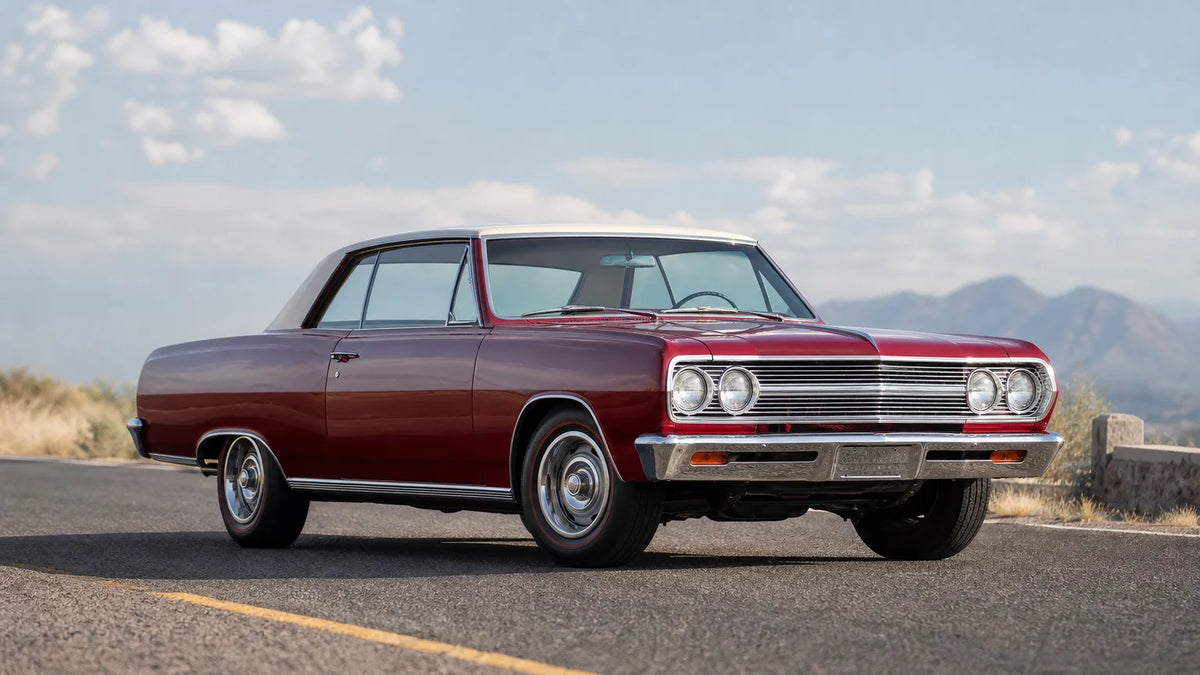
The 1965 Chevrolet Chevelle marked a decisive moment in Chevrolet performance history. It combined practical mid-size proportions with increasingly serious V8 power, creating a car that could serve as family transport, a stylish cruiser, or a genuine muscle machine. For readers evaluating provenance, our 1965 Chevrolet Chevelle Z16 for sale provides a useful reference point for the rarest factory configuration.
Chevrolet positioned the Chevelle between the compact Chevy II and full-size models such as the 1965 Impala. The model used a 115-inch wheelbase, offered multiple body styles, and gave buyers access to engines ranging from an economical inline six to a 375 horsepower 396 cubic inch V8. The broader Chevelle history overview shows how this platform became one of Chevrolet's most important muscle car foundations.
What makes the 1965 Chevrolet Chevelle historically important?
Introduced for the 1964 model year, the Chevelle answered growing demand for an intermediate American car. The 1965 model received modest styling revisions, including a revised grille and rear lighting, while retaining the straightforward A-body structure that made it adaptable across several segments.
Its significance increased when Chevrolet expanded the performance range. The Malibu SS could be ordered with strong small-block engines, while the mid-year Z16 package introduced the 396 big block to the Chevelle. That combination gave the car a meaningful place in the developing muscle car market, before the more dramatic redesigns of 1966 and 1968.
The Chevelle also mattered because it did not force buyers into a single identity. A two-door sport coupe, convertible, four-door sedan, or station wagon could share the same basic platform while serving very different purposes. This variety explains why the model appeals to both collectors seeking originality and enthusiasts seeking a usable classic.

Which trims and body styles were available?
For 1965, Chevrolet offered the Chevelle 300, Chevelle 300 Deluxe, Malibu, and Malibu SS. Each level brought a different balance of equipment, appearance, comfort, and performance potential.
- Chevelle 300: The practical entry point, available in sedan and wagon configurations with simpler trim and interiors.
- Chevelle 300 Deluxe: A more refined intermediate series with additional brightwork and interior appointments.
- Chevelle Malibu: The upscale range, offered as a sport coupe, convertible, sedan, or station wagon.
- Malibu SS: The performance-oriented series, offered as a two-door sport coupe or convertible with bucket seats, special trim, and stronger engine options.
Body style is important when evaluating a surviving car. A sport coupe is not the same as a two-door sedan, even when both share similar proportions. Convertibles carry additional structural requirements, while station wagons have different rooflines, wheelbase details, and restoration challenges.
Equipment can also distinguish a well-preserved Malibu SS from an ordinary Malibu that has received later SS-style parts. Bucket seats, the console, SS emblems, special wheel covers, gauge arrangements, and the correct body details should be considered together. No single badge proves a car's original specification.
How do the engines and transmissions compare?
The 1965 engine range covered a broad performance spectrum. Period specifications list a 194 cubic inch inline six rated at 120 horsepower and a 230 cubic inch inline six rated at 155 horsepower. V8 choices included 283 cubic inch engines rated at 195 or 220 horsepower, plus 327 cubic inch engines producing 250, 300, or 350 horsepower.
| Engine | Advertised output | Collector significance |
|---|---|---|
| 194 cubic inch inline six | 120 horsepower | Originality, affordability, and everyday usability |
| 230 cubic inch inline six | 155 horsepower | Practical performance with period-correct character |
| 283 cubic inch V8 | 195 or 220 horsepower | Traditional small-block appeal and easy serviceability |
| 327 cubic inch V8 | 250, 300, or 350 horsepower | Strong performance and greater collector interest |
| 396 cubic inch V8, Z16 | 375 horsepower | Exceptional rarity and documented factory significance |
Transmission choices included a three-speed manual, a four-speed manual, overdrive in applicable configurations, and the two-speed Powerglide automatic. The correct transmission can materially affect desirability, especially when it matches the engine, axle ratio, build documentation, and original trim.
The 350 horsepower 327, commonly associated with the L79 option, is particularly attractive to buyers who want genuine performance without the extreme rarity and cost of a Z16. A four-speed manual, Positraction, dual exhaust, power steering, and factory instrumentation can further strengthen a car's specification.
Why is the Z16 SS 396 so rare?
The Z16 was not simply a large engine installed in an ordinary Chevelle. It combined the new 396 cubic inch big block with a reinforced convertible-type frame, heavy-duty suspension components, special rear axle equipment, upgraded braking hardware, a four-speed manual transmission, and distinctive interior and exterior details.
Chevrolet built 200 regular-production Z16 cars at Kansas City, with a prototype bringing the commonly cited total to 201. The package carried the L37 396 V8, rated at 375 horsepower and 420 pound-feet of torque. The Z16 was available only as a Malibu SS sport coupe in regular production, making authentication especially important.
Rarity alone does not establish value. A credible Z16 must also show consistent body and chassis details, correct drivetrain components, appropriate casting and stamping evidence, and a chain of ownership or restoration records. Because many ordinary Chevelles have been modified to imitate high-performance models, documentation is central to any serious evaluation.
How can you verify an authentic 1965 Chevelle?
A careful inspection should begin with the vehicle identification number, cowl tag, body style, assembly information, and trim data. These records help establish how the car left the factory, but they should be checked against physical evidence rather than treated as isolated proof.
Engine identification requires attention to casting numbers, assembly dates, stamped suffix codes, intake and carburetor details, cylinder heads, and transmission type. A replacement engine does not necessarily make a car undesirable, but it changes the way originality and value should be assessed.
For a Malibu SS, inspect the interior and exterior as a complete system. Correct bucket seats, console design, gauge layout, SS emblems, rear cove treatment, wheel covers, body moldings, and trim patterns should agree with the claimed configuration. Inconsistent details may indicate a later conversion, an incomplete restoration, or a car assembled from multiple sources.
For a Z16, the inspection should be more rigorous. Confirm the four-speed-only configuration, reinforced chassis features, appropriate rear axle and braking components, correct 396 evidence, and supporting documents such as invoices, build records, historical photographs, or expert reports.
What should you expect to pay in today's market?
There is no single market value for a 1965 Chevelle. A six-cylinder Chevelle 300, an original Malibu convertible, a 350 horsepower L79 car, and a documented Z16 occupy very different parts of the collector market.
A September 9, 2026 listing snapshot reported approximately $21,495 at the low end, $58,250 as an average, and $159,000 at the high end for 1965 Chevelle listings. These figures describe asking-price activity, not guaranteed transaction prices.
A 2026 Hagerty report covering the broader 1964 to 1967 Chevelle generation recorded a highest sale of $412,500, a lowest sale of $1,430, and a most recent sale of $47,958 across 3,794 sales. These generation-wide figures demonstrate the wide spread created by condition, originality, body style, and performance specification.
For a configuration-specific starting point, consult the current Chevelle valuation tool and compare it with completed sales, not only advertised prices. A premium example should justify its price through documented authenticity, high-quality restoration work, correct components, and strong provenance.
Within our classic cars selection, the same principle applies: rarity and visual appeal attract attention, but credible documentation and mechanical condition determine whether a car is a compelling acquisition.
Which 1965 Chevelle is right for your collection?
A buyer seeking an approachable classic may prefer a Chevelle 300 or Malibu with a small-block V8. These cars can deliver the period appearance, straightforward mechanical layout, and enjoyable driving experience associated with the model without requiring the documentation burden of a rare SS.
A Malibu SS with a 283 or 327 is a stronger choice for someone who wants factory performance and recognizable muscle car identity. The 350 horsepower 327 and four-speed combination can be especially attractive, provided the drivetrain and trim evidence are credible.
The Z16 is appropriate for an advanced collector who values rarity, historical importance, and documented originality above casual usability. It is not simply a faster Chevelle. It is a limited production milestone that requires careful inspection and specialist knowledge.
Modified cars deserve a separate category. A restomod with modern brakes, suspension, cooling, and fuel systems may be more enjoyable on contemporary roads, but it should not be confused with a factory-original example. Decide whether your priority is historical accuracy, driving usability, investment-grade provenance, or a balanced combination of these goals. Our muscle car marketplace provides a useful setting for comparing rare performance-focused vehicles by specification and character.
Conclusion
The 1965 Chevrolet Chevelle stands apart because it combines broad model variety with a genuine performance breakthrough. The Malibu SS established the visual and mechanical foundation, the 327 V8 created several compelling collector configurations, and the Z16 SS 396 introduced a level of rarity that remains exceptional. When evaluating one today, prioritize the body style, factory documentation, drivetrain authenticity, structural condition, and quality of any restoration. A well-documented car with the right specification will always be more meaningful than one relying only on badges or appearance.
Take action with TheArsenale
If you are researching a 1965 Chevelle for collection, display, or acquisition, the next step is to compare specification, provenance, and presentation with care. TheArsenale connects collectors with a curated selection of extraordinary mobility objects and provides a focused environment for discovering distinctive machines.

Explore classic cars selected for design, rarity, and collector appeal. Our team can help you navigate the differences between original examples, restored cars, and highly individual custom builds, so your search remains aligned with your intended use and collecting priorities.
Frequently Asked Questions
What is the 1965 Chevrolet Chevelle known for?
It is known for combining practical mid-size proportions with increasingly powerful V8 engines. The model is especially recognized for the Malibu SS and the rare Z16 SS 396.
Was the 1965 Chevelle available as a convertible?
Yes. Convertibles were available in the Malibu and Malibu SS ranges. Their structural requirements and body-specific parts make originality and rust inspection especially important.
What engine options did the 1965 Chevelle have?
Engine choices included 194 and 230 cubic inch inline sixes, 283 and 327 cubic inch V8s, and the 396 cubic inch V8 reserved for the Z16 package. Output ranged from 120 horsepower to 375 horsepower.
How can you tell whether a 1965 Chevelle SS is genuine?
Review the VIN, cowl tag, body style, trim, engine codes, transmission, chassis details, and ownership records together. A badge or replacement interior alone cannot establish factory SS authenticity.
Is the Z16 the most valuable 1965 Chevelle?
It is generally among the most desirable because of its limited production and factory performance specification. Final value still depends on authenticity, condition, documentation, originality, and the quality of any restoration.