Electric Hydrofoil Boat Buying Guide: What to Know in 2026
Lifting a hull clear of the water on submerged foils can reduce drag by roughly 80 percent, and that single principle reshapes every decision you will face when acquiring a foiling craft. Because efficiency changes so dramatically once a boat is flying, the specifications you learned in the combustion world no longer translate cleanly. Before you weigh one brochure against another, our guide to buying an electric boat helps you frame the questions that matter most.
The appeal of electric hydrofoil boats is easy to understand: near silence, minimal wake, and remarkable energy efficiency at cruising speed. According to Data Bridge Market Research, foiling can lower drag by up to 80 percent compared with conventional hulls, which explains why a modest battery can carry a foiler surprisingly far. The remainder of this article translates that physics into practical buying criteria.
Why foiling changes the buying equation
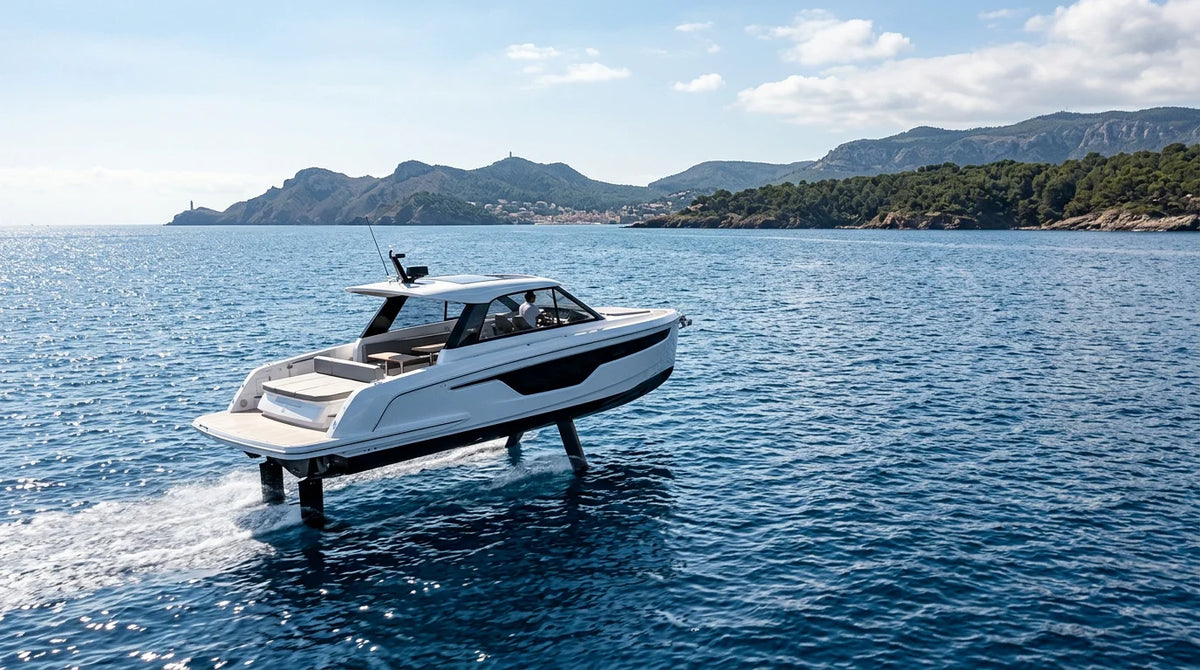
This electric hydrofoil boat buying guide begins with the reason foiling matters commercially, not merely aesthetically. When the hull rises on its wings, wetted surface area collapses, and the energy required to sustain speed falls with it. That is why a foiler often travels farther on a given battery than a comparable displacement or planing boat.

The category is also maturing quickly. The broader hydrofoil boats market was valued at roughly 1,322 million dollars in 2026, with North America holding about 36.4 percent of revenue in 2025. That growth brings more models, clearer specifications, and a widening secondary market, all of which work in a careful buyer's favour.
Two design details deserve early attention. Fully submerged foils managed by active sensors deliver a smooth, stable flight but rely on electronics. Mechanically self-stabilising systems trade some refinement for simplicity and lower complexity. Neither is universally correct; the right choice depends on your appetite for technology and your service options.
Choose the type before the brand
The first question is not which manufacturer, but what kind of boating you will genuinely do. A compact foiling dayboat suits relaxed coastal runs and short hops. A performance-oriented foiler rewards spirited driving. A larger commuter or ferry-style craft prioritises passenger comfort and predictable range on a fixed route.
Be honest about a typical outing. If you spend most of your time at anchor and only briefly under way, raw top speed matters little. If you commute across a bay or tour longer distances, cruising speed and the range sustained at that speed become decisive. Where a broad electric fleet interests you beyond foilers, our overview of the best electric boats offers useful context.
Riders drawn to the smaller, board-style end of the foiling world face a different set of trade-offs entirely. If that is your direction, our guide to buying an eFoil addresses wing size, board volume, and rider skill rather than cabin comfort and berth charging.
Battery capacity and real-world range
Two numbers dominate day-to-day ownership: battery capacity, measured in kilowatt-hours, and real-world range, measured in nautical miles. A larger battery can extend range, but it also adds weight, cost, and recharge time. Bigger is not automatically better.

Manufacturer range figures are usually measured at one specific speed under favourable conditions. Because consumption rises steeply with speed, a headline maximum range may bear little resemblance to range at fast cruise. Ask any dealer for a speed-versus-range table for the exact battery and propulsion configuration you are considering, and request an estimate based on your typical route, passenger load, and a sensible reserve.
Context helps here. Some current foilers pair automotive-derived battery packs of around 69 kilowatt-hours with roughly 57 nautical miles of range at moderate cruising speed, which is ample for dayboat use. Treat every published figure as a starting point, then verify it against how existing owners actually operate the same model.
Charging and marina access
Shore-power charging at your home berth is the default for most owners. Before committing, confirm the voltage, current, and power available at your marina, whether charging a propulsion battery is permitted, and how long a full recharge would take. Where an upgrade is required, its cost depends on the marina's existing installation and local grid capacity.
DC fast charging is spreading to electric-friendly marinas but remains less common on the water than on the road. Its usefulness depends on the battery size, the charger's output, and the maximum power your specific boat can accept. Solar assistance can support onboard consumption on some craft, yet it rarely replaces shore charging for propulsion. Confirm the charging specification of the exact configuration rather than the model in general.
Total cost of ownership, honestly
Electric foilers often carry a higher purchase price than comparable combustion boats, while promising lower running and maintenance costs. Whether the economics favour you depends on how often you use the boat. The total cost of ownership calculation should include purchase price, electricity cost at your berth, avoided fuel, annual hours of use, servicing, insurance, berthing, charging upgrades, battery warranty, and expected resale value.
The environmental case is part of the value too. According to Verified Market Reports, the U.S. Department of Energy estimates that adopting electric vessels can reduce greenhouse gas emissions by up to 40 percent, and the same analysis projects the electric hydrofoil segment growing at a 15.5 percent compound annual rate through 2033. Ask the seller for a written ownership-cost projection, then check its assumptions on annual usage and energy prices.
Sourcing route also affects value, particularly for premium and low-volume craft. The comparison below outlines what different acquisition channels typically offer.
| Sourcing route | Early access before public listing | Curated luxury selection | Free shipping |
|---|---|---|---|
| Standard dealer | No | Limited | Varies |
| Generic online listing site | No | Mixed | Varies |
| TheArsenale (Private Membership) | Yes | Yes | Yes |
The questions to ask before you buy
A knowledgeable seller should welcome detailed questions. Bring this short list to any showroom, boat show, or demonstration day, and treat vague answers as a warning sign rather than a detail to overlook later.
- May I see a speed-versus-range table for the exact battery size I am considering?
- What precisely does the battery warranty cover, including cycle limits, guaranteed state of health, and transferability?
- How and where will I charge, and is my home berth's supply suitable?
- What is the typical annual service cost, and is specialist support available near my cruising area?
- What documentation, including battery diagnostics, will pass to a future owner?
Commercial momentum is worth watching as well, because it signals long-term support and residual value. According to Research Nester, the hydrofoil boats industry was estimated at about 2.28 billion dollars in 2026, supported by public investment such as the roughly 300 million dollars the U.S. Federal Transit Administration allocated in 2024 to modernise ferry systems. Ferries and water taxis flying on foils help normalise the technology, as our coverage of the electric hydrofoil ferry on Lake Tahoe illustrates.
Bringing the decision together
The soundest purchase of an electric hydrofoil boat rests on three disciplines. First, buy the craft that matches how you actually use the water, not the version you imagine using. Second, weigh verified real-world range and charging access above the largest number on a specification sheet. Third, choose a seller and support network that will still answer your questions years from now. Get those three right, and the foiler you buy today should still feel like a considered decision well into the next decade.
Take action with TheArsenale
Once you understand range, charging, and ownership costs, the remaining challenge is access to the right craft at the right moment. Sought-after foilers and electric runabouts often sell before they reach public listings, which leaves careful buyers waiting rather than choosing.

We curate luxury mobility and ocean-exploration machines, and our Private Membership grants access to vehicles before they are listed publicly, with free shipping on every order. Explore our curated collection of electric boats and reach our sales team directly, as we usually reply in under thirty minutes.
Frequently Asked Questions
How much range can an electric hydrofoil boat achieve?
Range depends heavily on speed, battery capacity, passenger load, and conditions. A foiler may travel considerably farther at moderate cruising speed than at full pace. Always request a speed-versus-range table for the exact configuration you intend to buy.
Are electric hydrofoil boats more efficient than conventional boats?
Yes, generally. Lifting the hull on submerged foils can cut drag by up to roughly 80 percent, so a foiler often covers more distance on the same energy. That efficiency is the core advantage of the design.
Do I need a special charger at my marina?
Not always. Many owners charge from standard shore power at their berth, provided the voltage and current are suitable. Confirm that propulsion-battery charging is permitted and that recharge times fit your routine before you buy.
How can I access models that are not yet publicly listed?
Some premium foilers and electric runabouts sell before appearing on open marketplaces. Our Private Membership is designed to give buyers early access to such vehicles ahead of public listings. It suits collectors who want first choice on limited-run craft.
Is an electric hydrofoil boat expensive to maintain?
Electric drivetrains typically have fewer moving parts and lower routine servicing needs than combustion engines. However, battery health and specialist support matter over time. Request a written ownership-cost projection and confirm that qualified technicians serve your cruising area.