BMW’s AEON: The Humanoid Robot Rolling Into the Factory
By Patrice Meignan — TRANSMISSION Magazine
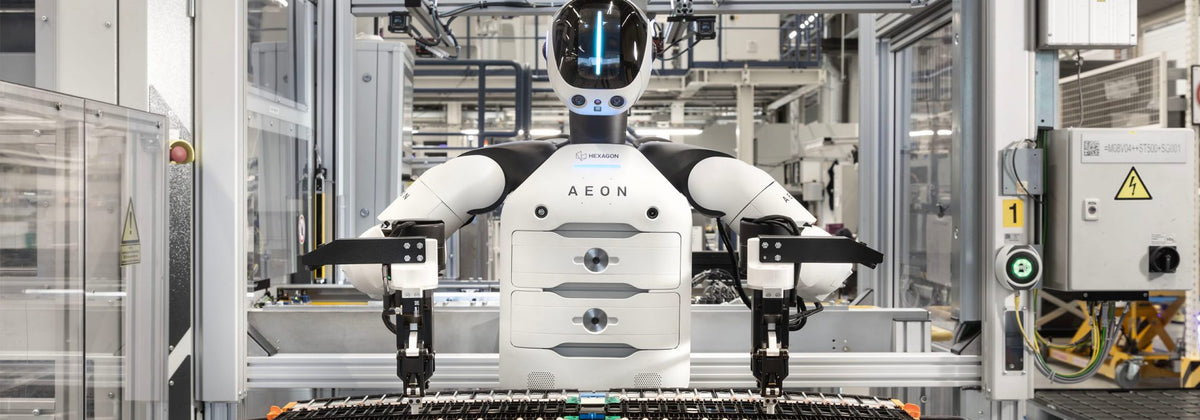
The next robot to enter a car factory may not arrive on two legs. At BMW Group Plant Leipzig, AEON looks humanoid from the waist up, but rolls through the workspace on wheels. That small detail is the whole story: in a factory, the useful question may not be whether a robot can imitate a person’s walk, but whether it can move parts safely, precisely and comfortably alongside people.

BMW AEON at a glance
- Robot: AEON, developed by Hexagon Robotics
- Height and weight: 1.65 metres and 60 kilograms, according to BMW
- Movement: wheeled base, with a stated top speed of 2.5 metres per second
- Where it is being tested: BMW Group Plant Leipzig, Germany
- Purpose: pilot support for high-voltage battery assembly and component production
BMW describes AEON as a humanoid robot intended to support employees, not replace them. In the Leipzig pilot, it can deliver materials to the line, navigate around obstacles and take on repetitive or physically demanding work. Its human-like torso can be fitted with different gripping tools, hands or scanning devices, allowing teams to assess more than one use case without changing the robot’s basic structure.
Why wheels may be the most human answer
Humanoid robotics often sells the promise of machines that fit spaces designed for people. Yet resemblance is only useful if it helps with the job. AEON’s wheeled base suggests a more pragmatic interpretation: keep a form that can work with familiar tools and stations, while using wheels for movement across the factory floor. That is an editorial reading of the design; BMW’s announcement focuses on flexible task integration and employee support rather than claiming that wheels are inherently better than legs.

The initial focus is concrete: high-voltage battery assembly and the production of exterior components. BMW’s timeline says AEON made its operational debut at Leipzig in December 2025, following theoretical assessment and laboratory testing; additional tests in 2026 were intended to prepare for pilot operations. The company presents this as a pilot project, not a factory-wide deployment or a fully autonomous production workforce.
From physical AI to the production line
BMW places AEON inside a broader “physical AI” programme, where software and AI agents connect to machines acting in real environments. The company says its common data and IT architecture is part of the foundation: robots need to understand tasks and surroundings, while production teams need to supervise, evaluate and adapt the way work is organised.

There is a useful reality check in the word “pilot”. A robot moving a component in a test cell is not yet proof of productivity at scale. The value of the Leipzig programme will depend on ergonomics, safe interaction, reliability across shifts and whether the system can handle the variability of real production without adding complexity for the people around it.
A factory robot does not need to walk like us
AEON makes the debate more interesting by challenging one of robotics’ most visible assumptions. If wheels are enough to navigate the line, perhaps the measure of a humanoid is not how convincingly it walks, but how naturally its tools, height and reach fit into a human workplace. For now, BMW and Hexagon are testing that proposition in a real industrial setting. The result may tell us less about machines becoming people than about factories learning how to work with a new kind of colleague.
Official sources and further reading
BMW’s report on the Leipzig pilot, AEON’s dimensions and the company’s production strategy: BMW Group — AEON at Plant Leipzig. Robot background and launch announcement: Hexagon — AEON humanoid robot.