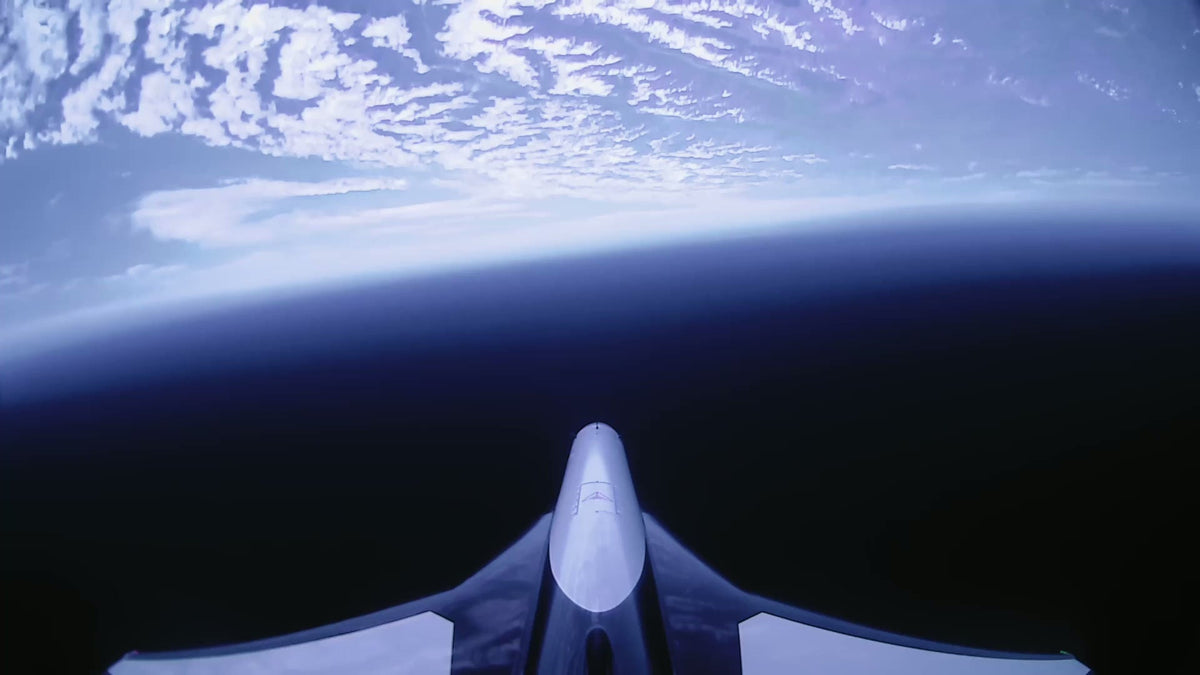
Dawn Aerospace Aurora: The Real Breakthrough Would Be Flying Again.
The spectacular part of a spaceplane is easy to picture.
A runway. A rocket engine. A small aircraft climbing towards an environment where conventional aviation runs out of answers.
The more consequential image might be what happens afterwards: the same vehicle back on the ground, its payload recovered, its next mission being prepared.
Dawn Aerospace’s Aurora puts that operational question at the centre of its proposition.
How much more useful could access to high altitude and suborbital space become if researchers could repeat it more frequently?
A Different Kind of Space Vehicle
Aurora is a remotely piloted, rocket-powered aircraft designed to operate from a runway.
Its intended work includes carrying instruments and experiments through demanding flight conditions, returning them to the ground and supporting another iteration. Dawn markets the platform for suborbital research, microgravity and high-speed missions.
Those applications give the aircraft a purpose beyond the spectacle of its trajectory.
An experiment becomes more valuable when its team can inspect the hardware, understand what happened and improve it. The vehicle’s return is part of the research process.

The Numbers Need Their Labels
Dawn’s published vehicle overview advertises a payload capacity of 15 kilograms, speeds up to Mach 3.7 and an altitude of around 100 kilometres.
These are the company’s published platform figures. They should not be confused with a claim that every capability has already been demonstrated together on a particular flight.
The distinction matters because development programmes move through different aircraft configurations and test campaigns.
Dawn documents a supersonic milestone in November 2024, when Aurora reached approximately Mach 1.12 and 25 kilometres altitude. Its flight-history pages also describe subsequent payload missions.
That is evidence of a flying programme. It does not, by itself, establish every performance or turnaround claim associated with the complete commercial proposition.
Research Gives the Programme a Concrete Test
The State of Oklahoma’s Suborbital Spaceplane Challenge offers a useful way to examine what Aurora is intended to enable.
Dawn announced the competition’s finalists on October 27, 2026. Proposed experiments include biological research, materials and systems testing, with flight opportunities planned for 2027.
The programme remains subject to vehicle availability, regulatory approval and campaign scheduling.
Those conditions are central to the story. A research platform becomes dependable through the combination of an aircraft, an operating team, suitable facilities and a schedule its customers can use.
The payload may be small. The system required to fly it repeatedly is substantial.

Frequency Changes the Value
A single successful flight can demonstrate a capability.
A repeatable service has to demonstrate something broader: consistent preparation, predictable operations, useful data and a manageable path back into the air.
That is the part of Dawn’s ambition I find most interesting.
If teams can test an instrument, recover it, revise it and return for another mission within a practical programme, the aircraft starts to become a working tool.
Its value then extends beyond maximum altitude or speed. It includes how effectively it supports the people using it.
Watch the Second Flight
Aurora’s appeal lies in a recognisable aviation idea being applied to an unusually demanding environment.
Take off. Carry out the mission. Return. Prepare to fly again.
Making that sequence routine is an ambitious engineering and operational task. It will need to be assessed through flight results and customer experience, rather than imagery alone.
The climb will always attract attention.
I will be watching how convincingly the programme earns the next departure.
Sources and Photography
Performance figures and programme plans are attributed to Dawn Aerospace. Advertised capabilities, demonstrated milestones and future missions are distinguished in the text. No flight or site visit is claimed.
- Dawn Aerospace — Aurora spaceplane
- Dawn Aerospace — flight history
- Dawn Aerospace — Suborbital Spaceplane Challenge
All three photographs: Dawn Aerospace, official programme imagery.