Ora ïto: A Personal Tribute to a World in Motion
By Pat Meignan
From Citroën’s imagined spacecraft to Renault’s electric R17, from a bicycle to the everyday rhythm of a city: a personal appreciation of Ora ïto and the many ways he has rethought movement.
There are designers whose work I admire from a distance. With Ora ïto, this is personal. Our paths have crossed through a subject that matters deeply to me: how to give mobility a future worth wanting. When I put him forward for the Renault project that became the R17 electric restomod, I wanted to see what would happen when his eye met that particular piece of French automotive history. The result is one reason I wanted to write this. The rest of his work is another.
I spend a great deal of my life looking at things that move. Eventually, you stop being impressed simply because an object looks futuristic. You start asking whether it has a point of view. Whether you would recognise it without its badge. Whether it changes something in your understanding of the brand, the journey or the place.
Ora has that point of view. You can see it in a wheel, a window, a tram arriving at a platform. His idea of “simplexity” — giving complex things an apparently simple form — can sound like a neat design slogan. Looking across his work, I read it as a discipline: keep working until the object feels coherent. Then give it enough character to stay with you.
The R17, and why it matters to me
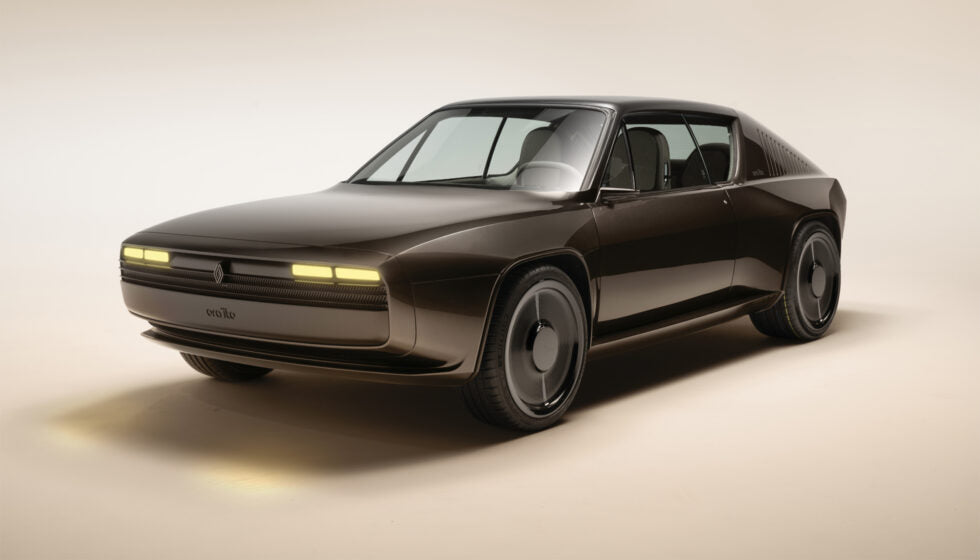
The R17 electric restomod, unveiled in 2024, makes a particularly good place to begin. Developed with Renault’s design team, it reinterprets the coupé introduced in 1971 as a one-off electric show car.
The original glasshouse remains immediately familiar. Around it, the body becomes wider, cleaner and more assured. Carbon-fibre bodywork, a rear-mounted electric motor and a Galactic Brown finish give the project its contemporary substance. Inside, wool upholstery and geometric digital instruments make the cabin feel considered rather than merely updated.
What moves me is the balance. The R17 still carries the personality that made the original interesting, but the proportions and details give you a new reason to look. It takes confidence to touch a familiar object without smothering it in references. Seeing Ora achieve that within a collaborative Renault project has particular meaning for me. My part was to put his name forward; the design belongs to Ora and the team who brought it to life.
Lead image: Renault R17 electric restomod. Image via Studio Ora ïto. Project interview and collaboration background.
Citroën: giving imagination a physical shape
Long before the R17, the Citroën experiments had already established something essential about his approach. Evo Mobil draws on the Traction Avant; UFO transforms the visual memory of the DS into a flying-saucer-like sculpture. Presented publicly in 2011, these were speculative objects, rather than functioning airborne vehicles.

I love the permission they give themselves. The Traction and the DS were extraordinary acts of invention in their own time. Ora responds to that spirit by allowing their descendants to become strange again. Evo Mobil stretches an automotive silhouette into something almost biological. UFO takes the DS’s otherworldliness seriously enough to leave the road behind.

For me, these projects remain an important part of mobility culture. A sculpture can ask a question that a production programme cannot yet accommodate. It gives an idea a body, and lets the rest of us decide what it might mean.
Angell: the city at bicycle speed
With Angell, developed with entrepreneur Marc Simoncini and launched in 2019, the scale changes. An aluminium frame, carbon-fibre elements, integrated lighting, a connected cockpit and a removable battery become part of one deliberately spare composition. The broader range explored different frame sizes and riding positions through models including Rapide and Cruiser.

What interests me here is the ambition to make a technologically complicated bicycle look natural. The visual weight is controlled. The frame remains readable. You can understand the object before you know everything it contains.
That design lineage also reached the MINI E-Bike 1 in 2023. Developed by Angell Mobility with MINI’s design team under Oliver Heilmer, it translated the platform into another brand’s identity. The collaborative credit matters: Ora’s original bicycle language is part of the story, alongside MINI’s own design contribution.
I see these bicycles as an attempt to give an ordinary urban journey the attention usually reserved for a much more expensive machine. That is an ambition I respect.
Nice and Marseille: design belongs to the people who use it
The Nice tram, developed with Alstom, brings that attention into public transport. Its ochre-red and black palette connects the vehicle to the city’s architecture. The treatment extends through the interior and station design, giving the journey a coherent visual setting.

A tram has to look convincing in motion and while waiting at a stop. It has to work within a street, among buildings and pedestrians, in changing light. Looking at Nice, I appreciate how much identity can come from a disciplined choice of colour and shape. The vehicle feels as though somebody has considered where it belongs.
In Marseille, Ora’s metro design forms part of Alstom’s programme for the city’s new trains. The exterior and interior carry a distinctive visual language, with a rounded, geometric face and a white-and-blue palette. Alstom’s presentation of the project also records the public consultation involved in choosing the design.

These projects are especially important to my reading of his work. A train becomes part of someone’s morning, their route home, their image of the city. That gives the designer a responsibility extending far beyond the launch photograph. I admire the willingness to bring a recognisable creative voice to something so widely shared.
The same thought continues above ground in Marseille’s Place Castellane. Developed with STOA and the wider project team, the eye-shaped limestone bench known as La Paupière accompanies the square’s transformation into a more pedestrian space. Here, mobility includes walking, meeting and sitting down. The pause deserves design attention too.
Air and sea: drawing the journey from within
For Sabena technics, the Aero System aircraft cabin concept explored a continuous interior language. Seating, lighting, windows and architectural surfaces were considered together, with spaces for work, conversation and rest.

I find this work interesting because a cabin is such an unforgiving volume. Every decision is close to the body. A line can make the space feel calmer; a poorly resolved junction can make it feel smaller. In these images, Ora treats the interior as a whole. You can follow the architecture with your eye and understand the atmosphere it is trying to create.
At sea, his 56-metre sailing-yacht concept for Perini Navi, presented in 2019 and developed with the shipyard’s Franco Romani, works through similarly continuous lines. Sometimes referred to as Capsule, it reinterprets the shipyard’s established sailing-yacht platform through a flowing relationship between deck and superstructure.

I am drawn to the restraint in that silhouette. A yacht offers ample opportunity to add things. This proposal asks how much character can emerge from bringing its elements together. Both the yacht and Aero System belong here as design concepts; their value is in the ideas they make visible.
The places around movement
A proper appreciation also has to leave room for the projects around the vehicles. Ora’s mobility work reaches into the places where a journey starts, stops or changes pace.
The Toyota showroom, his Toyota motor-show work and the Citroën Moscow Motor Show project belong to the architecture of automotive presentation. They address how we first encounter a vehicle: the space around it, the route towards it, the way a brand becomes a physical environment.
The La Chaponne motorway service area, designed for Elior, takes that thinking onto the A6. Curved architecture, landscape and circulation give a roadside stop an identity of its own. I like the attention paid to a place so easily dismissed as purely practical. Anyone who spends time on the road understands the value of a good stop.
The Gare d’Austerlitz redevelopment concept, developed with Daniel Buren and an architectural team, addresses the station as an experience of arrival and departure. It belongs to the speculative part of his portfolio, rather than being a claim about the station as built.
There is another thread in the Mobile Home for Cappellini, a 2007 virtual-architecture project, and Flying Nest for Accor, introduced in 2018. Flying Nest turned converted shipping containers into temporary accommodation, with conversion specialist Capsa involved in the project. It brought the idea of a hotel that could be deployed where it was needed into physical form.
Even the Ora ïto Mobility accessories collection deserves a place in this wider picture. Headphones, cases and connected accessories deal with the smaller objects we carry through the world. They extend his interest in movement into daily life.
A personal thank-you
Looking across this body of work, I keep coming back to one quality: continuity. A speculative Citroën, an electric bicycle and a public tram are very different assignments. Yet each carries the conviction that an object should make sense as a whole, and that its presence can change how we feel about using it.
That is what I value in Ora’s contribution. He gives familiar things another possibility. He is willing to work at the scale of an imagined spacecraft and at the scale of a commuter’s seat. The distance between those two is where much of the future of mobility will be decided.
Ora, this is my way of recognising that work, and of saying thank you for the perspective you bring to a world I care about. The R17 gave our professional connection a very tangible form. This wider journey makes clear why I wanted your eye on it in the first place.
— Pat Meignan
Project images sourced from Studio Ora ïto’s published portfolio. Collaborating brands and teams are identified in the text and captions. Explore the Studio Ora ïto portfolio for further project material.