Handcrafted Bicycle for Sale: A Buyer’s Guide for 2026
What makes a bicycle genuinely worth buying when it is presented as handmade? A handcrafted bicycle for sale should offer more than visual appeal. It should reflect a clear riding purpose, thoughtful geometry, credible construction, and a level of detail that justifies the purchase. Our guide to luxury designer bicycles for sale provides useful context for readers who view a bicycle as both transport and design.
Independent framebuilding has also developed into a specialized global craft. Recent Philly Bike Expo coverage described renewed interest in tailored bicycles, professional fitting, and small-scale builders, while also noting that the trade remains commercially demanding. That combination makes careful research essential, especially when a bicycle is ordered internationally or built to specification.
What should “handcrafted” mean when you buy?
The word handcrafted should describe a real production process, not simply a premium finish. Ask which parts are made by hand, which operations are performed by machines, where the frame is constructed, and who completes the final assembly. A builder may hand-miter tubes, braze or weld the frame, file joints, prepare the finish, and assemble the bicycle personally. Another may design the frame in-house while using specialist partners for paint, components, or production.
Neither approach is automatically superior. The important issue is transparency. A credible seller should be able to explain the construction method, the builder’s role, the frame material, the assembly location, and the quality checks performed before delivery. Look for photographs of the workshop, technical explanations, a named builder or design team, and a written specification that distinguishes the frame from the complete bicycle.
Handmade also does not necessarily mean fully bespoke. A small builder may offer standard geometry, limited sizes, or a short series of frames assembled with individual attention. A bespoke build normally involves deeper personalisation, including measurements, geometry, tubing selection, paint, braze-ons, component choices, and intended-use decisions. Understanding that difference prevents you from paying custom pricing for a largely standard configuration.
Start with the ride, not the appearance
Imagine two bicycles with equally impressive paintwork. One is designed for fast road riding, while the other accepts wide tires, luggage, fenders, and rough surfaces. The more attractive bicycle is not automatically the better purchase. Your first decision should be the bicycle’s role in your life.
- Road and endurance riding: Prioritise position, tire clearance, stability, efficient power transfer, and comfort over long distances.
- Gravel and mixed surfaces: Review clearance, mounting points, gearing, wheel size, braking, and protection from mud.
- Touring and bikepacking: Confirm rack mounts, load limits, low gearing, serviceability, and space for bags.
- Urban and daily use: Consider fenders, lighting, locks, weather resistance, step-over height, and maintenance access.
- Collection and display: Place greater weight on provenance, finish quality, design language, rarity, and documentation.
A well-built frame cannot compensate for an unsuitable use case. If you expect to carry luggage, ride rough roads, or use larger tires, specify those requirements before the builder finalises the geometry. If the bicycle is primarily an object for display, the evaluation may focus more on materials, finishing, originality, and presentation.

Why fit and geometry deserve the most attention
Fit is where a handcrafted bicycle can provide its clearest practical advantage. A builder can adjust the relationship between saddle, handlebar, pedals, and contact points rather than forcing your body into a fixed stock geometry. That does not mean every custom bicycle will feel perfect automatically. The quality of the result depends on accurate measurements, honest communication, and a clear understanding of how you ride.
Before requesting a quotation, prepare your height, inseam, current saddle height, reach preferences, flexibility concerns, typical ride duration, and any recurring discomfort. Photos or measurements from a current bicycle can help, but they should not replace a professional fitting process when the purchase is significant. Your preferred handlebar, tire width, crank length, and riding position can influence the frame design.
For a more structured process, our bespoke bicycle buying guide can help you organise questions about fit, use, materials, and build choices before contacting a seller. The goal is not to make the bicycle complicated. It is to make every major decision intentional.
Which materials and components should you examine?
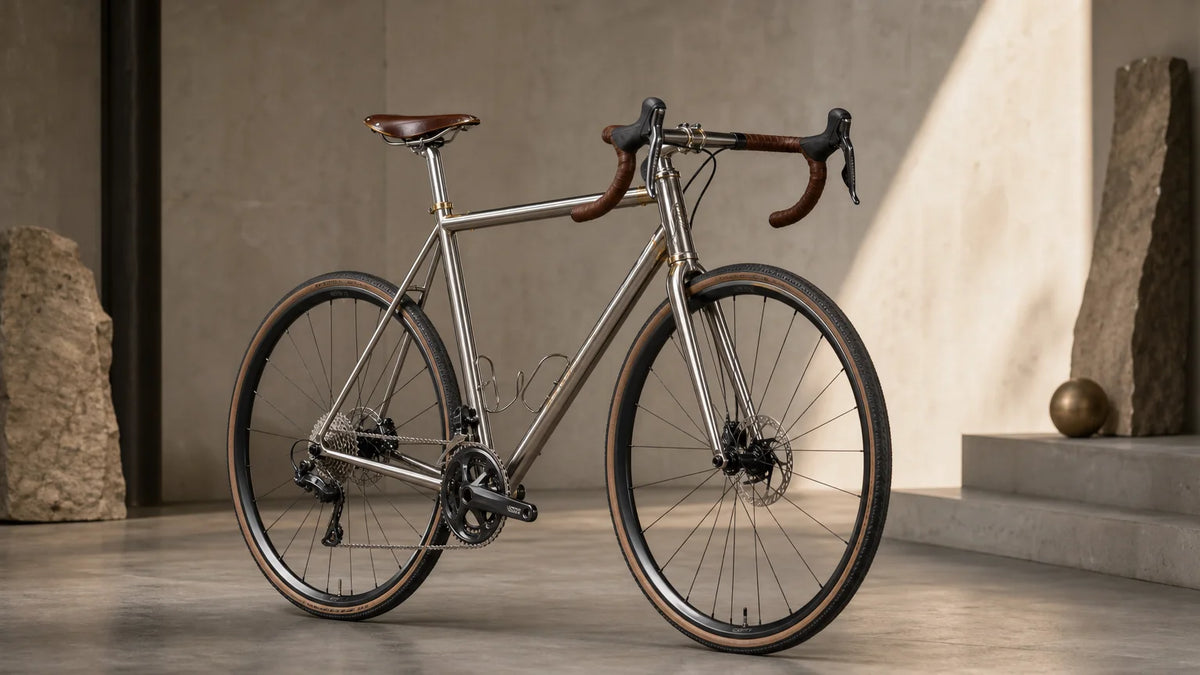
Material selection affects ride character, durability, weight, repairability, and appearance. Steel remains valued for its repair potential, familiar ride qualities, and ability to support classic construction techniques. Titanium is often chosen for corrosion resistance, durability, and a distinctive balance between strength and refinement. Carbon can deliver low weight and precise shaping, while aluminium may provide efficient performance with a broad range of frame designs.
The material alone does not determine quality. Tube selection, wall thickness, joint design, heat treatment, alignment, finishing, and engineering all matter. A carefully designed steel bicycle can be more appropriate for touring than a lighter racing frame. A titanium frame may suit a rider seeking long service life, but it still requires correct geometry and component compatibility.
Review the complete specification rather than focusing only on the frame. Confirm the drivetrain, brakes, wheels, tires, cockpit, saddle, seatpost, lighting, racks, and included accessories. Ask whether the quoted price covers a frameset or a ready-to-ride bicycle. If you are interested in unusual materials or alternative construction, our guide to wooden bicycles for sale offers a useful example of how material choice can become part of the bicycle’s identity.
How much does a handcrafted bicycle cost?
There is no single reliable price for a handcrafted bicycle. Cost depends on the builder’s labour, frame material, design complexity, paint, component level, wheel choice, accessories, and the amount of individual engineering involved. A frame-only quotation may look accessible until the cost of a fork, headset, wheels, drivetrain, brakes, finishing kit, assembly, shipping, taxes, and insurance is added.
Ask for an itemised quotation with a clear validity period. You should also confirm the deposit, payment schedule, cancellation terms, revision policy, estimated completion date, and treatment of unexpected changes. A builder may require approval at the design stage before fabrication begins. Changes after that point can affect both timing and price.
Pricing should be judged against the intended ownership period, not only the purchase day. A bicycle that fits correctly, uses serviceable components, and can be repaired or refinished may offer stronger long-term value than a cheaper bicycle that quickly becomes uncomfortable or difficult to maintain. Our overview of the best custom bicycles can help you compare design, fit, material, and build priorities without reducing the decision to price alone.
How do availability and ordering usually work?
A handcrafted bicycle may be available in one of three forms: ready to ship, partly configured, or made to order. A ready-to-ship bicycle can be inspected through photographs and a fixed specification. A partly configured bicycle may allow you to choose components or finish. A made-to-order build normally requires a consultation, deposit, design approval, fabrication, finishing, assembly, and final inspection.
Lead times can change as workshops manage material supply, paint capacity, component availability, and existing orders. Request a written estimate rather than relying on a general statement such as “soon” or “available this season.” If the bicycle is a one-off or show build, ask whether it has been ridden, displayed, modified, or stored for an extended period.
In the second half of the twentieth century, bicycle sale notices already focused on condition, specification, and price. A 1974 newspaper archive includes a simple bicycle-for-sale listing, a reminder that the basic buyer questions have remained consistent even as materials and design have changed.
What should international buyers confirm?
International purchasing adds practical questions that should be resolved before payment. Confirm the shipping destination, packaging method, insurance, delivery responsibility, import taxes, customs paperwork, and local assembly requirements. Ask whether the seller ships complete bicycles, framesets, or disassembled packages, and whether your local service network can support the selected components.
Warranty coverage should be written in clear terms. Check who pays for return shipping, whether paint damage is treated separately from structural damage, how replacement parts are sourced, and whether the builder can support a future repair. A detailed invoice, serial number, build sheet, and photographs taken before dispatch can also help establish provenance.
Global maker networks can be highly collaborative. A 2020 maker report documented distributed production across 86 countries, showing why a finished object may involve designers, fabricators, suppliers, and logistics partners in several locations. For a handcrafted bicycle, that makes it especially important to ask where each major stage takes place.
A practical checklist before you commit
- Define the use: Write down where, how often, and with what load you will ride.
- Verify the fit: Provide accurate measurements and explain comfort issues or position preferences.
- Inspect the specification: Confirm materials, geometry, tire clearance, mounts, components, and included accessories.
- Review the quotation: Separate frame, complete build, delivery, taxes, and optional upgrades.
- Document the purchase: Keep the invoice, build sheet, serial number, warranty, and delivery agreement.
These steps are simple, but they protect the most valuable part of the purchase: alignment between the bicycle and your expectations. They also make it easier to compare different construction approaches without confusing customisation with quality.

Choose the bicycle you will keep riding
The best handcrafted bicycle for sale is not necessarily the rarest or most expensive. It is the bicycle whose fit, purpose, materials, specification, provenance, and support make sense together. Take time to verify how it was made, who built it, what is included, how long it will take, and how it will be supported after delivery. A considered purchase should feel distinctive when you see it, but dependable every time you ride it.
Take action with TheArsenale
When your search extends beyond a conventional bicycle, curation can help you evaluate design, rarity, engineering, and provenance together. TheArsenale brings a mobility-focused perspective to extraordinary machines and connects collectors with a carefully selected international network.

Browse our selection of curated bicycles to explore distinctive designs and current availability. For a high-value acquisition or a less conventional specification, our sales team can also help clarify the next step, the relevant details, and the appropriate route for your request.
Frequently Asked Questions
What qualifies a bicycle as handcrafted?
A handcrafted bicycle involves meaningful human work in design, fabrication, finishing, or assembly. Ask the seller which stages are completed by hand, which are outsourced, and where the final bicycle is built.
Is a custom bicycle always better than a standard bicycle?
Not necessarily. Custom construction is most valuable when your fit, riding purpose, proportions, or equipment needs differ from standard options.
Should I buy a frame or a complete bicycle?
A frameset gives you more control over components and may suit an experienced mechanic. A complete bicycle is usually simpler for most buyers because compatibility, assembly, and initial setup are handled together.
What should I ask before paying a deposit?
Confirm the final specification, total price, deposit terms, estimated completion date, delivery arrangements, warranty, and policy for design changes. Request these details in writing before fabrication begins.
Can I find a distinctive bicycle through TheArsenale?
Yes. TheArsenale curates bicycles and other mobility objects through an international marketplace, with sales assistance available for unusual or high-value acquisitions. Availability, specifications, and purchasing terms should be confirmed for each individual listing.