1930s American Cars: Icons, History, and Collector Value
Between 1929 and 1932, American vehicle output collapsed from more than 5.6 million units to roughly 1.3 million, one of the sharpest industrial declines the country had ever witnessed. Despite this, the decade produced some of the most admired automobiles ever built, and our curated 1930s cars for sale reflect that enduring fascination. The story of the American cars of the 1930s is one of survival, artistry, and quiet engineering revolution.
The Great Depression reshaped every corner of the industry. According to EBSCO research, the number of American automakers fell from forty-four before the crash to fewer than twelve a decade later. What survived was leaner, bolder, and technically far more advanced. To understand these vehicles is to understand how economic catastrophe accelerated design and consolidated an entire industry.
How the Great Depression Shaped 1930 American Cars
Few products were harder to sell during an economic crisis than a durable good such as an automobile. The phrase "1930 american cars" now evokes elegance, yet the reality behind these vehicles was defined by scarcity and difficult choices. Buyers delayed new purchases, repaired what they owned, and turned to secondhand options wherever possible.
The scale of the collapse was severe. University of Michigan research notes that in 1932 more cars were junked than were sold, and in one month that year, three times as many cars were stolen as were purchased in Chicago. Recovery arrived gradually after 1933, but the industry still produced only around 3.6 million vehicles in 1939, well below its pre-crash peak.
Ownership patterns nonetheless remained resilient. Americans continued to drive, even when they were not buying new. This paradox, cars everywhere yet showrooms empty, defined the entire decade and forced manufacturers to compete on value and innovation rather than volume alone.
A Design Revolution: Streamlining and Engineering

Economic pressure did not slow innovation; in many ways it sharpened it. During the 1930s, engineers introduced independent front suspension, hydraulic brakes, and more powerful engines that laid the groundwork for the modern automobile. Bodies grew rounded and integrated, replacing the boxy, carriage-like shapes of the 1920s.
The 1932 Ford V8 marked a turning point, bringing eight-cylinder performance to an affordable price point. Chrysler pushed aerodynamic styling with its Airflow design, an idea ahead of its commercial time yet deeply influential. Amenities that drivers now take for granted, including heaters, radios, and early automatic transmissions, began appearing throughout the decade.
These advances explain why so many enthusiasts still admire the classic cars of the 1930s. For readers exploring the wider field, our guide to classic cars places these developments in a broader historical context.
Legendary Marques and Hollywood Icons
The early 1930s witnessed a remarkable paradox: as the broader economy suffered, the luxury car market reached a peak. Hollywood stars in custom-built automobiles offered the public a glamorous distraction from hardship. These machines became rolling symbols of aspiration.
Consider a few celebrated examples of these Depression-era luxury cars:
- The Duesenberg SSJ, an ultra-rare model of which only two were built, owned by Clark Gable and Gary Cooper.
- The supercharged Cord 812, capable of exceeding 110 mph, a technical marvel for its time.
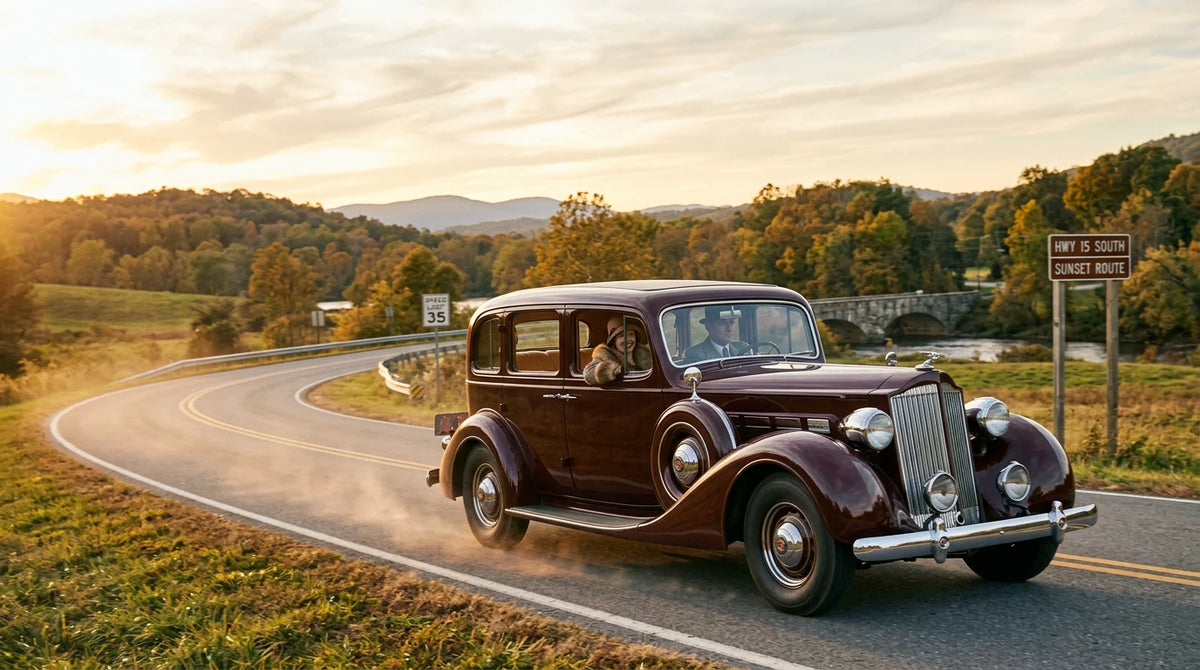
- The Packard and Pierce-Arrow lines, which defined refined American coachbuilding.
These vehicles were viewed as moving art, and their reputations have only grown. The scarcity that once reflected a struggling market now underpins extraordinary collector demand.
The Rise of the Big Three
Consolidation was perhaps the defining commercial legacy of the decade. General Motors, Ford, and Chrysler weathered the storm while smaller rivals faltered. Automotive News reporting records that the three companies accounted for 74 percent of vehicle sales in 1929, rising to 87 percent by 1935.
This shift concentrated resources and engineering talent. Chrysler maintained a strong research division, while Ford pioneered innovations such as a floating power engine mounting for a smoother ride. Competition among the three forced continual improvement across every price range, from economy models to flagship luxury lines.
Labor relations also transformed the industry. The United Auto Workers formed in 1935, and after a series of dramatic strikes, General Motors signed the first union contract in American automobile history in 1937. The modern industrial framework of American carmaking was forged in these years.
The Independents That Vanished

Not every marque survived the decade. Smaller independents, with limited capital and thin margins, were hit hardest. Hagerty reports that automakers lost to the Depression included Peerless in 1931, Marmon in 1933, Franklin in 1934, Auburn-Cord-Duesenberg in 1937, Pierce-Arrow in 1938, and Stutz in 1939.
These names are now some of the most sought after among serious collectors. Rarity, combined with a compelling backstory of ambition cut short, gives these vintage American automobiles a distinctive place in the market. A surviving Cord or Duesenberg carries both mechanical significance and a genuine sense of lost history.
Understanding which marques disappeared, and why, is essential for anyone evaluating authenticity, provenance, and long-term value. The stories behind these vanished builders often matter as much as the metal itself.
Collecting 1930s American Cars Today
Interest in prewar classics remains strong in 2026, driven by both nostalgia and the recognition that surviving examples are finite. Acquiring one of these cars responsibly requires curation, verified provenance, and access to trusted channels. The table below compares common acquisition routes.
| Channel | Curation | Early access | Focus |
|---|---|---|---|
| TheArsenale | Curated selection | Yes, via Private Membership | High-end mobility and collectibles |
| Public auctions | Variable | No | Broad, event-based |
| General classifieds | Minimal | No | Mixed, unvetted |
For buyers who value discretion and vetting, our classic car marketplace brings curation and structure to a market that can otherwise feel fragmented. Through our Private Membership, you may access vehicles before they are listed publicly, an advantage when sought-after prewar cars appear rarely and sell quickly.
Whichever route you choose, prioritize documentation, matching numbers, and restoration history. A well-documented 1930s automobile protects both its heritage and its long-term value.
Final Thoughts on a Defining Decade
The American cars of the 1930s represent a rare intersection of adversity and artistry. An industry brought to its knees by the Great Depression responded with streamlined design, mechanical innovation, and enduring icons that still command respect. For collectors and enthusiasts, these vehicles reward careful study: understand the marques, verify provenance, and value the stories behind the machines as much as the machines themselves. That informed approach transforms a purchase into genuine stewardship of history.
Take action with TheArsenale
If the elegance and history of prewar automobiles resonate with you, the next step is finding a trusted way to explore what is available. We bring curation and clarity to a market where remarkable machines can be difficult to locate.

As a luxury mobility marketplace, we curate high-end vehicles and collectible machines, and our Private Membership offers access to vehicles before they are listed publicly. Browse vehicles to see how a curated approach can support your search for a distinctive classic.
Frequently Asked Questions
What defined 1930s American cars?
The decade was defined by streamlined bodies, hydraulic brakes, independent front suspension, and more powerful engines. These innovations emerged despite the Great Depression and laid the foundation for the modern automobile.
Which 1930s American cars are most collectible?
Rare luxury marques such as Duesenberg, Cord, Packard, and Pierce-Arrow are among the most sought after. Limited production numbers and compelling histories drive their value among serious collectors.
Why did so many carmakers fail in the 1930s?
The Great Depression drastically reduced new car sales, and smaller independents lacked the capital to survive. Consolidation left the Big Three, General Motors, Ford, and Chrysler, dominating the market by mid-decade.
Are 1930s American cars a good investment today?
Well-documented, authentic examples can hold value strongly because surviving cars are finite. Provenance, matching numbers, and restoration history remain the most important factors to evaluate before purchasing.
Where can I find curated 1930s cars for sale?
Curated marketplaces provide vetting and structure that general listings often lack. Our classic car marketplace and Private Membership are designed to help you discover distinctive prewar vehicles with confidence.