The 1932 Ford Convertible: History, Value, and Hot Rod Icon
Few automobiles carry the cultural weight of the open 1932 Ford. Ford built only 12,597 examples of the 1932 roadster, a scarcity that helped transform an affordable Depression-era car into the most coveted platform in hot rodding history. When enthusiasts discuss the 1932 Ford convertible, they are describing a car whose lightweight body, elegant proportions, and pioneering V8 engine set the template for an entire subculture. If your interest extends to open-top collectibles more broadly, you may browse our luxury convertibles guide alongside this history.
The appeal is not merely nostalgic. The 1932 Ford convertible remains a benchmark for craft, provenance, and value, blending genuine engineering significance with decades of pop-culture recognition. Affectionately nicknamed "the Deuce" for the "2" in its model year, the car has appeared on postage stamps, in hit songs, and in landmark films, cementing a legacy that continues to shape the collector market today.
What the 1932 Ford Convertible Actually Is
The term "1932 Ford" covers several distinct models produced between 1932 and 1934. According to Wikipedia, the range comprised the four-cylinder Model B, the V8-powered Model 18, and the later Model 40, all succeeding the Model A. The open body styles within this family are what most collectors mean by an open-top Deuce.
Rather than simply updating its predecessor, Ford launched an entirely new vehicle for 1932. The flathead V8 engine made the Model 18 the first low-priced, mass-marketed car to offer eight cylinders, a genuine milestone in American automotive history. The 221 cubic inch unit was initially rated at 65 horsepower, with output rising in subsequent years through carburetor and ignition improvements.
Open configurations included the two-door roadster, the two-door cabriolet, the four-door phaeton, and a two-door convertible sedan. Prices in 1932 started around US$495 for the roadster, with the convertible sedan reaching US$650. The rare flathead V8 B400, a convertible coupe with fixed side window frames, saw only 842 units built, making it the scarcest of the 1932 Fords.

Why the Deuce Became a Hot Rod Icon
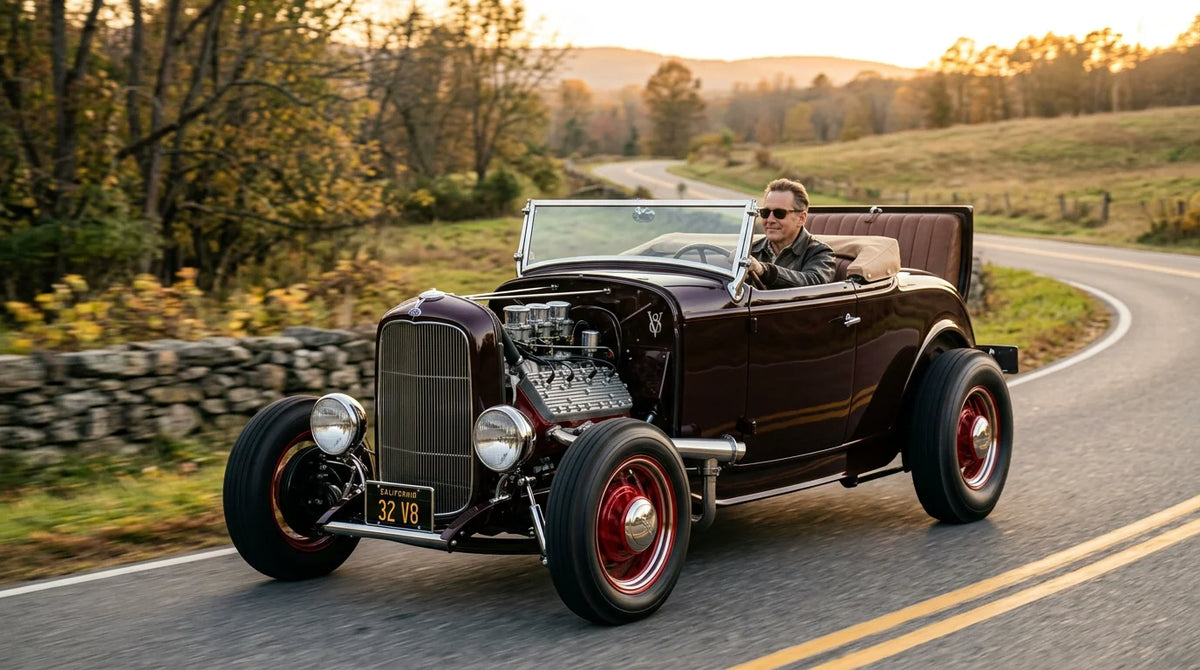
What elevated an economy car into a legend? The answer lies in its post-war second life. As Sports Car Market notes, the 1932 roadster, "better known as the Deuce," has always been the quintessential hot rod, prized for timeless lines and a light body that shed weight beautifully once stripped of its fenders.
In the 1940s and 1950s, surplus Model 18 roadsters and coupes were plentiful and cheap enough for young men to buy and modify. Builders stripped weight, dropped front axles, and "hopped up" the flathead V8 to develop several times its factory output, racing at California's dry lakes and later at the Bonneville Salt Flats. This grassroots ingenuity defined the traditional hot rod aesthetic that enthusiasts still emulate.
The cultural footprint grew accordingly. The Beach Boys immortalized the model with their 1963 hit "Little Deuce Coupe," and the car featured prominently in the 1973 film "American Graffiti." Few mass-produced products of any kind have earned such widespread and enduring recognition across music, film, and popular memory.
Roadster, Cabriolet, and Convertible Sedan Explained
Not every open 1932 Ford is the same, and the distinctions matter for both drivers and collectors. The roadster is the purest expression: a spartan two-seat body with minimal weather protection and no fixed side window frames. It is the shape most associated with the classic Deuce roadster and the most sought-after for period-style builds.
The cabriolet added roll-up windows and a more refined convertible top, offering greater comfort while retaining open-air appeal. The four-door convertible sedan and phaeton served buyers who needed room for passengers without sacrificing the open configuration. Each body style carries a different rarity profile, which directly influences desirability today.
Modern builders often blend heritage with usability. Contemporary reproductions such as the Dearborn Deuce introduced a foldaway convertible top that tucks neatly into the body, pairing vintage silhouette with modern drivetrains. If you are weighing a period-correct restoration against a modernized build, our overview of a 1932 Ford restomod / classic build outlines the trade-offs involved.
What a 1932 Ford Convertible Is Worth in 2026
Value is where the Deuce market becomes genuinely nuanced. Prices span an enormous range, and condition, provenance, and build quality drive the spread. Per Conceptcarz data, the most recent tracked sale of a 1932 Ford hot rod occurred in October 2025 at Mecum's Dallas and Fort Worth event, closing at US$55,000.
At the higher end, licensed limited-production builds and documented originals command premiums. A 2026 Barrett-Jackson listing for a custom Dearborn Deuce roadster illustrates how modern glass-bodied convertibles with quick-change rear ends and climate control reach well into the mid five figures. Historically important steel roadsters have gone considerably higher; a documented highboy sold for US$154,000 at Pebble Beach in 2011.

For buyers entering the market in 2026, the practical takeaway is clear: a fiberglass-bodied driver-quality build sits at the accessible end, while original-steel, provenance-rich examples occupy the six-figure tier. When you are ready to compare verified listings, you may shop classic cars for sale through our curated marketplace.
Authenticity: Steel Versus Fiberglass and Buyer Diligence
Because 1932 Ford bodies and frames have been reproduced in fiberglass and steel since the 1970s, authentication is essential. Knowledgeable collectors who can pay top dollar consistently favor genuine original-steel bodies over even excellent reproductions. This preference is the single largest driver of value at the upper end of the market.
Before committing, verify the cowl tag and body style code, inspect door gaps and window channels, and assess panel weight, since steel and fiberglass feel markedly different. Study recent auction results for comparable configurations rather than relying on a single asking price. Provenance documentation, especially a known ownership chain, substantially strengthens both confidence and resale value.
Period-built rods, meaning cars assembled and driven with era-correct techniques, occupy a distinct and prized category. A correctly documented pre-war or early post-war build using authentic components carries genuine historical significance that later restomods, however polished, cannot fully replicate.
Final Perspective on an Enduring Icon
The enduring fascination with the 1932 Ford convertible rests on a rare combination of engineering firsts, timeless design, and cultural resonance that spans nearly a century. Whether you pursue a faithful original-steel roadster or a driveable modern build, prioritize provenance, inspect the body construction closely, and benchmark against recent 2026 auction data before you commit. Approached with patience and homework, an open Deuce rewards its owner with both driving pleasure and a tangible piece of hot rod heritage.
Take action with TheArsenale
Sourcing a genuine open-top Deuce demands access to vetted machines and trustworthy provenance, precisely the challenge a curated marketplace is built to solve. If you are searching for a landmark convertible or a bespoke collectible build, we can connect you to the right car with confidence.

As a luxury mobility marketplace, we curate high-end collectible vehicles and offer Private Membership access to select machines before they are listed publicly. Explore our luxury mobility marketplace and Private Membership to begin your search with a team that responds quickly and works internationally across Monaco, Dubai, Doha, and online.
Frequently Asked Questions
Is a 1932 Ford roadster the same as a convertible?
The roadster is one type of open 1932 Ford, alongside the cabriolet, phaeton, and convertible sedan. The roadster is the most spartan and the most collectible, while the cabriolet added roll-up windows and a more refined top. All fall under the broader convertible umbrella.
Why is it called the Deuce?
The nickname "Deuce" refers to the "2" in the 1932 model year. The name became shorthand within hot rod culture and was popularized further by songs and films. Today it signals the specific reverence enthusiasts hold for this particular Ford.
How much does a 1932 Ford convertible cost in 2026?
Prices vary enormously with body construction, condition, and provenance. A tracked October 2025 Mecum sale of a hot rod example closed at US$55,000, while original-steel, historically significant roadsters have reached six figures. You can compare verified current listings through our classic car marketplace.
Did the 1932 Ford convertible come with a V8?
The Model 18 offered Ford's new flathead V8, the first low-priced mass-market V8 in America, initially rated at 65 horsepower. The four-cylinder Model B was the more affordable alternative. The V8 quickly became the enthusiast favorite and the basis for most hot rod builds.
How can I tell if a body is original steel or fiberglass?
Inspect the cowl tag, panel weight, door gaps, and window channels, since fiberglass reproductions differ noticeably in feel and construction. Original steel bodies command a significant premium among collectors. Documented provenance further verifies authenticity and protects resale value.