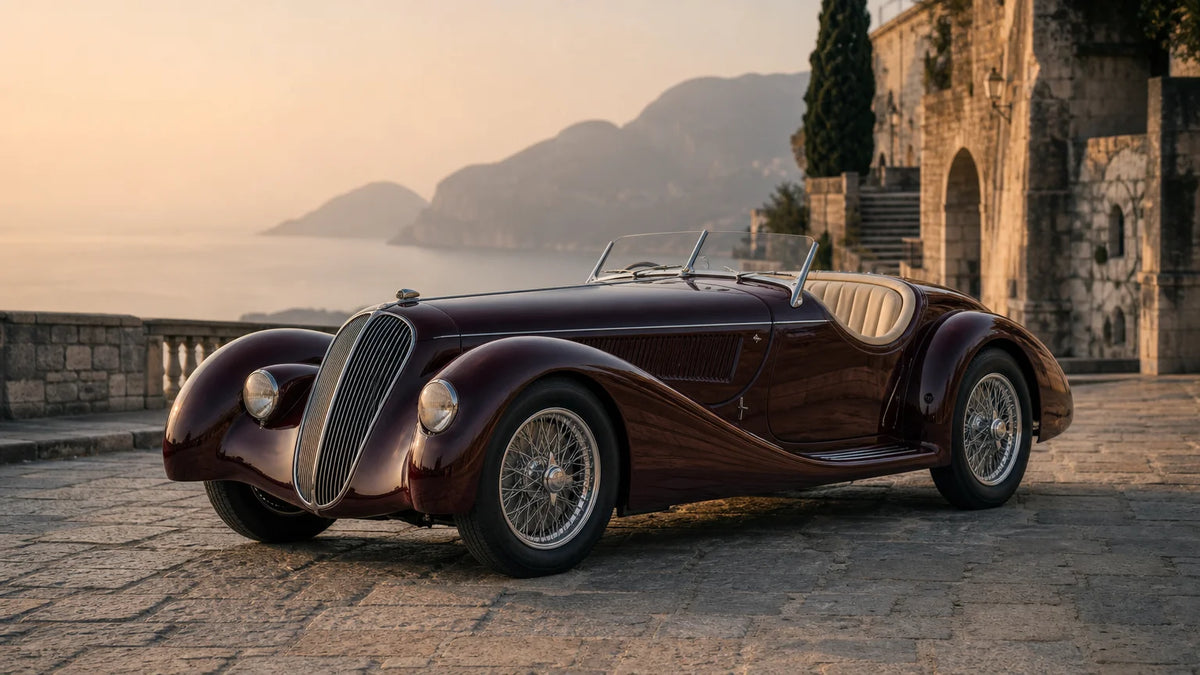
1939 Alfa Romeo 8C 2900B Lungo Spider Guide for Collectors
A pre-war roadster once crossed the $19.8 million threshold, yet its real significance is not the headline price. The 1939 Alfa Romeo 8C 2900B Lungo Spider joins racing-derived engineering, hand-built Italian coachwork, and an ownership history that must be read as carefully as a work of art. Within our view of classic cars, it remains a defining study in how design, scarcity, and usability can converge.
Built in the late 1930s, the Lungo variant was the longer-wheelbase expression of Alfa Romeo’s 2.9-liter 8C platform. Contemporary accounts describe about 32 2.9 chassis, 12 Touring Spiders, and seven long-chassis bodies, figures that should be treated as production and survival estimates rather than a simple inventory. A period profile also records the car’s 180 bhp and roughly 110 mph capability. The result was unusually fast for 1939, yet sufficiently refined for long-distance touring.
Why does the 8C 2900B Lungo Spider still matter?
The answer begins with its position in Alfa Romeo’s engineering history. The 8C name came from an advanced straight-eight engine developed under Vittorio Jano, whose work connected Alfa Romeo’s road cars with its Grand Prix and endurance-racing programs. The 8C 2900B was not simply a luxury roadster with sporting styling. It brought competition thinking into a usable open car.
That distinction explains the model’s enduring importance. The car combined speed, lightness, mechanical sophistication, and coachbuilt elegance at a time when those qualities rarely appeared together. Its long chassis added visual balance and greater touring practicality, while the Spider body preserved the sense of occasion expected from an Italian grand tourer.
The Lungo is also significant because it reflects the pre-war coachbuilding system. Buyers could acquire a rolling chassis and commission a body from an independent specialist. The result was not a standardized product line, but a collection of individual cars shaped by chassis specification, body number, customer preference, and later restoration decisions.
What made its engineering so advanced for 1939?
For a 1939 road car, the specification was extraordinary. The 8C 2900B used a 2,905 cc alloy straight-eight with dual overhead camshafts and twin Roots superchargers. Road-going tune was generally described at about 180 bhp, while competition versions could produce considerably more.
- Engine: 2,905 cc supercharged inline eight-cylinder unit.
- Valve train: Gear-driven dual overhead camshafts.
- Transmission: Four-speed manual transaxle mounted at the rear.
- Front suspension: Independent trailing arms with coil springs and hydraulic dampers.
- Rear suspension: Swing axles, radius arms, and a transverse leaf spring.
- Braking: Four-wheel hydraulic drum brakes, often with finned alloy drums.
- Wheelbase: Approximately 118.1 inches for the Lungo chassis.
The rear transaxle helped distribute weight and improved the car’s balance. Independent suspension at both ends was equally important, because it allowed the chassis to exploit the engine’s performance on uneven roads. These solutions were not decorative engineering. They addressed the practical demands of high-speed touring and competition driving.
The engine’s twin superchargers delivered strong acceleration for the period, but the car’s appeal was broader than power. Its compact straight-eight layout, alloy construction, sophisticated crankcase design, and rear-mounted transmission made it technically coherent. Every major system supported the same objective, combining high performance with control and long-distance usability.
How did Touring coachwork define the car’s identity?
Mechanical specification explains why the 8C 2900B was important. The body explains why the Lungo Spider became unforgettable. Carrozzeria Touring of Milan developed elegant open coachwork using its patented Superleggera coachwork method, which combined a lightweight tubular framework with thin aluminum panels.
The design is immediately recognizable through its long bonnet, steeply inclined windscreen, flowing front wings, narrow cabin, and carefully tapered rear body. The proportions are not merely decorative. They communicate the location of the engine, the length of the chassis, and the car’s intended ability to cover distance at speed.
Because the bodies were assembled by hand, small details matter. Panel fit, body numbers, fastener patterns, dashboard construction, trim materials, and the relationship between the coachwork and the frame can all help establish identity. For a collector, originality is therefore not limited to the engine or chassis plate.
Our editorial perspective on Italian luxury cars considers this relationship between engineering and form essential. The 8C 2900B shows how a machine can become culturally important when its performance architecture and visual language are developed as one coherent object.
What should collectors verify before considering one?
A surviving 8C 2900B should be approached as a forensic research project. Rarity can make assumptions expensive, especially when a car has passed through competition use, rebodying, major restoration, or incomplete documentation.

- Provenance chain: Establish ownership, location, competition use, export history, and restoration chronology.
- Chassis identity: Confirm the frame number, factory records, structural repairs, and any changes to the wheelbase.
- Coachwork identity: Review body numbers, panel markings, construction details, and evidence connecting the body to the chassis.
- Mechanical integrity: Inspect the engine, superchargers, transaxle, suspension, brakes, and steering through specialists familiar with the model.
- Restoration dossier: Request invoices, photographs, technical reports, parts records, and details of who completed the work.
- Usability: Determine whether the car is suitable for touring, concours presentation, occasional demonstrations, or static display.
Matching numbers are valuable, but they are not the only measure of authenticity. Some cars survived because they were modified for racing, rebodied, or separated into components. A credible history should explain those changes rather than conceal them.
The quality of restoration also requires careful judgment. A visually perfect car may still have weak mechanical documentation, while a historically complex example may possess unusually strong original components. Collectors should evaluate the complete evidence package instead of relying on appearance or a single expert opinion.
What does the market reveal about rarity and value?
The market treats the 8C 2900B Lungo Spider as a high-value historic object, but individual results vary considerably. A 1939 example achieved $19.8 million at a 2016 Monterey sale, a result documented in a 2016 auction report. That figure reflects an exceptional combination of rarity, presentation, provenance, restoration, and collector demand at that time.
It should not be used as a universal price guide. Chassis identity, coachwork originality, restoration quality, concours history, mechanical readiness, and the credibility of the documentation can shift the value of one 8C 2900B dramatically. The most meaningful comparison is between cars with similar specifications and similarly complete histories.
Availability is also a major consideration. As of September 2026, the public market page for the Alfa Romeo 8C 2900 shows no examples currently listed for sale, according to a September 2026 market snapshot. That does not mean private opportunities do not exist. It does mean that a serious acquisition usually depends on relationships, patience, and discreet sourcing rather than ordinary online inventory.
For collectors, the market lesson is simple. A headline price can confirm the model’s importance, but it cannot replace a vehicle-specific assessment. The strongest acquisition case is built from rarity and evidence together.
How should an international collector approach acquisition?
The first step is to define the intended role of the car. A collector seeking a concours centerpiece will prioritize originality, presentation, awards, and historical consistency. Someone planning long-distance touring will place greater weight on mechanical preparation, cooling, braking, usability, and access to specialist support.
The second step is to build an independent advisory group. This should include a marque historian, a restoration specialist, a legal or import adviser, and a transport provider experienced with high-value historic vehicles. Their roles should remain separate where possible, because independent opinions reduce the risk of relying on one incomplete assessment.
The third step is to inspect the car in person. Photographs rarely reveal chassis repairs, panel thickness, corrosion treatment, interior alterations, or the quality of mechanical assembly. A physical inspection should include cold starting, fluid checks, braking performance, steering response, gearbox operation, and evidence of overheating.
The fourth step is to review the transaction structure. Confirm title, export permissions, insurance arrangements, transport conditions, taxes, registration requirements, storage, and post-purchase servicing before committing funds. A rare car can become difficult to use if these practical matters are addressed too late.
Our editorial work on the Alfa Romeo 33 Stradale explores how historic Alfa Romeo ideas continue to influence modern design. That continuity is useful here, because the Lungo Spider should be understood as both a historic automobile and a reference point for enduring Italian mobility culture.
What is the lasting lesson of the Lungo Spider?
The 1939 Alfa Romeo 8C 2900B Lungo Spider demonstrates that collectability is never created by scarcity alone. Its importance comes from the alignment of advanced engineering, racing lineage, exceptional coachwork, limited production, and a history that still rewards careful investigation.
For a prospective owner, the correct approach is measured rather than impulsive. Establish the car’s identity, understand its mechanical condition, test the strength of its documentation, and decide whether its character suits your intended use. A rare automobile becomes truly valuable when its story, structure, and experience remain convincing together.
A collector’s perspective on the 1939 8C 2900B
The 1939 Alfa Romeo 8C 2900B Lungo Spider belongs to a rare category of machines that unite engineering achievement with artistic presence. Its appeal is strongest when rarity is supported by provenance, coachwork identity, mechanical integrity, and a restoration record that respects the car’s history. For collectors, those qualities should guide every stage of evaluation, from the first enquiry to long-term ownership.
Take action with TheArsenale
Finding a historically significant automobile requires more than browsing a public listing. It demands informed curation, discreet access, and a clear understanding of the machine’s character, provenance, and practical requirements. For collectors searching internationally, the right conversation can be as important as the car itself.

We connect collectors with rare and future-oriented mobility objects through a curated international marketplace and personal sales assistance. Our team can help you explore classic and collector cars, clarify your priorities, and identify an acquisition path suited to your interests. We also provide access to a wider mobility ecosystem spanning automotive design, motorcycles, boats, aviation, and other exceptional machines.
Frequently Asked Questions
What is the Alfa Romeo 8C 2900B Lungo Spider?
It is the long-wheelbase road-going version of Alfa Romeo’s 2.9-liter 8C platform, fitted with elegant Touring Spider coachwork. The car combined a supercharged straight-eight engine with advanced suspension and high-speed touring ability.
How rare is the 8C 2900B Lungo Spider?
Historical production accounts commonly identify about 32 2.9 chassis, with a much smaller number receiving Touring Spider bodies on the Lungo chassis. Exact survivor counts vary because some cars were raced, rebodied, dismantled, or reconstructed.
What makes the car valuable to collectors?
Value depends on rarity, provenance, coachwork identity, mechanical originality, restoration quality, concours history, and usability. No single auction result can determine the value of every example.
Can an 8C 2900B be driven regularly?
A properly restored and maintained example can be used for selected touring events, but it requires specialist care and careful mechanical preparation. Owners must balance driving enjoyment with preservation, safety, and the availability of appropriate technical support.
How can TheArsenale help with a collector-car search?
We provide curated access to rare mobility objects and personal assistance for high-value acquisitions. Our international network can help collectors clarify requirements and explore suitable cars when public availability is limited.