1964 Ferrari 250 LM: Le Mans History, Specs and Value
Only 32 examples of the 1964 Ferrari 250 LM were produced, making every surviving chassis a distinct piece of Ferrari competition history. Its importance becomes even clearer when viewed alongside the wider 250 family, including our 1962 Ferrari 330 LM 250 GTO.
This is not simply a scarce classic Ferrari. It is a purpose-built endurance car with a mid-engine layout, a 3.3-liter V12 in most production examples, and a career shaped by the transition from front-engine GT cars to rear-engine prototypes. A current valuation reference also shows why condition, provenance, and specification matter more than a single model-wide price.
Why the 1964 Ferrari 250 LM remains significant
What made the 250 LM so important was its willingness to move Ferrari's established formula forward. Instead of placing its V12 ahead of the cockpit, Ferrari installed the engine behind the driver. The result was a compact endurance berlinetta with improved weight distribution, strong traction, and a body shaped around its competition layout.
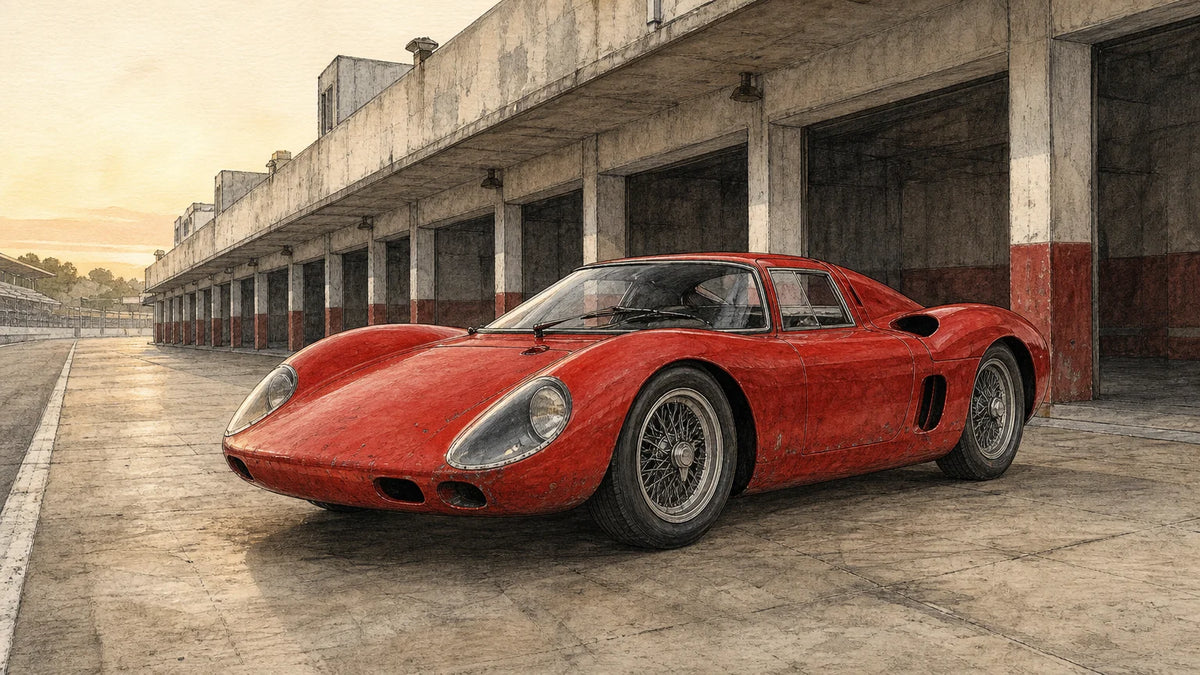
The model was introduced at the 1963 Paris Salon as a closed-roof evolution of the 250 P sports prototype. Pininfarina developed the overall form, while Scaglietti produced the lightweight alloy coachwork. The low roof, flying buttresses, covered headlights, and short overhangs gave the car a visual identity that was both elegant and unmistakably technical.
Ferrari intended the 250 LM to replace the 250 GTO in customer racing. The FIA did not accept it as a production-based GT because the car was too different mechanically and Ferrari did not build enough examples to satisfy the homologation requirement. It therefore competed primarily as a prototype, where it faced more powerful machinery.
That regulatory setback did not prevent the model from becoming a racing landmark. Its greatest achievement came at the 1965 24 Hours of Le Mans, when a North American Racing Team entry driven by Masten Gregory and Jochen Rindt won overall. The result delivered Ferrari its sixth consecutive Le Mans victory and established the 250 LM as one of the defining endurance cars of the 1960s.
Engineering that defined the LM
The 250 LM was not a conventional road car adapted for racing. Its tubular chassis, independent suspension, four-wheel disc brakes, rear-mounted powertrain, and lightweight body were designed around endurance competition. The cabin was sparse, the controls were direct, and the car placed mechanical function above comfort.
Most production cars used a 3,286 cc, 60-degree V12 with dry-sump lubrication and six Weber carburetors. Output is commonly listed at approximately 320 horsepower, delivered through a five-speed manual transmission. A specialist specification reference lists a claimed top speed of approximately 183 mph for the European racing configuration.
| Specification | 1964 Ferrari 250 LM |
|---|---|
| Configuration | Mid-engine, rear-wheel drive berlinetta |
| Engine | 3,286 cc naturally aspirated V12 in most production examples |
| Power | Approximately 320 horsepower |
| Transmission | Five-speed manual |
| Body construction | Lightweight alloy coachwork over a tubular steel chassis |
| Production | 32 examples |
| Primary purpose | Endurance racing and privateer competition |
The numbers explain only part of the experience. The driving position is deeply committed, visibility is limited by the low body, and the cabin can be demanding during long sessions. That uncompromising character is central to the car's appeal. It feels closer to a period prototype than to a refined grand touring Ferrari.
Our editorial coverage of the period also includes the 1961 Ferrari 250 GT SWB California Spyder, a useful contrast to the LM's competition-first philosophy. The California Spyder represents open-air road-going elegance, while the 250 LM prioritizes aerodynamic efficiency, endurance performance, and mechanical focus.
Le Mans provenance changes everything
For a collector, the phrase Le Mans provenance is meaningful only when it is attached to a specific chassis. The model's overall victory in 1965 gives every 250 LM historical importance, but a car that raced at Le Mans, Daytona, Spa, or another major event carries a different level of documentary interest.
The winning chassis, numbered 5893, was entered by NART and finished ahead of another 250 LM. Its result was particularly notable because the car defeated faster prototypes through reliability, consistency, and survival across a difficult 24-hour contest. The result also made the LM the last Ferrari V12 to win Le Mans overall before Ferrari returned to the top of the race in 2023.
Individual race records should be examined carefully. Period entries can involve replacement engines, transaxles, body modifications, altered liveries, and repairs after accidents. A long competition history may increase desirability, but only when the identity of the chassis remains clear and the changes are documented.
Competition history can also support later recognition. A 1964 250 LM received the 2024 Peninsula Classics Best of the Best Award, an honor that reflects the continued importance of the model within the collector-car world. The official award release identifies the Ferrari among the significant vehicles recognized by the program.
How to evaluate a specific chassis
Two cars carrying the same model designation can have very different collector profiles. A serious evaluation should begin with the chassis number, factory records, delivery history, and period competition evidence. Photographs alone are not enough to establish originality.
1. Confirm the identity
Begin with the chassis, engine, gearbox, body, and factory documentation. The most valuable examples usually have a coherent chain of ownership and records that explain any mechanical replacements, body repairs, or specification changes.
2. Separate originality from restoration quality
A fully restored car can be highly desirable, but restoration quality is not identical to originality. Examine whether the bodywork, engine, transaxle, suspension components, instruments, wheels, and interior details correspond to the documented history of that chassis.
3. Review Ferrari Classiche documentation
Where applicable, Ferrari Classiche certification can help confirm the relationship between a car's surviving components and factory records. It should be reviewed alongside period documents, not treated as a substitute for a complete historical file.
4. Assess demonstrated usability
A competition Ferrari may be judged at concours events, raced in historic meetings, displayed in a collection, or preserved as an artifact. Those uses create different priorities. A car intended for regular historic competition requires a careful review of cooling, braking, fuel systems, transmission condition, and preparation records.
5. Check the international purchase structure
Cross-border acquisitions require attention to export paperwork, temporary import arrangements, taxes, duties, title status, transportation, and local registration. These factors can materially affect the final cost and timeline, even when the purchase price is already agreed.
Our marketplace helps collectors explore rare and high-value mobility objects and obtain sales-team support for acquisition questions. That service is relevant when a collector needs a structured route to evaluate provenance, rarity, condition, and sourcing requirements, although availability of a specific 250 LM must always be confirmed separately.
What determines 250 LM value in 2026
There is no single value for every 1964 Ferrari 250 LM. In 2026, the strongest pricing factors remain chassis-specific rather than purely model-based. A documented Le Mans entry, a major period victory, original mechanical components, an undisturbed body, and respected certification can place one car in a very different category from another.
The market also distinguishes between a car with famous provenance and a car with attractive presentation. A concours restoration may deliver exceptional visual quality, while an unrestored or lightly used example may appeal more strongly to collectors who prioritize authenticity. The correct choice depends on whether your objective is display, historic competition, preservation, or long-term ownership.
Recent public interest in the model has reinforced that distinction. One highly significant example sold publicly in 2025 for €34.88 million, but that result reflected an exceptional combination of Le Mans history, NART identity, originality, documentation, and museum ownership. It should not be treated as a universal price for every 250 LM.
A more useful approach is to compare the candidate car with genuinely similar chassis. Consider period race entries, driver history, surviving components, restoration scope, certification, public presentation, and the quality of the documentary file. The model's rarity creates scarcity, but provenance determines how that scarcity is valued.
For context within Ferrari's evolving competition range, our archive also features the 1965 Ferrari 275 GTB. It belongs to the same broad period but represents a different balance between road use, grand touring, and competition potential.
Why sourcing requires patience
Only a small number of 250 LMs exist, and many are held in long-term collections. Public availability can therefore be irregular. A collector should be prepared to review opportunities individually rather than assume that a model-level search will produce a straightforward purchase.
Patience is especially important because a compelling car may not be the most visually perfect example. A car with a clear period record, correct surviving components, and transparent restoration history can be more compelling than one with a flawless presentation but incomplete documentation.
Private sourcing can also reveal information that is absent from a public listing. Factory correspondence, old race photographs, maintenance invoices, scrutineering papers, and previous expert reports may clarify the car's identity. Each document should be checked against the physical car and the chronology of its ownership.
The most responsible acquisition process combines historical research, technical inspection, legal review, transport planning, and independent advice. It should also leave room for questions that cannot be answered immediately. With a car as rare as the 250 LM, uncertainty is not a minor administrative issue. It is a central part of the decision.
A lasting reference in Ferrari competition history
The 1964 Ferrari 250 LM remains exceptional because it combines rarity, advanced architecture, elegant coachwork, and a decisive Le Mans victory. Its significance is strongest when the model's general history is connected to the exact identity, documentation, originality, and competition record of the individual chassis.
For collectors, the right evaluation is therefore neither purely emotional nor purely financial. It is a disciplined review of provenance, mechanical integrity, restoration quality, intended use, and international ownership requirements. Those criteria provide the clearest foundation for understanding what a 250 LM represents and whether a specific example deserves a place in your collection.
Bring Le Mans design into your collection
The 250 LM demonstrates how endurance racing can influence form, proportion, and mechanical expression. If that connection between motorsport history and collectible design speaks to your collection, our broader mobility universe provides a considered way to explore rare machines and racing-inspired objects.

For a tangible expression of that visual language, explore our Ferrari Le Mans hood. It offers a focused way to extend the atmosphere of Ferrari endurance racing into a display, styling, or collector environment.
Frequently Asked Questions
How many 1964 Ferrari 250 LM examples were built?
Ferrari produced 32 examples of the 250 LM across the model's short production run. Because each car developed its own history, chassis identity and provenance are essential when comparing examples.
Did the Ferrari 250 LM win Le Mans?
Yes, a NART-entered 250 LM won the 1965 24 Hours of Le Mans overall with Masten Gregory and Jochen Rindt. The victory remains the model's defining achievement.
Was the 250 LM a road car or a race car?
It was fundamentally a competition car, although some examples were used on the road or prepared for more practical ownership. Its sparse interior, demanding driving position, and race-focused engineering reflect its original purpose.
What should you check before acquiring one?
You should review the chassis identity, factory records, race history, matching components, restoration documentation, certification, current condition, and international import requirements. A specialist inspection should accompany the historical review.
Can TheArsenale help with a rare Ferrari acquisition?
Our marketplace supports the exploration and sourcing of rare, high-value mobility objects, with sales-team support for acquisition questions. Availability, pricing, delivery arrangements, and ownership terms for a specific Ferrari must be confirmed on an individual basis.