1968 Lamborghini Miura: History, Specs, and Collector Guide
What makes the 1968 Lamborghini Miura so important is not only its beauty. The car brought a transverse rear-mid-mounted V12, an exceptionally low silhouette, and road-going supercar performance into one coherent design. Its visual influence remains clear in the Miura artwork and in the continuing fascination surrounding rare Italian machines.
1968 is also a transition year. The original P400 remained central to the Miura story, while the more powerful P400 S appeared around the same period with greater comfort and revised mechanical details. Lamborghini’s official history records 763 Miuras built between 1966 and 1973, giving the model lasting significance in both automotive design and collector culture.
Why 1968 is a pivotal Miura model year
A 1968 Miura cannot always be identified correctly from its registration year alone. The year sits between the development of the original P400 and the arrival of the P400 S, so two cars registered or delivered in 1968 may represent different specifications.
The P400 is the purist version. It uses a 3.9-liter V12, a five-speed manual transaxle, and the original body treatment associated with Marcello Gandini’s work for Bertone. The P400 S added more power, revised suspension tuning, improved interior equipment, and additional comfort features.
This distinction matters because a car described simply as a “1968 Miura” may have been produced earlier, completed later, or updated during its life. Buyers should therefore examine the chassis number, engine number, factory documentation, delivery date, and original color combination before assigning a precise identity.
For readers studying the wider context, our editorial coverage of classic cars places the Miura within a broader history of collectible design, engineering, and cultural value.
Engineering that changed the supercar formula
The Miura’s defining technical decision was the placement of its V12 behind the passenger compartment and ahead of the rear axle. The engine was mounted transversely, a compact arrangement that shortened the wheelbase and helped create the car’s distinctive proportions.
The layout also created difficult engineering compromises. The engine, gearbox, and differential were closely integrated within a restricted rear compartment. This arrangement saved space, but it demanded careful maintenance and made the mechanical package unusually important to the car’s authenticity.
The Petersen Automotive Museum identifies the 1968 P400 as a 3.9-liter V12 car with 345 horsepower and a measured top speed of 171 mph. Its description also highlights the transverse mid-engine configuration as one of the features that helped establish the Miura as the first production car widely associated with the modern supercar.
The factory figures can vary slightly between period testing, later references, and individual cars. Lamborghini’s own historical material lists approximately 350 horsepower and a top speed near 280 km/h for the P400. These differences do not weaken the Miura’s significance, but they show why specifications should always be attached to a particular version and source.
Design, coachwork, and the Miura visual language
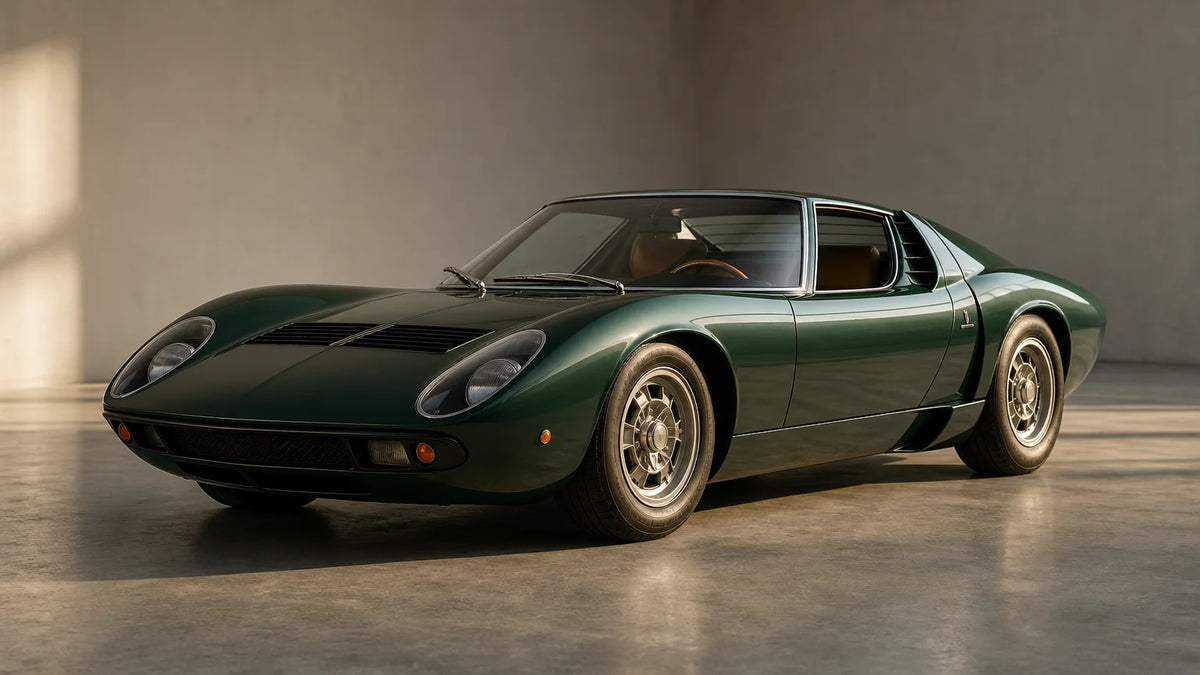
The Miura’s design works because every major surface supports the same idea. The nose is low, the glasshouse is compact, and the rear engine cover gives the car a strong visual focus without adding unnecessary mass.
Gandini’s body design for Bertone also introduced details that became central to the model’s identity. The clamshell front and rear sections expose the mechanical components, while the headlamp surrounds and delicate side treatments create a balance between aggression and elegance.
The car’s low stance was not merely decorative. It reflected the placement of the engine, the compact chassis, and the effort to keep the center of gravity close to the road. The result was a silhouette that looked closer to a racing prototype than to a conventional grand touring coupe.
Color and interior specification also influence the perception of a 1968 Miura. Period colors such as deep green, yellow, blue, and orange became closely associated with the model. However, repainting and retrimming were common over several decades, so appearance alone cannot establish originality.
1968 Lamborghini Miura specifications at a glance
The table below separates the main production versions. It also explains why the phrase “1968 Miura” requires more precision than a simple model-year label.
| Version | Period | Power | Defining characteristics |
|---|---|---|---|
| P400 | 1966 to 1969 | Approximately 350 hp | Original body, transverse 3.9-liter V12, purist specification |
| P400 S | 1968 to 1971 | Approximately 370 hp | More power, revised suspension, improved trim, additional comfort equipment |
| P400 SV | 1971 to 1973 | Approximately 385 hp | Wider rear track, revised suspension, greater performance, later separate lubrication systems |
Production totals also require care. Petersen’s museum record for a 1968 P400 lists 275 examples, while Lamborghini’s current historical account lists 265 P400 cars produced between 1966 and 1968. Such differences may reflect cataloging boundaries or production accounting, which is why the identity of an individual car should be established through documentation.
For a 1968 P400, period references commonly cite a top speed around 171 to 174 mph. The P400 S delivered more power and improved usability, but published acceleration and top-speed figures vary according to testing method, market specification, and vehicle condition.

How collectors should assess authenticity
With a rare car from the late 1960s, provenance is part of the specification. A strong presentation should connect the chassis number, body number, engine number, delivery record, restoration invoices, ownership history, and current mechanical configuration.
Matching numbers can strengthen a car’s appeal, but the phrase must be used precisely. It should identify which major components are original to the chassis, not imply that every component remains untouched. A period-correct replacement engine may be valuable, but it should not be described as the original engine.
Color history deserves the same level of attention. A repaint in the correct factory shade is not equivalent to untouched original paint. Conversely, an older restoration may be more usable than an unrestored example, depending on the quality of the work and the buyer’s objectives.
The Registro Italiano Miura maintains an archive of registered cars and owner-contributed information. Such registries can help researchers compare chassis details, historical photographs, and known configurations, although factory documents and specialist inspection remain essential.
A sensible inspection should include the steel chassis, body alignment, engine and gearbox condition, carburetor operation, cooling system, suspension, brakes, wiring, and evidence of corrosion. The Miura’s beauty can make visual judgment tempting, but a professional mechanical inspection protects against expensive surprises.
When your search extends beyond one listing, our rare machines for sale editorial offers a useful starting point for evaluating unusual mobility objects through rarity, provenance, design, and engineering.
Why the Miura still matters in 2026
The Miura remains relevant because it changed expectations rather than merely improving an existing formula. It made the mid-engine layout visually desirable, technically aspirational, and commercially meaningful for road cars.
Its influence also extends beyond performance figures. The car connected industrial design, mechanical packaging, luxury, and popular culture in a way that few earlier road cars had achieved. That combination explains why collectors continue to value original specification, documented history, and correct restoration choices.
In 2026, Lamborghini is marking the Miura’s 60th anniversary with the “Born Incomparable” exhibition at its museum in Sant’Agata Bolognese. The exhibition includes historically significant Miura examples and references the 1968 Roadster, showing that the model remains an active part of the marque’s cultural identity rather than a forgotten historical footnote.
For collectors, the most durable approach is to treat the Miura as both an engineered object and a historical document. Performance matters, but so do production context, design integrity, mechanical originality, and the quality of the evidence supporting each claim.
What the 1968 Lamborghini Miura still teaches collectors
The 1968 Lamborghini Miura represents the moment when advanced engineering and expressive design became inseparable in a road-going supercar. Its transverse V12, low body, limited production, and complex history make careful identification essential. The strongest examples are not simply the most attractive. They are the cars whose specifications, provenance, restoration, and mechanical condition can be explained clearly and supported by evidence.
Explore Miura-inspired design
The Miura’s lasting appeal comes from its proportions, color, and mechanical drama. If those qualities speak to your collection or interior, our design-led mobility universe offers a considered way to bring that visual language into a contemporary setting.

Explore our 1968 Lamborghini Miura-inspired design and discover an object shaped by the same fascination with rare machines, bold surfaces, and expressive automotive culture.
Frequently Asked Questions
What is a 1968 Lamborghini Miura?
It is a Miura built or delivered during the transition between the original P400 and the P400 S. The exact version must be confirmed through chassis records and factory specifications.
Was every 1968 Miura a P400 S?
No. 1968 includes late P400 cars and the introduction of the P400 S. Registration year, delivery date, and production date may not identify the variant by themselves.
How many 1968 Miuras were built?
No single number should be assigned without defining the version and accounting method. Published historical totals differ, so collectors should focus on the documented identity of the individual car.
What should you verify before buying one?
Verify the chassis and engine numbers, factory or delivery records, color history, restoration documentation, ownership history, and current mechanical condition. A specialist inspection is advisable before any purchase decision.
Can TheArsenale help with a rare Miura search?
We help collectors explore rare and design-led mobility objects through our marketplace and sales network. Availability of a specific 1968 Miura must be confirmed directly with our team, since inventory and sourcing opportunities can change.