How to Choose a BMX: A Complete Buyer’s Guide for 2026
A BMX is not a universally sized machine. A race bike built for explosive acceleration will feel very different from a freestyle bike designed for ramps, street features, or repeated landings. If you are learning how to choose a BMX, begin with your intended riding environment rather than the paintwork or the lowest price. For a structured starting point, our BMX buying guide provides a useful foundation for comparing the main decisions.
The category remains active across different rider profiles. In March 2026, a participation series covered BMX activity in the United States from 2011 through 2025, using weighted survey data for people aged six and older. That breadth matters because a child learning basic control, an adult returning to BMX, and a committed racer need different geometry and equipment.
How to choose a BMX by riding discipline
Ask yourself one question first: what do you want the bike to do most often? BMX categories overlap, but their priorities do not. Choosing the wrong discipline can leave you with a bike that feels uncomfortable, inefficient, or unnecessarily fragile.
| Riding discipline | Primary priority | Typical features |
|---|---|---|
| Race | Acceleration and stability | Light frame, race geometry, efficient tires, powerful rear brake |
| Park | Air tricks and transitions | Responsive handling, durable frame, compact rear end, optional detangler |
| Street | Technical tricks and grinding | Strong wheels, pegs, hub guards, maneuverable geometry |
| Flatland | Balance and low-speed control | Shorter geometry, freecoaster hub, four pegs, responsive fork |
| Dirt jump | Stability and controlled landings | Longer geometry, grippy tires, robust wheels, dependable braking |
Race BMX prioritizes speed over versatility. The frame is generally lighter and stiffer, while the geometry supports fast starts, precise lines, and high-speed cornering. Race bikes are not the natural choice for grinding, repeated concrete impacts, or technical street riding.
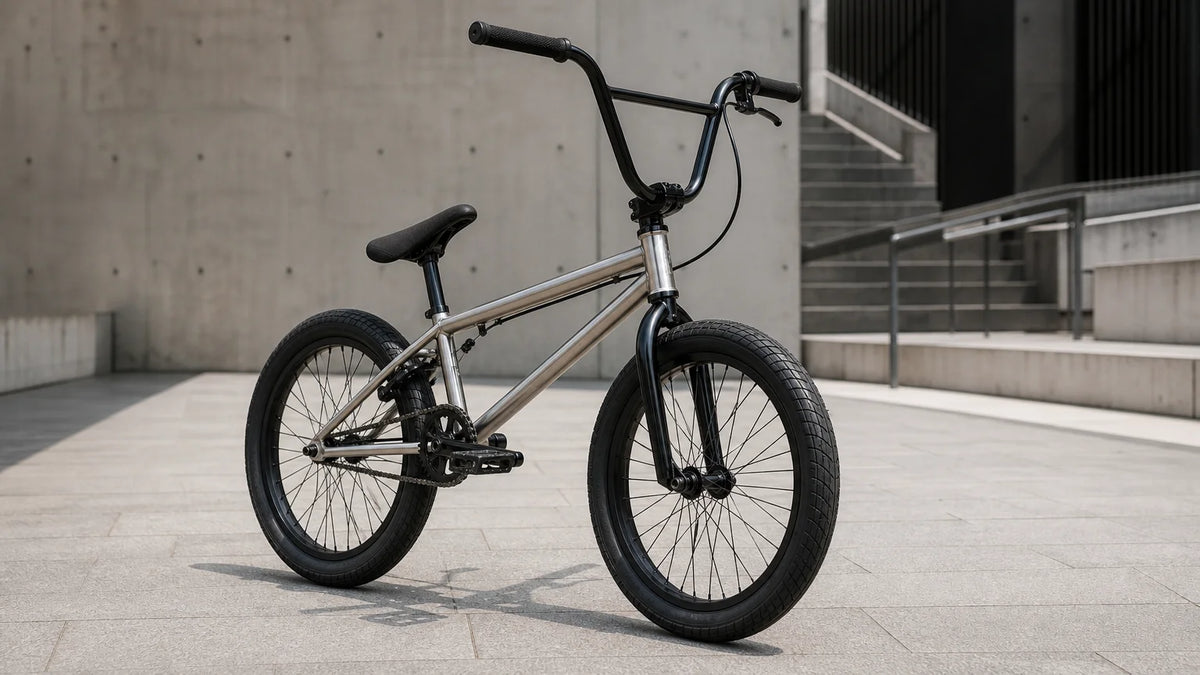
Freestyle BMX covers park, street, dirt, and flatland riding. A versatile freestyle bike is usually the most sensible starting point when you are still discovering your preferred style. Park riders often value stability through transitions, street riders prefer quick responses around obstacles, and flatland riders need specialized geometry that keeps the bike balanced during slow spins and pivots.
If you are unsure which direction to take, begin with a durable all-around freestyle setup. Our overview of the best BMX bikes can help you compare designs according to purpose, construction, and riding character rather than appearance alone.
Match wheel size and top tube length to your body
Most adult freestyle BMX bikes use 20-inch wheels. That diameter keeps the bike agile and easy to move beneath the rider during hops, spins, and aerial tricks. Smaller riders may need 12-inch, 14-inch, 16-inch, or 18-inch wheels, while taller riders who prioritize comfort may consider 22-inch or 24-inch options.
Wheel diameter is only the first measurement. The more important fit variable on a standard freestyle BMX is top tube length, measured from the head tube toward the seat tube. A shorter top tube can make the bike feel quicker and more playful. A longer top tube generally gives taller riders more room and can feel more stable during jumps.
| Rider height | Common starting point | Typical top tube guidance |
|---|---|---|
| Up to approximately 150 cm | 16-inch to 18-inch wheels | Scaled youth geometry |
| 145 cm to 160 cm | 20-inch wheels | Approximately 19.5 to 20.25 inches |
| 160 cm to 175 cm | 20-inch wheels | Approximately 20.25 to 20.75 inches |
| 175 cm to 183 cm | 20-inch wheels | Approximately 20.75 to 21 inches |
| Above 183 cm | 20-inch, 22-inch, or 24-inch options | Often 21 inches or longer for freestyle |
These ranges are starting points, not fixed rules. Your riding discipline, arm length, inseam, flexibility, and personal preference also affect the correct fit. A dedicated flatland rider may prefer a shorter frame than a street or park rider of the same height, while a tall casual rider may prefer larger wheels for smoother cruising.
When possible, stand over the bike and check that you can move naturally without your knees contacting the bars. The bike should feel balanced when you lift the front wheel, not cramped or difficult to control. A short test ride is more informative than choosing by age or wheel diameter alone.

Inspect the frame material and core components
The frame material influences weight, durability, comfort, and price. Entry-level bikes commonly use high-tensile steel, which can be suitable for gentle riding but is usually heavier. Many serious freestyle bikes use chromoly steel, a strong alloy that offers a useful balance between resilience and weight.
Race bikes often use aluminum because low weight and stiffness support acceleration. Carbon fiber also appears in advanced racing equipment, although it is less common in general-purpose freestyle BMX. The correct material depends on impact demands, riding frequency, rider weight, and performance expectations.
Look beyond the frame name. A good BMX should have components that can withstand the forces created by landings, grinding, and repeated acceleration. Prioritize the following details:
- Sealed bearings in the hubs, headset, and bottom bracket, because they generally need less maintenance than exposed bearings.
- Two-piece or three-piece cranks, which are typically more robust than basic one-piece cranks.
- A MID bottom bracket on freestyle builds, which can make future crank upgrades simpler.
- A cassette hub with a practical driver, especially if you expect to change gearing later.
- Double-wall rims and an appropriate spoke count for the impacts your riding will create.
For a deeper look at premium materials, bearings, and upgradeable construction, our premium BMX buying guide offers a useful reference. The main principle is simple: pay for structural quality and serviceable components before paying for decorative details.
Decide between a complete BMX and a custom build
For most first-time riders, a complete BMX is the practical choice. The frame, fork, wheels, drivetrain, brakes, and cockpit are selected to work together, and the initial cost is usually easier to control. A complete bike also lets you learn your preferences before investing in specialized parts.
A custom build makes more sense when you already understand your riding position and component preferences. You may want a particular top tube length, crank size, gearing arrangement, hub configuration, handlebar rise, or brake setup. Customization is valuable when each part solves a known requirement, not simply because a longer list of components appears more advanced.
Before buying a complete bike, check whether its key standards allow upgrades. Confirm the crank interface, bottom bracket type, hub spacing, axle size, headset format, brake mounts, and tire clearance. A low initial price can become expensive if the frame does not support the parts you are likely to need later.
For younger riders, avoid buying a bike that is too large simply to extend its useful life. Poor fit can make learning harder and reduce confidence. A correctly sized youth BMX is generally a better foundation than an oversized adult model.
Build the budget around durability and total ownership cost
Your budget should cover more than the bicycle itself. Include a helmet, gloves, suitable pedals, basic tools, replacement tubes, maintenance, and possible upgrades. It is usually better to buy a sound frame and dependable wheels than to spend heavily on visual accessories while compromising structural parts.
The 2025 PAC reports separate BMX participation from other cycling categories and include demographic information and recent purchasing topics across a six-year period from 2018 through 2024. That distinction reinforces an important buying principle: BMX riders do not form one uniform group, so the right budget depends on age, discipline, frequency, and progression.
For occasional cruising, a straightforward complete bike may provide everything you need. For regular park, street, or dirt sessions, spend more on the frame, wheels, cranks, hubs, and bearings. For racing, prioritize weight, stiffness, geometry, and equipment that supports repeatable starts and controlled speed.
Also consider the cost of replacing parts. Tires and grips are normal wear items. Wheels, cranks, hubs, and frames are more significant expenses. A bike with widely supported standards and upgradeable components can remain useful for longer than a cheaper model that forces a full replacement when one major part fails.
Check brakes, hubs, gearing, tires, and pegs
Small components can change how the BMX feels. They also reveal whether the bike was designed for a specific discipline or assembled as a general recreational product.
- Brakes: Race bikes commonly use a powerful rear brake. Freestyle bikes may use a rear U-brake, a detangler, or no brake, depending on the discipline and rider preference.
- Hubs: Cassette hubs are versatile and serviceable. Freecoaster hubs allow backward movement without forcing the cranks to rotate, which is useful for certain street and flatland techniques.
- Gearing: Freestyle bikes commonly use a compact chainring and rear driver for quick acceleration and better clearance. Race bikes generally use gearing that supports stronger top-end speed and gate starts.
- Tires: Smooth or lightly treaded tires suit many street and park surfaces. Dirt riding usually benefits from more tread and a pressure choice that improves grip.
- Pegs: Pegs support grinds and flatland tricks but add weight and are not appropriate for every riding discipline. They are generally not used on race bikes.
- Handlebars and cranks: Taller bars can provide leverage for manuals and hops, while crank length affects clearance, leverage, and comfort.
Do not assume that more equipment is always better. A detangler is useful if you plan bar spins. A freecoaster is valuable for specific backward-riding techniques. Pegs are worthwhile when grinding or flatland is part of your plan. Otherwise, each added component can increase cost and maintenance without improving your actual riding.
Finish with a test ride, safety check, and support review
Before you commit, inspect the bike in person if possible. Check that the wheels run true, the headset turns smoothly, the crank has no side play, the chain moves cleanly, and the brakes engage consistently. Look closely at welds, axle hardware, tire condition, and bearing movement.
A scoping review that examined BMX injury research through June 2023 found that reported injury rates varied substantially by event and method. It reported figures of 22.2 injuries per 100 athletes in one freestyle study and 27.1 per 100 athletes in one racing study, while also noting that the evidence was heterogeneous. The review is available through the medical literature, and its main lesson is practical: equipment choice should be paired with appropriate protective habits.
Wear a properly fitted helmet for every session. Gloves can improve grip and protect your hands, while knee, elbow, shin, or full-face protection may be appropriate for aggressive riding or racing. Learn the rules of your local track or park, and replace damaged equipment rather than continuing to ride it.
Finally, review assembly, warranty, returns, spare parts, and after-sales support before purchase. If you buy online, confirm whether the bike arrives assembled and adjusted. If it arrives partially assembled, have a qualified bicycle mechanic complete the setup, especially when brake alignment, headset tension, or wheel installation is involved.
Choose the BMX that fits your next year of riding
The most reliable way to choose a BMX is to work in order: define the discipline, select the correct wheel and top tube size, inspect the frame and components, then compare ownership cost and support. A versatile complete freestyle bike is often the right starting point, while racers and experienced riders may need more specialized geometry. Focus on fit, durability, and upgrade potential rather than appearance alone. The best choice is the bike that supports how you intend to ride now and gives you room to progress.
Take action with TheArsenale
Once you understand your riding discipline, fit, and component priorities, the next step is to review machines that match your standards. TheArsenale brings together curated mobility objects for collectors and enthusiasts who value design, engineering, rarity, and distinctive riding experiences.

Explore our curated bicycle collection to see available options, then contact our team if you require guidance on specifications, sourcing, or a high-value acquisition. Our marketplace and sales assistance are designed to make the search more considered, from the first selection to the final decision.
Frequently Asked Questions
What is the best BMX bike for a beginner?
A durable complete freestyle BMX is usually the most practical starting point because it offers a balanced setup and leaves room for later upgrades. Choose a model that fits your height and supports the type of riding you expect to try first.
Should adults choose a 20-inch BMX?
Most adult freestyle riders use 20-inch wheels because they remain agile and responsive for tricks. Taller riders who prioritize cruising comfort may consider 22-inch or 24-inch options, but top tube length remains essential.
Is chromoly worth the extra cost?
Chromoly can be worthwhile for frequent freestyle riding because it offers a strong balance of resilience and weight. If you expect regular jumps, grinds, or hard landings, prioritize chromoly and durable components over cosmetic upgrades.
Is a complete BMX better than a custom build?
A complete BMX is generally better for beginners because the parts are selected to work together and the initial cost is easier to manage. A custom build becomes more valuable when you already know your preferred geometry, gearing, hubs, cranks, and cockpit setup.
Can I buy a distinctive BMX through TheArsenale?
Yes, our BMX bikes for sale page provides a starting point for reviewing distinctive mobility objects. Contact our team for product-specific information, sourcing questions, and guidance on available specifications.