Sea Scooter Buying Guide: Choose the Right Model in 2026
A sea scooter should make your time on the water easier, more controlled, and more enjoyable. The wrong model can create unnecessary weight, short runtime, difficult handling, or battery complications before you even reach the water. If you are assessing a premium machine, our guide on how to choose a diving scooter provides a useful starting point for matching performance to your intended use.
The phrase sea scooter buying guide covers several different products, from compact recreational devices for snorkeling to more capable diver propulsion vehicles for scuba use. Your decision should begin with the experience you want, then move through performance, battery, safety, transport, and service requirements.
Start with the water experience you want
Where will you use the scooter most often? A pool, calm lake, coastal reef, open ocean, or deeper dive site creates different demands. A first-time snorkeler usually benefits from low weight, simple controls, gentle acceleration, and positive or near-neutral buoyancy. A scuba diver may need more thrust, a stronger depth margin, a reliable tow position, and battery capacity for a planned return route.
Consider who will use the device as well. A shared family scooter should be easy to release, retrieve, and operate at a low speed. An underwater photographer may value smooth power delivery and a camera mount more than maximum speed. A frequent traveler will usually prioritize a compact body, manageable carry weight, removable batteries, and clear transport documentation.
A July 2026 2026 buyer guide makes the same practical point: the best model depends on the environment, user, route, and handling requirements. For snorkeling-specific considerations, our editorial resource on the best sea scooters for snorkeling can help you define the experience before comparing specifications.
- Pool or family use: prioritize guarded propulsion, gentle starts, simple controls, and low weight.
- Snorkeling: look for easy maneuverability, comfortable cruising, positive buoyancy, and enough runtime for the return journey.
- Recreational scuba: check depth rating, tow position, trim, thrust, and service support.
- Photography: favor stable low-speed control, camera compatibility, and predictable stopping.
- Travel: confirm the complete carry weight, battery watt-hours, charger size, and airline requirements.

Compare speed, thrust, and control together
Top speed is easy to notice, but it is rarely the most useful buying criterion. A scooter that accelerates aggressively may be tiring to hold and difficult to control near swimmers, reefs, rocks, or marine life. A lower cruising speed with smooth power delivery can produce a better experience across a wider range of conditions.
Look for several power settings and ask how the controls behave when you release the trigger. The motor should stop or reduce power predictably. Controls should remain reachable while you are wearing gloves or holding a camera. The grip should keep your wrists comfortable, and the scooter should not force you into an unstable body position.
Thrust describes the force available to pull you through the water. More thrust can help with currents, larger users, or additional equipment, but it also increases grip load and can make a mistake more consequential. Choose enough power for your normal conditions, then prioritize smooth low-speed behavior and a controlled stop.
When comparing specifications, check whether thrust is described as peak or continuous, and whether it was measured under static conditions or while moving. These details affect how a scooter feels in real use. A useful model is not necessarily the one with the largest number, but the one that provides usable power across the speeds you can control.
Read battery, runtime, and charging claims carefully
Battery capacity is one of the most important parts of a sea scooter buying decision. Watt-hours can help you compare energy capacity, but they do not tell you exactly how long the scooter will run in your conditions. Speed setting, rider weight, equipment, current, water temperature, and repeated acceleration all affect consumption.
Treat an advertised runtime as a reference point rather than a route promise. Ask whether the figure applies to the lowest power mode, intermittent use, or continuous operation. You should also check whether the display shows a percentage, several battery bars, or only a low-charge warning.
A May 2026 buyer resource recommends checking the battery watt-hour rating before travel because airline policies can vary. Its travel guidance is especially relevant when a compact scooter has a larger optional battery that changes the transport requirements.
Build your route around a conservative reserve. Estimate the time required to reach the farthest point, account for the return journey against a possible current, and allow additional capacity for delays. Never plan to use the full published runtime, particularly when you are unfamiliar with the water or the device.
Charging convenience also affects ownership. Check the full charge time, charger dimensions, voltage compatibility, battery replacement process, and availability of spare batteries. For frequent use, a removable battery can be more practical than a permanently installed pack, provided the manufacturer gives clear instructions for removal, storage, and inspection.
For readers comparing premium machines, our page covering electric sea scooters for sale offers a more focused route into this category. The key is to compare the complete battery system, not only the headline runtime.
Treat depth, buoyancy, and safety as one system
A depth rating is a housing limit, not a target for your next outing. Select a rating that exceeds your planned operating depth, but remain within your training, experience, visibility, breathing plan, and local conditions. A recreational scooter is not automatically suitable for technical diving simply because its housing carries a high number.
Buoyancy affects both control and recovery. A positively buoyant scooter is easier to retrieve if released near the surface. A negatively buoyant model may descend when dropped, which creates a greater recovery concern. Neutral behavior can be useful for scuba, but the result may change between fresh and saltwater environments.
Check how the scooter behaves with the battery installed, with accessories attached, and in the water where you intend to use it. Avoid improvised weights or unapproved modifications. A camera mount, tow attachment, or buoyancy sleeve can alter trim and handling.
Essential safety features include guarded propulsion, a trigger or control that returns to off, a safety lock, and an emergency shutoff method. Keep hair, straps, loose clothing, and equipment clear of the intake and propulsion area. A lanyard may help with recovery when the manufacturer approves it for the intended activity.
Before entering the water, inspect the housing, seals, propeller area, controls, battery condition, and charge level. Practice starting, stopping, turning, releasing, and recovering the scooter in calm, shallow water. Scuba users should follow appropriate DPV training and team procedures before using a scooter on deeper or more complex dives.
Calculate portability, service, and total ownership cost
A scooter that is difficult to carry may stay at home more often than you expect. Measure the complete travel system, including the device, battery, charger, case, handles, mounts, tools, and spare parts. Consider how you will move it from a vehicle to the shore while carrying your mask, fins, exposure protection, and other equipment.
Air travel requires additional planning. Confirm the exact watt-hour rating printed on the battery, the rules of every airline on your itinerary, and whether spare batteries must travel in cabin baggage. A scooter described as travel-friendly is not automatically accepted by every carrier.
Serviceability can matter more than a low purchase price. Before buying, confirm whether replacement batteries, seals, guards, propellers, chargers, and covers are available in your region. Check the warranty terms, service locations, expected inspection intervals, and the procedure for water intrusion or battery damage.
A 2026 specialist review illustrates why runtime comparisons are more useful when they are measured at each speed setting rather than taken from one maximum claim. Its test methodology reinforces a broader lesson: performance should be judged in relation to the conditions and power mode that produced it.
Price is only the first ownership figure. Include replacement batteries, transport cases, chargers, mounts, maintenance materials, shipping, and possible service costs. Our article on how much does a sea scooter cost can help you frame the purchase as a complete ownership decision rather than a single checkout price.

For buyers seeking a more distinctive mobility object, we bring together rare and future-oriented machines through a curated network of more than 250 builders, designers, and brands. Our sales team also supports high-value acquisitions, although the right technical specifications, fulfillment terms, service arrangements, and local operating requirements should always be confirmed for the specific machine.
Make the specification serve your route
The best sea scooter is the one you can control comfortably, transport realistically, maintain properly, and operate with enough battery reserve for the complete outing. Define your water activity first, then compare speed, thrust, runtime, depth, buoyancy, safety, service, and total cost as one connected system. A measured choice will usually deliver more value than a faster model that exceeds your practical needs.
Explore a Premium Sea Scooter
If your search has moved beyond basic recreation toward a premium personal watercraft, your priorities may include design, engineering, performance, and a more distinctive ownership experience.

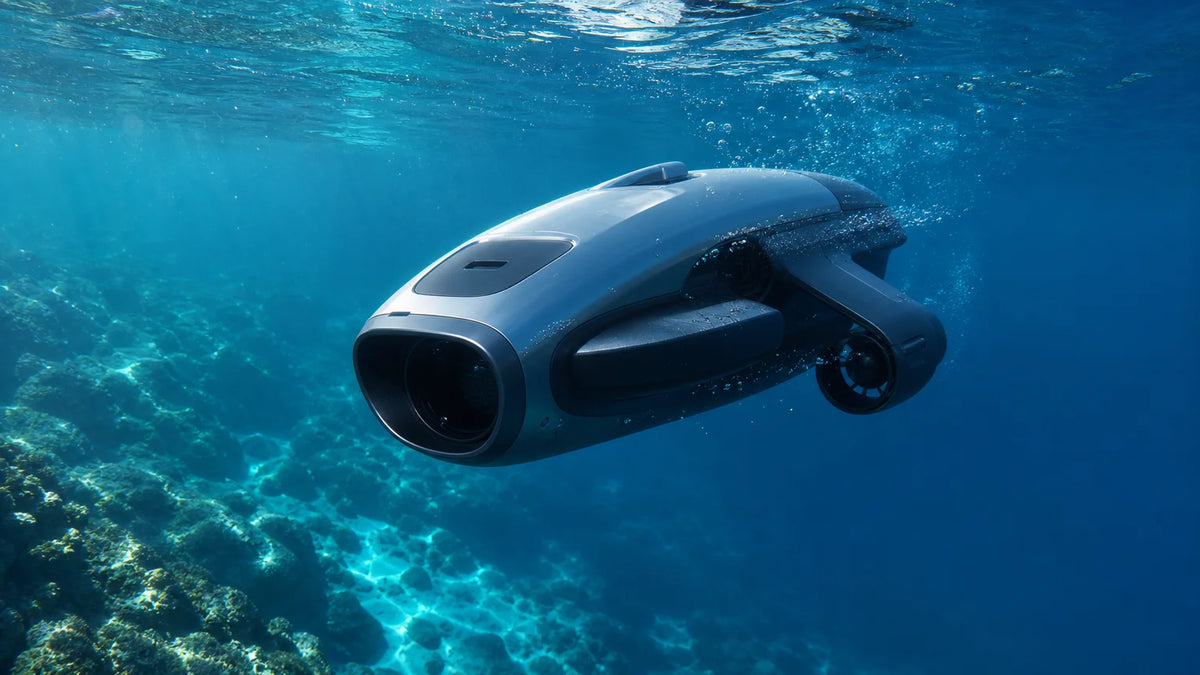
We curate future-oriented mobility objects for collectors and enthusiasts worldwide. Explore the SEABOB F9 sea scooter as a premium option, then confirm the model’s specifications, operating conditions, delivery arrangements, and local requirements before purchase.
Frequently Asked Questions
What is the most important feature in a sea scooter?
Controllability is usually more important than maximum speed. Choose a model with smooth acceleration, several power settings, reachable controls, and enough thrust for your normal environment.
How much runtime should a sea scooter have?
It should cover the planned route, the return journey, and a conservative reserve in the power mode you expect to use. Do not plan an outing around the longest low-speed runtime stated by the manufacturer.
Can you use a sea scooter for snorkeling and scuba diving?
Some models support both activities, but the manufacturer’s depth rating and approved use must match your equipment and training. A recreational snorkeling scooter should not be treated as a technical DPV without suitable specifications and instruction.
What should you check before taking a sea scooter on a plane?
Check the battery’s exact watt-hour rating, the airline rules for installed and spare batteries, cabin baggage requirements, and restrictions at connecting airports. Confirm the policy before buying if frequent air travel is part of your use case.
Does TheArsenale offer a premium sea scooter?
Our curated mobility marketplace includes rare and future-oriented machines, and the SEABOB F9 sea scooter is the relevant premium product for readers seeking a distinctive personal watercraft. Confirm current specifications, availability, and purchase terms for your destination before ordering.