NOVUS One: The Lightbike Leaves the Sketchbook
By Patrice Meignan
I have a weakness for machines that refuse to introduce themselves properly. Is it a bicycle? A scooter? A motorcycle? The NOVUS One seems happiest when you take a moment to work that out.
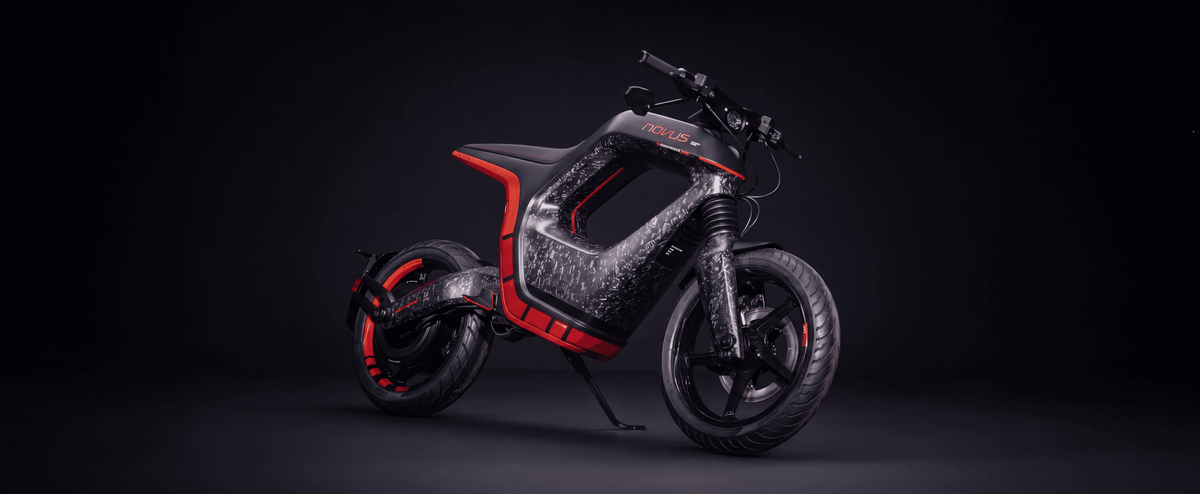
NOVUS calls it a Lightbike: a new kind of electric two-wheeler that borrows the immediacy of an e-bike, the ease of a scooter and the presence of a motorcycle. That description could easily feel like branding in search of a product. What makes the One more convincing is that its visual identity comes from a different construction idea: a full-carbon monocoque, with the structure and outer body brought together in a single form. NOVUS says the frame weighs 5.8 kilograms. The company describes the architecture on its official website.

The One began with a sketch by founder René Renger. That sketch became a prototype, developed with Marcus Weidig, and then a production-intent machine. NOVUS has since announced the first customer deliveries of its limited Founders Edition—a significant step for a young manufacturer, and a more meaningful one than another polished concept reveal. The company’s announcement describes the move from prototype to series production and customer handover.
Renger puts the company’s ambition in personal terms: “We do not just sell bikes. We are on a mission.” His Founder Share pledge gives that statement a practical dimension: NOVUS says its first 100 customers will participate in and grow with the company, while one per cent of his shares will be divided among them. I find that an unusually direct invitation. Those first riders are being asked to believe in the product, of course, but also to become part of the story its founder is trying to build. That places responsibility on both sides: the promise will matter only if the bike, and the company behind it, continue to earn their trust. NOVUS presents the Founder Share idea on its official website.
A different idea of an electric two-wheeler
What I find interesting is the restraint of the idea. Electric mobility is often presented as a technology story: more power, more range, more screens. The NOVUS One is trying to make a case for something else. Its battery is integrated into the carbon structure, while the motor is built into the rear wheel. There is no chain, clutch or gearbox to negotiate. The result, at least on paper, is a machine designed to make the mechanics recede and the experience take centre stage.

The numbers still matter. NOVUS lists a top speed of 130 km/h and a 0–50 km/h time of 1.9 seconds for its higher-performance version. Its test-ride page gives different range figures for the two variants: 150 km for the 45 km/h Pure and 135 km for the 130 km/h God, all manufacturer claims. Those figures are not interchangeable; the range depends on the version and the conditions in which it is used. NOVUS’s test-ride page sets out the two specifications.
Made personal from the beginning
Then there is the way the company wants people to make the bike their own. NOVUS says the Founders Edition is limited to 100 units and can be configured in more than 500,000 theoretical combinations. That figure is the brand’s estimate of possible configurations, but the point is clear: personalisation is part of the product, not an afterthought. The company also describes these first riders as founding partners in its story. The Founders Edition configurator shows the bike and its available options.
That ambition comes with a high bar. A carbon monocoque and a striking silhouette can make a first impression; they cannot, by themselves, establish a new category. The everyday questions are less cinematic: how comfortable is it in traffic, how easy is it to live with, and how does its real-world range compare with the claim? Those answers will come from riders, not renderings.
Still, the first deliveries change the conversation. The NOVUS One is no longer only a promise about what urban mobility might look like. It is a road-going product that its first customers can ride, judge and make part of their daily lives.
I like that progression. A sketch becomes a structure; a structure becomes a machine; a machine becomes someone’s way home. The future of two-wheel mobility does not need another category name for its own sake. It needs products distinctive enough to make us reconsider the categories we already have.
The NOVUS One has made its opening move. Now the road gets a say.