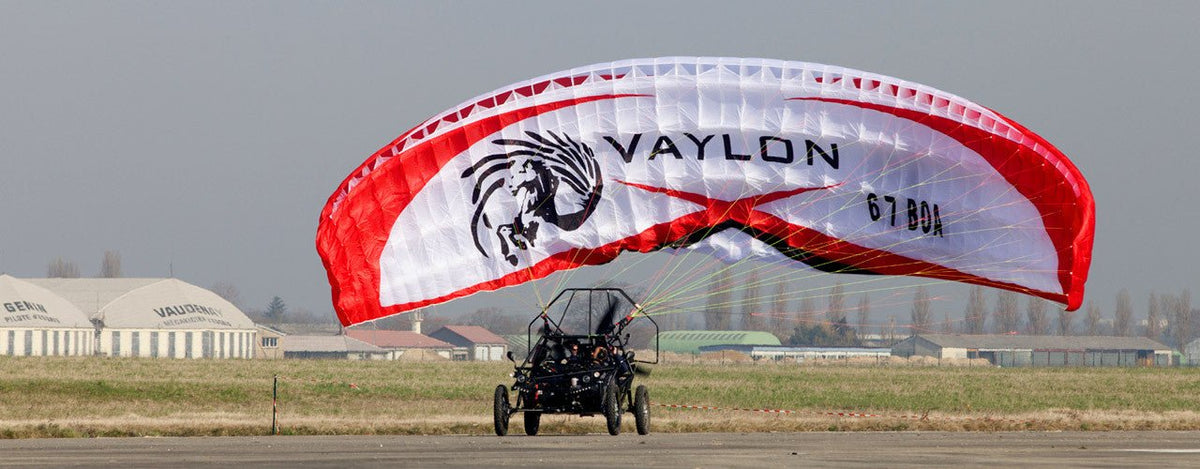
Vaylon Pégase, the Flying French Car Flies Accross the English Channel
The Vaylon Pegase flying car made history in June 2017 when French pilot Bruno Vezzoli flew it across the English Channel, becoming the first flying car to complete the crossing. Built by French startup Vaylon, the Pegase is a hybrid off-road buggy and powered paraglider that combines road driving at up to 100 km/h with paragliding flight at 80 km/h and altitudes up to 3,000 metres.
What Is the Vaylon Pegase?
Development of the Pegase began in 2014. The vehicle is essentially an off-road buggy with a steerable, stealthy paraglider wing that can be deployed for flight. On the ground it is powered by a Rotax 912 four-cylinder boxer engine, the same proven powerplant used in many light aircraft, which delivers excellent fuel efficiency and gives the Pegase a road range of 1,000 km on a single tank. In the air, twin propellers provide thrust, with the wing providing lift.

The English Channel Crossing
The Pegase's most significant test came on 14 June 2017, when pilot Bruno Vezzoli took off from Ambleteuse in northern France at 8:03 a.m. The route covered 72.5 km in total, including 33.3 km over the English Channel at an altitude of 1,240 metres. The crossing itself took approximately 1 hour and 15 minutes, landing at East Studdal near Dover. To reach the departure aerodrome, Vezzoli had driven the Pegase from the Champs-Elysees to the Ambleteuse Aerodrome at a land speed of 100 km/h, demonstrating the vehicle's dual-mode capability in a single continuous journey.

Performance Specifications
In flight, the Pegase reaches a cruise speed of 80 km/h and can climb to a maximum altitude of 3,000 metres. The paraglider wing is designed for stealth, keeping the vehicle's visual and acoustic signature low. On road, the Rotax 912 engine provides a ground range of 1,000 km, making the Pegase capable of very long overland distances between flights. The vehicle is designed to operate from open fields or short strips, requiring no conventional runway.

Why the Pegase Matters for Personal Air Mobility
The Pegase represents a pragmatic approach to the flying car concept: rather than developing entirely new propulsion or lift technology, Vaylon combined proven paraglider mechanics with a capable off-road buggy. The result is a vehicle that costs considerably less than dedicated eVTOL aircraft and can be operated by someone with a standard paragliding licence. It points to a near-term future where personal air mobility does not require purpose-built vertiports or expensive certification programmes. To explore production flying vehicles available today, see the XPENG X2 eVTOL Flying Car and the Icon A5 Amphibious Light Sport Aircraft at TheArsenale, or browse the complete Flying Cars and Aircraft collection.
Sources: Designboom, Flying Magazine