What Gives the Inline 4 Engine Sound Its Distinctive Character
Ask any driver to imitate a small performance car and you will hear a high, thrashy buzz climbing toward a screaming redline. That instinctive impression captures the essence of the character of a four-cylinder engine's sound. It is not an accident of engineering. It is the predictable result of geometry, firing intervals and vibration that designers have wrestled with for more than a century. If you enjoy the raw mechanical texture of combustion, our inline engine sound inspiration feature shows how that engineering can become sculpture.
Understanding why this configuration behaves the way it does requires a short tour through firing order, balance and exhaust design. Each factor contributes a layer to the final acoustic signature. Together they explain why a compact four can feel more frantic than a smooth six, yet also more alive at high speed.
The voice behind the inline 4 engine sound
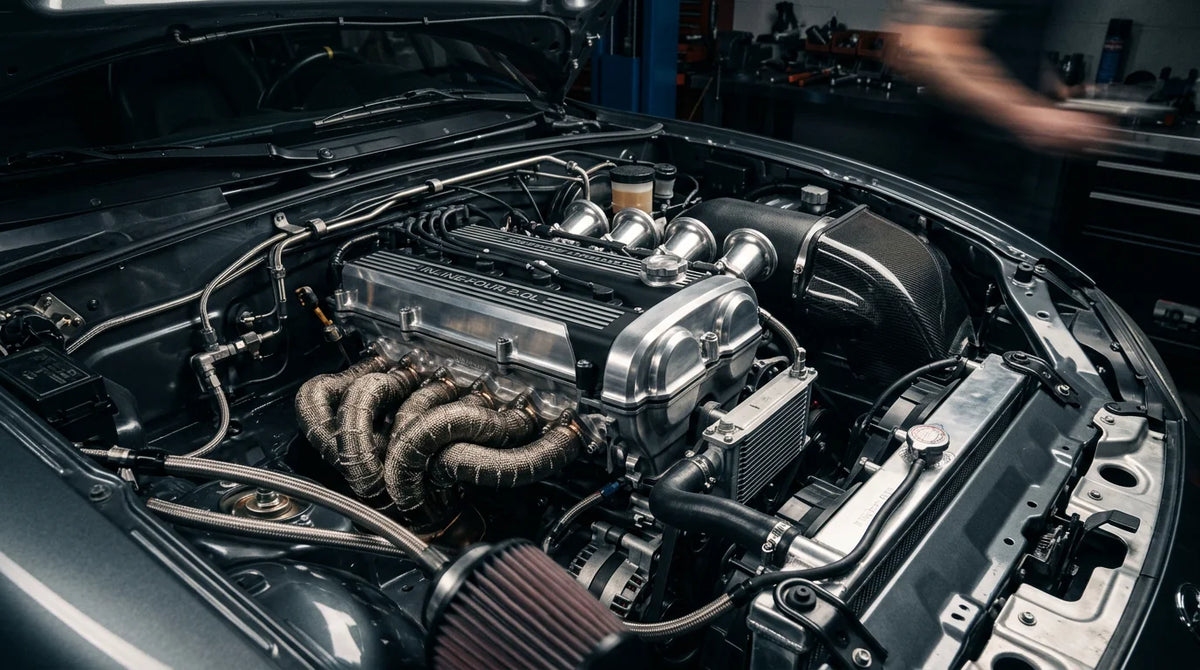
The starting point is combustion timing. In a four-stroke engine, each cylinder completes its power stroke once every 720 degrees of crankshaft rotation. With four cylinders sharing that cycle, a power stroke arrives every 180 degrees, producing an even, regular beat that defines the distinctive inline 4 engine sound. According to a technical breakdown, manufacturers use 1-3-4-2 or 1-2-4-3 as the firing order for four-cylinder engines.
That sequence is chosen deliberately. An optimal firing order can enhance engine smoothness by evenly distributing power strokes, which minimizes vibrations, and this matters in inline four-cylinder engines where the compact design can lead to pronounced vibrations if not properly managed. The firing order is therefore both an acoustic and a mechanical decision, shaping the pulse you hear at the tailpipe.
Why the pulse sounds so even
Picture the crankshaft as a metronome. Because each combustion event is spaced identically, the exhaust note lacks the syncopated lope of a V-twin or the woofle of a flat-plane V8. Instead it delivers a smooth, continuous drone that rises cleanly with revs.
The engineering literature is consistent on this point. The 1-3-4-2 order provides smooth and even power delivery, with firing pulses evenly spaced to minimize the intervals between power strokes. This even spacing is why a healthy four sounds tight and mechanical rather than ragged, and why a misfire is so immediately audible as a stumble in the rhythm.

The secondary imbalance every four fights
Here is the paradox. The inline-four is well balanced at the primary level, yet it carries an inherent buzz that smoother configurations avoid. The culprit is a secondary vibration that no crankshaft counterweight can cancel on its own.
The physics were documented decades ago. A four-cylinder in-line engine suffers from vibromotive forces of secondary order caused by the reciprocating masses, as described in a US patent for a secondary balancer system. As a US patent filing explains, these secondary forces act at twice the crankshaft frequency, which adds a fine, high-pitched hum to the fundamental beat. That hum is a signature part of the acoustic fingerprint, and it grows more noticeable as displacement per cylinder increases.
Balance shafts and the engineering of quiet
How do designers tame that buzz without silencing the engine's character? The dominant answer is the balance shaft, a pair of weighted rotors spun at twice engine speed to counteract the secondary forces.
Modern analysis quantifies how effective this can be. In an engineering study of a four-cylinder engine, researchers reported multi-body dynamics simulation resulting in 95% secondary balancing. The same work frames the stakes clearly: first-order and second-order inertial forces cause high-amplitude excitation of the vehicle structure and lead to interior noise and riding discomfort. Managing NVH, or noise, vibration and harshness, is therefore a balance between comfort and the mechanical honesty that enthusiasts prize. If you enjoy that debate, our feature on why motorcycles still need that mechanical feel explores where the line should sit.
Turbocharged versus naturally aspirated character
Two fours can sound like entirely different animals. A naturally aspirated unit breathes freely and rewards revs with a rising, metallic wail. A turbocharged four routes its exhaust energy through a turbine first, muffling the raw pulse and adding whoosh, chatter and blow-off hiss.
The trade-off is real. A turbocharged four gains torque and low-end muscle but often loses some of the crisp top-end scream, because the turbine dampens exhaust pulses before they reach the tailpipe. Enthusiast media have long celebrated the naturally aspirated screamers precisely for their unfiltered high-rpm scream, from Honda's high-revving fours to rally-bred turbo icons that trade purity for boost. Both approaches remain valid; they simply prioritize different parts of the soundtrack.

Iconic four-cylinder soundtracks
Some engines have earned cult status for their acoustics alone. High-revving Japanese fours built reputations on redlines above 8,000 rpm, where the even firing pulse blurs into a continuous, urgent howl. Turbocharged rally homologation specials, by contrast, are loved for their guttural bark and off-throttle crackle.
The lesson from these legends is that displacement and cylinder count do not dictate emotional impact. A well-tuned exhaust note, a generous rev ceiling and a free-breathing intake can make a modest four more thrilling than a lazy large-capacity engine. Character comes from how the engine is allowed to breathe and rev, not merely from how many cylinders it carries.
Keeping mechanical sound alive in an electric age
What happens to this acoustic heritage as powertrains go quiet? Electrification removes combustion pulses entirely, prompting engineers to reconsider what a performance vehicle should sound like. Some brands now design deliberate synthetic voices to preserve emotional connection.
This shift makes the traditional combustion note feel more precious, not less. The tension between silence and mechanical drama is playing out at the very top of the industry, as our look at a 'guitar-like' engine roar illustrates. For collectors, the enduring appeal of the four-cylinder pulse is one reason authentic engines are increasingly displayed and celebrated as objects in their own right.
Bringing the four-cylinder story together
The voice of a four-cylinder engine is the sum of clear engineering choices: even 180-degree firing intervals, a stubborn secondary imbalance, balance shafts that tame it and exhaust tuning that colors the final note. Naturally aspirated designs favor a high, revvy scream, while turbocharging trades purity for muscle. As electric powertrains reshape expectations, understanding this mechanical character helps you appreciate why the compact four still stirs so much feeling. Listen for the firing rhythm next time an engine climbs toward its redline, and you will hear the physics at work.
Take action with TheArsenale
If the mechanical drama of a four-cylinder engine speaks to you, that appreciation does not have to stay under a bonnet. The same combustion architecture that produces such a distinctive pulse can be preserved and displayed as functional art, honoring the engineering long after the engine has fallen silent.

We curate collectible pieces built from authentic engines, transforming genuine mechanical hardware into striking design objects for the home or studio. Explore our engine coffee tables to bring that heritage into your living space, with free shipping and a team that typically replies in under thirty minutes if you have questions.
Frequently Asked Questions
Why does a four-cylinder engine sound buzzy?
The buzz comes largely from a secondary imbalance inherent to the layout, which vibrates at twice the crankshaft frequency. This fine, high-pitched hum layers on top of the even firing beat, giving the engine its characteristic mechanical texture.
What is the typical firing order of an inline four?
Most inline four-cylinder engines fire in a 1-3-4-2 sequence, though 1-2-4-3 is also used. This ordering distributes power strokes evenly to keep the engine smooth and to minimize vibration and stress on the crankshaft.
Why do some four-cylinders rev so high and sound so aggressive?
Lighter reciprocating masses and free-breathing designs allow certain naturally aspirated fours to spin past 8,000 rpm. At those speeds the evenly spaced firing pulses blend into a continuous, urgent wail that many enthusiasts find thrilling.
Do balance shafts change how a four-cylinder sounds?
Balance shafts primarily reduce secondary vibration rather than alter the fundamental exhaust note. They make the engine feel smoother and quieter inside the cabin, which can soften some of the raw mechanical buzz drivers associate with the layout.
Can I keep a piece of that engine character at home?
Yes. We create collectible design objects from authentic engines, including our engine coffee tables, so the craftsmanship behind a real motor can be admired as functional art. It is a way to preserve mechanical heritage even as powertrains grow quieter.