1953 Porsche 356 Pre-A: History, Specs, and Value Guide
The 1953 Porsche 356 Pre-A captures Porsche at the moment when a small, hand-built sports car was becoming an established international marque. Its compact proportions, rear-mounted engine, and restrained detailing created a distinctive identity that still feels coherent today. That story sits naturally beside our 1939 Porsche Type 64 feature, which explores an earlier chapter in the brand’s engineering history.
The name “Pre-A” was applied retrospectively after the 356 A arrived for the 1956 model year. For a clear visual reference, Porsche Classic’s model guide identifies details that help distinguish early cars, including the split or center-creased windshield, bumper changes, and evolving luggage-compartment hardware. Those details matter because 1953 production included several transitions rather than one completely fixed specification.
What makes the 1953 Porsche 356 Pre-A distinctive?
In 1953, the 356 was no longer simply an early postwar sports car assembled around Volkswagen-derived mechanical ideas. It was developing its own visual and technical language. The body remained compact and aerodynamic, but production changes introduced clearer separation from the earliest Gmünd cars.
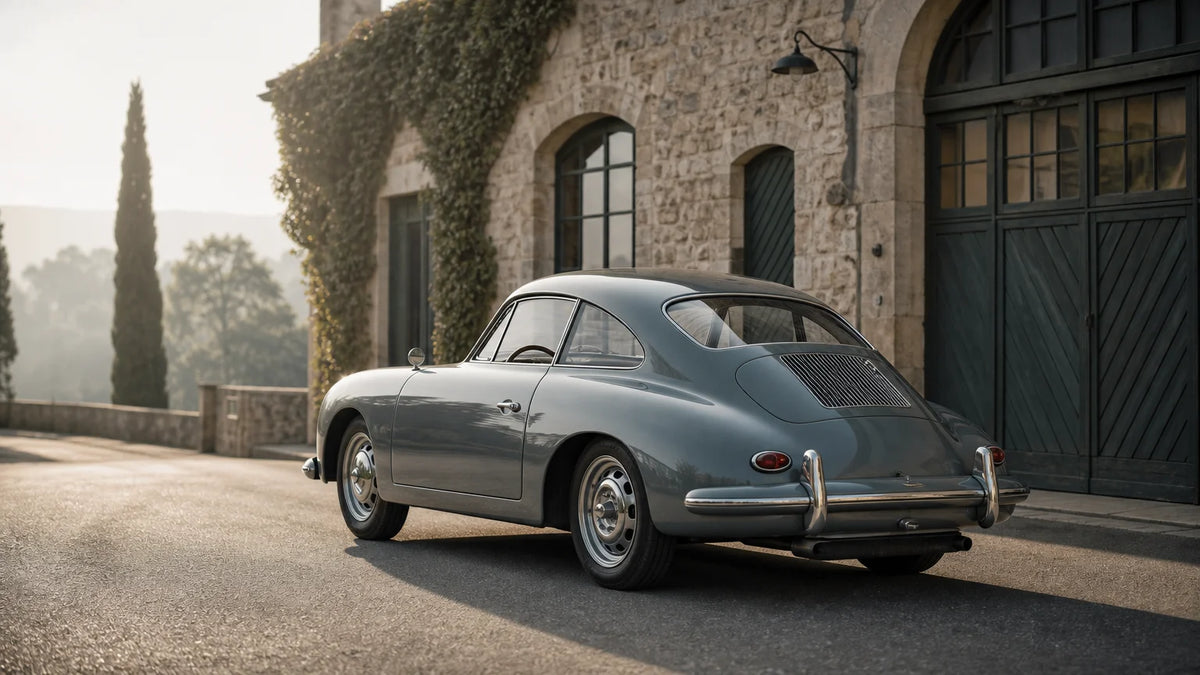
The most recognizable feature is often the bent-window detail. Earlier cars used a two-piece windshield divided by a central bar, while later Pre-A examples adopted a single pane with a pronounced crease. Bumpers also evolved from fittings placed directly against the body to more separated units with guards. These changes can help establish whether a car’s visible equipment corresponds to its claimed build period.
Coachwork was produced by Reutter in steel after Porsche’s move from Gmünd, Austria, to Stuttgart. Porsche’s own historical account states that the first German-built 356 was completed in Zuffenhausen on April 6, 1950, marking the beginning of series production at the site. The same source describes how Reutter supplied finished bodies during the early Stuttgart period. Read Porsche’s production history for that transition.
This background explains why the 1953 car is so important. It is not the earliest aluminum-bodied Gmünd 356, nor is it yet a 356 A. Instead, it belongs to a period when Porsche was refining manufacturing, improving usability, and responding to growing export demand.
Which engines and transmissions were available?
A 1953 example should not be judged by one engine specification alone. Depending on its build configuration, the 356 could be equipped with an 1,100 cc, 1,300 cc, or 1,500 cc air-cooled opposed four-cylinder engine. Output varied accordingly, with the higher-performance 1500 Super offering substantially more power than the standard versions.
The 1500 Super is particularly significant because it brought stronger performance without abandoning the car’s lightweight, compact character. Period descriptions commonly place the 1500 Super at approximately 70 horsepower, while the regular 1,500 cc engine produced less. A buyer should therefore verify the engine type through factory documentation rather than relying on badges, external appearance, or a later replacement engine.
The 1953 series also benefited from a fully synchronized four-speed gearbox. That improvement made the car easier to drive in normal traffic and represented the steady mechanical development taking place during the Pre-A period. Four-wheel drum brakes, a rear-mounted engine, and a relatively light body remained central to the driving experience.
The result is a car that rewards smooth, deliberate driving rather than brute-force acceleration. Its appeal comes from balance, visibility, steering feel, and the connection between the driver and the machinery. In that respect, it belongs to the same early performance culture explored in our 1956 Porsche 550 Spyder feature, although the 550 was conceived more directly around competition use.
How rare is a 1953 Pre-A coupe or cabriolet?
Production figures give useful context, but they require careful interpretation. Porsche states that it delivered 1,941 vehicles in 1953, including 394 cabriolets. The company also notes that only one of those cabriolets used an aluminum body produced by Reutter, making that particular car an exceptional historical case rather than a normal representation of the model.
The remaining cars were generally steel-bodied coupes and cabriolets with differences in equipment, coachbuilder details, engine specification, and delivery market. A 1953 coupe may therefore be less visually dramatic than a cabriolet, yet it can offer a stronger connection to the essential Pre-A silhouette and the compact closed-body design that defined the series.
Body style is only one measure of rarity. A car with an unusual factory color, documented early ownership, a desirable engine, or exceptional preservation may be more compelling than a superficially rarer example that has lost its original mechanical identity. The 356 Registry overview is useful for understanding the basic coupe and cabriolet configurations, rear-mounted air-cooled layout, and recurring model distinctions.
For collectors, rarity should therefore be considered alongside originality. A complete and well-documented car may offer a clearer historical story than a heavily modified example, even when both carry the same model designation.

Which details should you inspect before buying?
Suppose you are evaluating a 1953 Porsche 356 Pre-A offered as a restored car. The first step is to separate what is visible from what is documented. Paint, upholstery, bumpers, wheels, instruments, and trim can be replaced. Factory records, chassis identity, and consistent production details are harder to recreate convincingly.
Begin with the chassis number, engine number, transmission, and body style. Compare those details with the available Kardex, build sheet, or other factory records. Confirm whether the engine is original to the car, correct for the period, or a later replacement. A replacement engine does not automatically make the car undesirable, but it changes how you should understand its originality and value.
Next, inspect the body carefully. Rust repair around the floors, longitudinal members, wheel arches, door bottoms, and windshield area can affect both structural integrity and restoration cost. Look for evidence of accident repair, altered panel gaps, non-period lights, incorrect bumper guards, and replacement dashboard components.
The windshield and rear lighting are especially useful clues. Early cars can show different combinations of split-window, center-creased glass, rectangular lamps, or round lamps depending on their production period. A knowledgeable inspection should assess whether those details belong together, rather than treating one feature as definitive proof.
Documentation is also a practical ownership tool. Porsche’s official service explains that its Classic Technical Certificate can include original production information such as completion date, exterior and interior color, interior material, and factory equipment. Consult Porsche’s vehicle documentation before assuming that a car’s description is complete.
Why does provenance matter as much as specification?
In a historic sports car, provenance connects the physical object to a verifiable story. A 1953 Pre-A with a known delivery date, documented ownership, period competition use, or long-term preservation can offer a stronger collecting proposition than a visually attractive car with limited records.
This does not mean every undocumented car lacks merit. Many early cars changed hands before modern collector documentation became common. However, missing records increase the importance of physical inspection, expert interpretation, and conservative claims. You should distinguish clearly between confirmed factory data, period evidence, owner testimony, and assumptions based on appearance.
The broader production context is also important. A 2018 filing with the United States Securities and Exchange Commission cited total Porsche 356 production of 79,470 cars from 1950 through 1966. That figure covers the complete production run, not the 1953 Pre-A alone, but it shows why the early cars represent a distinct portion of a much larger historical family. The SEC filing provides that wider production reference.
Provenance can also guide restoration decisions. If a car retains its original body panels, dashboard, upholstery fragments, or unusual factory equipment, preserving those elements may be more valuable than replacing them with visually perfect reproductions. The best restoration strategy depends on the car’s existing evidence and intended use.
How does the Pre-A fit into Porsche’s wider design lineage?
The 1953 car occupies an important place between Porsche’s experimental beginnings and the more mature 356 A generation. Its form is recognizable, yet many of its details still reveal a company learning how to manufacture a sports car consistently at increasing volume.
That balance makes the model especially relevant to design-focused collectors. The rounded roof, narrow glasshouse, simple bumpers, painted dashboard, and compact wheels create a visual language that is less polished than later Porsche models but more direct. Each change reflects a practical decision about production, usability, performance, or export requirements.
Its influence is visible in later interpretations of the 356 shape. The connection is not simply nostalgic. Designers continue to reference the early car because its proportions communicate lightness without relying on excessive decoration. Our Porsche Vision 357 homage explores how that original design vocabulary can be reinterpreted for a contemporary audience.
For the collector, this lineage adds meaning without replacing the need for evidence. A car should be appreciated for its design and history, but its condition, specification, and documentation still determine whether it is a sound acquisition.

What should you remember about the 1953 Pre-A?
The 1953 Porsche 356 Pre-A is best understood as a transitional sports car with a strong individual identity. Its Stuttgart construction, evolving bent-window details, air-cooled flat-four engines, synchronized gearbox, and limited production create a compelling historical combination. If you are assessing one, prioritize verified provenance, correct period details, structural condition, and a clear distinction between original components and later restoration work. The most desirable example is not defined by age alone, but by the strength and consistency of its complete story.
Take action with TheArsenale
Owning or studying an early Porsche requires more than recognizing a familiar silhouette. You need access to carefully selected machines, informed context, and a route toward acquisition that reflects your collecting interests. That is where a curated mobility marketplace can make the search more focused and more personal.

At TheArsenale, we bring together rare cars and other extraordinary mobility objects through our international marketplace, sales assistance, and collector-focused network. Our team can help you explore unusual machines, understand their place within a broader design culture, and pursue a tailored acquisition process. Browse our selection of classic Porsche cars to continue your search.
Frequently Asked Questions
What does “Pre-A” mean on a 1953 Porsche 356?
“Pre-A” is a retrospective term used for 356 models built before the 356 A generation introduced for the 1956 model year. A 1953 car therefore belongs to the earlier development period of the original 356.
Was every 1953 Porsche 356 equipped with a 1,500 cc engine?
No. The 1953 range included different engine capacities and performance levels, including 1,100 cc, 1,300 cc, and 1,500 cc configurations. Factory records are necessary to confirm the specification of an individual car.
What is the most recognizable visual feature of a 1953 Pre-A?
The windshield is one of the clearest visual clues, especially the transition from a split windshield to a single center-creased or bent windshield. Bumpers, lamps, luggage-compartment hardware, and dashboard details should also be considered together.
Is a matching-numbers engine essential?
A matching-numbers engine can strengthen originality and provenance, but its absence does not automatically disqualify a car. The importance depends on the vehicle’s overall condition, documentation, restoration quality, and intended use.
Can TheArsenale help with a rare Porsche acquisition?
Yes. TheArsenale’s curated marketplace and sales network are designed for collectors seeking rare and high-value mobility objects. The team can provide a more tailored route when you are exploring an unusual classic car or broader collection.