How to Buy an Electric Scooter: A Practical 2026 Guide
Buying an electric scooter should begin with your routine, not with a product page. Decide where you will ride, how far you will travel, whether you must carry the scooter, and which conditions you will encounter. Our electric scooter buying guide can help you frame those questions before comparing models.
The market includes compact commuter scooters, comfortable long-range machines, off-road designs, and high-performance vehicles. In 2026, safety, support, and battery quality deserve as much attention as speed. The CPSC safety guidance advises buyers to choose products and batteries designed, manufactured, and certified for applicable safety standards, while also following local traffic laws.
What should you decide before shopping?
Start by describing your most common journey in practical terms. A short, flat trip between home, transit, and work requires a different scooter from a route with steep hills, poor pavement, or frequent rain. Write down your usual distance, the steepest incline, the surface quality, and the places where you will store and charge the scooter.
Next, identify your priorities. Portability matters if you carry the scooter upstairs or place it in a car. Comfort matters if you ride for more than a few minutes at a time. Range matters if charging between trips is inconvenient. Acceleration and hill performance matter if your route includes traffic, inclines, or frequent stops.
Legal requirements also vary by country, state, city, and road type. Check whether private scooters may use roads, cycle lanes, or sidewalks in your area. Confirm any speed, lighting, helmet, minimum-age, insurance, registration, or equipment rules before paying. Rental scooter rules do not necessarily apply to privately owned vehicles.
- Primary use: commuting, errands, leisure, touring, or mixed riding.
- Route: flat pavement, hills, uneven roads, gravel, or mixed surfaces.
- Distance: one-way distance, daily distance, and charging opportunities.
- Portability: stairs, public transport, car storage, and lifting frequency.
- Environment: rain exposure, temperature, storage space, and theft risk.
- Rider requirements: height, weight, posture, and preferred riding position.
How much should you spend on an electric scooter?
Your budget should cover more than the advertised scooter price. Allow room for a certified charger, helmet, lock, lights or reflective equipment, maintenance, replacement tires, and possible delivery or assembly costs. A lower purchase price can become less attractive if parts are difficult to source or support is unavailable.
Consider total ownership cost over the period you expect to keep the scooter. A model with a larger battery may cost more but suit a longer commute. A lighter model may be easier to carry but provide less suspension or hill performance. A premium machine may make sense when comfort, design, durability, and specialized assistance are central to your decision.
Published prices also need context. Check whether the listed price includes taxes, shipping, a suitable charger, warranty coverage, and the battery configuration you need. Look for the cost of replacement batteries, brake components, tires, and service. Avoid making a decision based only on a temporary promotion or a high claimed top speed.
When your purchase involves a rare, design-led, or highly specialized machine, our electric scooter price guide provides a useful framework for assessing what influences cost. We recommend comparing the value of engineering, materials, support, and exclusivity rather than treating price as a performance score.
Which specifications matter most?
Motor power is useful, but wattage alone does not determine how a scooter feels. Controller settings, battery voltage, rider weight, tire size, incline, and software limits all affect acceleration and hill performance. Look for independent testing, incline information, and rider-load limits whenever those details are available.
Battery capacity is usually expressed in watt-hours, or Wh. A larger capacity can support longer trips, but it can also increase weight and charging time. Range claims are often measured under favorable conditions. Your actual result will change with speed, rider weight, temperature, wind, hills, tire pressure, and riding mode.
Plan your route with a reserve rather than treating the published maximum as your daily target. If you need 12 miles of reliable travel, a scooter advertised for exactly 12 miles may leave little margin for weather, battery aging, or an unexpected detour. Ask whether the battery is replaceable and whether the manufacturer supplies approved replacement parts.
Brakes deserve priority. A scooter should provide predictable stopping control for your speed and environment. Mechanical disc brakes, hydraulic systems, drum brakes, electronic braking, and regenerative braking each have different maintenance and feel characteristics. Confirm how the systems work together and whether replacement components are available.
Tires determine comfort, traction, and maintenance. Solid tires reduce puncture concerns but usually transmit more vibration. Pneumatic tires can provide a smoother ride, but they require pressure checks and may suffer punctures. Tubeless tires can combine air cushioning with lower puncture risk, but they still require inspection and correct inflation.
Suspension is valuable on rough roads, although it adds weight, cost, and mechanical complexity. Lighting, turn signals, a clear display, a stable folding mechanism, a bell or audible warning device, and a sufficiently large deck can improve everyday usability. Our guide to how to choose an electric scooter can help you weigh these features against your route instead of selecting them in isolation.

How do you match the scooter to your body and terrain?
A scooter that looks suitable on paper may feel uncomfortable after ten minutes. Check handlebar height, deck length, riding posture, maximum load, and the space available for both feet. Taller or heavier riders may need a larger deck, stronger suspension, and more motor reserve than a compact commuter scooter provides.
Terrain changes the buying decision. Smooth city pavement favors lighter tires and easy folding. Broken pavement increases the value of suspension, larger tires, and a stable deck. Hills demand motor and battery reserve, while loose surfaces require appropriate tires and careful speed control. No scooter is equally suited to every surface.
Weight is an important trade-off. A light scooter may be easier to lift, store, and take on public transport. A heavier scooter may offer a larger battery, stronger frame, wider tires, and more controlled handling. Measure the distance between your storage point and the street, then consider whether you can carry the scooter safely when the battery is empty.
Weather protection also needs careful interpretation. An ingress protection rating can indicate resistance to water and dust, but it does not make a scooter suitable for deep water, pressure washing, or careless charging after a wet ride. Dry the charging port and inspect seals, connectors, and exposed components after poor weather.
What battery and safety checks should you make?
Battery safety begins before checkout. Confirm that the scooter comes with a charger designed for that model. Do not assume a universal charger is safe. Check for clear manufacturer information, a traceable seller, warranty terms, recall notices, and instructions for storage and charging.
The United Kingdom’s Department for Transport published battery guidance in 2024 explaining how to purchase, charge, store, and monitor an e-scooter. It notes that lithium battery packs can create serious fire risks when they are poor quality, damaged, or used improperly. The battery safety guidance is UK-specific for legal matters, but its charging and storage principles are broadly useful.
- Charge with the supplied or manufacturer-approved charger.
- Keep the scooter on a stable, nonflammable surface while charging.
- Do not charge a damaged, swollen, leaking, or unusually hot battery.
- Keep charging equipment dry and inspect the port before connecting it.
- Store the scooter away from extreme heat, freezing conditions, and blocked exits.
- Use only approved replacement batteries and compatible components.
Riding safety is equally important. Wear a properly fitted helmet, use lights in low visibility, ride alone unless the manufacturer explicitly permits another arrangement, and respect local speed limits. Practice braking and turning in a quiet area before entering traffic. A scooter can feel stable at low speed while responding very differently during emergency braking.
Safety research also has limitations. The National Academies published its 2023 safety toolbox to support evidence-based approaches to e-scooter safety, education, and risk reduction. This reinforces a practical point: equipment, rider behavior, infrastructure, and local rules all influence the outcome.
How can you evaluate sellers and product claims?
Read the product page as a contract, not as advertising. Look for a complete specification sheet, battery capacity, charger details, maximum load, dimensions, warranty duration, return conditions, delivery information, and service contacts. Vague descriptions create uncertainty when a repair or warranty claim becomes necessary.
Separate manufacturer claims from independent evidence. A claimed range is useful for comparing models, but it is not a guarantee for your route. Seek testing that explains rider weight, speed, temperature, terrain, and riding mode. Also check whether the stated top speed is legal where you intend to ride.
Examine the seller’s support structure. Ask where replacement batteries, tires, brake parts, displays, and folding components can be obtained. Confirm who performs warranty work and whether service is available in your country. A scooter that cannot be maintained may have a shorter practical life than its specifications suggest.
The NTSB’s 2022 research highlighted challenges in collecting and classifying micromobility injury data. That does not make safety information irrelevant. It means you should avoid relying on one headline statistic and instead assess the complete system, including the scooter, route, rider, maintenance plan, and local environment.
For a more focused product comparison, our best electric scooters selection offers a curated way to explore machines where design, engineering, and future mobility are part of the decision. We encourage you to confirm current specifications and availability directly before ordering.
What should you do before placing the order?
Before you buy, convert your research into a short checklist. This prevents an attractive design or unusually high speed claim from distracting you from practical constraints.
- Confirm that private electric scooters are legal on your intended routes.
- Measure your daily distance and add a sensible range reserve.
- Check the maximum rider weight and handlebar dimensions.
- Compare braking systems, tire type, suspension, and lighting.
- Verify battery capacity, charger compatibility, and replacement options.
- Review warranty, returns, service locations, and spare-part availability.
- Calculate shipping, tax, accessories, maintenance, and storage costs.
- Inspect the scooter immediately after delivery and keep all documents.
When the scooter arrives, photograph the packaging before opening it. Check the frame, stem, folding latch, deck, tires, cables, display, lights, brakes, and charger. Test the scooter at low speed in a controlled area. Do not make a long trip until you know how the braking, acceleration, steering, and battery display behave.

Choose for the ride you will actually take
The most reliable way to learn how to buy an electric scooter is to begin with your route and responsibilities. Match range, braking, tires, comfort, weight, and support to that real use case. Then verify legal requirements, battery safety, service access, and total ownership cost. A thoughtful purchase may not have the most dramatic specification sheet, but it should remain useful, manageable, and supportable throughout your ownership.
Take action with TheArsenale
Once you understand your route, performance needs, and preferred design language, you can move from general research to a more considered mobility choice. The right machine should reflect how you travel, how you store it, and the experience you expect from the purchase.

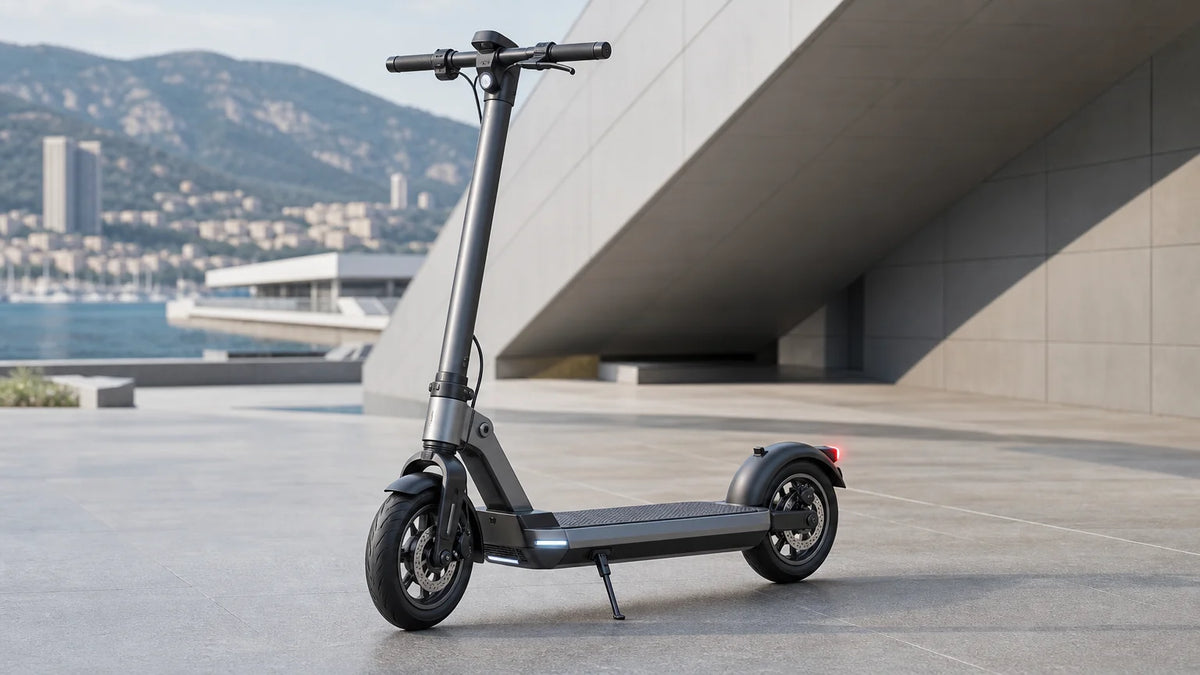
Our curated mobility marketplace connects collectors and enthusiasts with unusual, future-oriented machines and personalized acquisition support. If you are looking for a distinctive electric scooter, explore the dedicated product presentation and contact our team for further information about availability, specifications, and acquisition.
Frequently Asked Questions
Is an electric scooter suitable for daily commuting?
It can be suitable when the route, local rules, weather, storage, and charging arrangements are compatible. Choose a model with enough range reserve, dependable braking, suitable tires, and service support for repeated use.
How much range should an electric scooter have?
Choose more claimed range than your normal one-way distance requires. Actual range changes with speed, rider weight, hills, temperature, tire pressure, and battery age, so a reserve is important.
Are heavier electric scooters better?
Not automatically. Heavier models may provide larger batteries, stronger frames, wider tires, and more suspension, while lighter models are easier to carry and store. The better choice depends on which trade-off affects your routine most.
What should I check when buying an electric scooter online?
Check the full specification sheet, warranty, return policy, charger compatibility, battery information, service network, spare parts, delivery terms, and seller reputation. Confirm that the listed performance is appropriate for your local laws and intended route.
Can TheArsenale help with an electric scooter purchase?
Yes, our marketplace presents curated mobility objects and supports personalized inquiries for distinctive machines. The dedicated product page and sales team can help you request information about the featured electric scooter, availability, and acquisition details.