The Complete Electric Scooter Buying Guide for 2026
The global market for electric scooters is projected to reach roughly 52.8 billion dollars in 2026, a figure that explains why the shelves are crowded and the choices feel overwhelming. Before you compare a single specification sheet, it helps to understand which numbers actually matter for your daily route. Our guide on how to choose an electric scooter lays the groundwork, and the sections below build on it with a practical, priority-first framework.
The intent behind an electric scooter buying guide is simple: to translate confusing jargon into decisions you can act on. According to Grand View Research, the sector was valued at 41.7 billion dollars in 2024 and is expanding at a compound annual growth rate close to 9.6 percent, which means more models, more marketing, and more reasons to stay focused on your genuine needs rather than the loudest advertisement.
What a Practical Electric Scooter Buying Guide Should Prioritize
Consider the reader who buys the fastest scooter available, only to discover it weighs 70 pounds and cannot be carried up a single flight of stairs. That mismatch is the most common purchasing mistake. A useful buying guide for electric scooters begins not with top speed but with the question of how, where, and how far you intend to ride.
Start by writing down three facts: your typical one-way distance, the steepness of your route, and whether you must carry the scooter at any point. These three inputs quietly determine almost every specification that follows, from battery capacity to deck size. Once those constraints are clear, comparing models becomes a matter of elimination rather than guesswork.

Range and Battery: Matching a Scooter to Your Commute
Range is the specification most often exaggerated. Manufacturers publish figures achieved under ideal conditions: a light rider, flat ground, mild weather, and the most economical riding mode. Real-world results frequently land well below the headline number, so a sensible rule is to assume you will see roughly 60 to 70 percent of the claimed distance.
Range depends on motor power, battery size, rider weight, temperature, and riding style. If your round trip is ten miles, a scooter claiming fifteen miles leaves little margin for cold days or hills. To compare tested figures against advertised ones, our electric scooter range comparison is a useful reference point before you commit.
Battery chemistry matters too. Lithium-ion cells dominate the market because they balance weight, longevity, and charge time. A larger battery extends range but adds weight, which affects portability, so the goal is the smallest battery that comfortably covers your route with a buffer.
Motor Power, Hills, and Terrain
Two riders can buy the same scooter and reach opposite conclusions, simply because one lives on flat ground and the other faces a steep climb every morning. Motor output, measured in watts, decides that outcome. A single motor rated around 250 to 350 watts suits flat urban riding, while sustained hills or heavier riders call for 500 watts or more.
Manufacturers quote two figures: nominal power, the output a motor sustains continuously, and peak power, the short burst available for acceleration or climbing. Hill-climbing ability depends far more on nominal power than on the flattering peak number. Dual-motor scooters combine two units for stronger acceleration and grip, though they consume the battery faster and add weight.
Demand for this category continues to climb. Fortune Business Insights reports the global electric scooter market at around 21.5 billion dollars in 2025, with growth driven largely by commuters seeking an efficient alternative to short car journeys. If reducing car dependence is your motivation, our overview of electric scooter efficiency and transportation use explains how the numbers translate into daily savings.
Safety: Brakes, Tires, Suspension, and Weather Resistance
Speed without stopping power is a liability. Braking distance separates a confident ride from a dangerous one, and the difference between brake types is significant. Mechanical drum and disc brakes are common on budget models, while hydraulic and semi-hydraulic systems on higher tiers deliver shorter, more consistent stops, especially at higher speeds.
Tires and suspension govern comfort and control. Pneumatic (air-filled) tires absorb road vibration and grip better than solid tires, though they can puncture. Solid or airless tires never go flat but transmit more of the road into your hands and spine. Suspension compensates for that, and it becomes essential on uneven surfaces or if you plan any off-road riding.
Weather protection is measured by the IP rating. A scooter rated IP54 or lower should not be ridden in wet conditions, whereas IP55 or higher offers meaningful resistance to rain and dust. Even then, no scooter is fully waterproof: avoid deep puddles, never hose it down, and allow it to dry between rides.

Price Tiers: What Your Budget Actually Buys
The old adage holds: you generally get what you pay for. Yet spending more is only worthwhile when the extra capability matches your route. The table below summarizes typical characteristics across common price bands, so you can identify where your needs sit before you shop.
| Tier | Typical top speed | Typical tested range | Best suited to |
|---|---|---|---|
| Budget (under 500 dollars) | Around 15 mph | 8 to 10 miles | Light, occasional errands on flat roads |
| Commuter (500 to 1,500 dollars) | 20 to 25 mph | 15 to 20 miles | Daily commuting on mixed urban surfaces |
| Performance (1,500 to 2,500 dollars) | 30 to 40 mph | 25 to 40 miles | Longer routes, hills, and heavier riders |
| Our curated premium selection | Design-led, model dependent | Model dependent | Riders prioritizing build quality, style, and longevity |
Budget models are perfectly capable for short, light use, but they typically ship with a single mechanical brake and modest range. The mid-range band is where the market concentrates, and where value improves fastest each year. If your priority is a scooter that remains a trusted companion for years rather than the cheapest possible entry point, weigh long-term build quality against upfront cost.
Portability Versus Performance: The Trade-Off You Cannot Avoid
Here is the constraint no marketing claim can escape: with current battery technology, a scooter cannot be both feather-light and long-range. Battery cells are heavy, so the models light enough to carry effortlessly, generally under 30 pounds, tend to deliver shorter real-world distances, while the machines that travel farthest often exceed 50 or even 70 pounds.
Decide which side of that line you fall on. If you combine your scooter with public transport or carry it upstairs daily, prioritize weight and folding design. If you ride door to door and never lift it, you can trade portability for a larger battery and more powerful motor. Adoption of both styles is accelerating: Precedence Research cites an International Energy Agency projection that global e-scooter sales will exceed 70 million units annually by 2030, a sign that manufacturers are pushing hard on both lightweight and high-performance ends of the range.
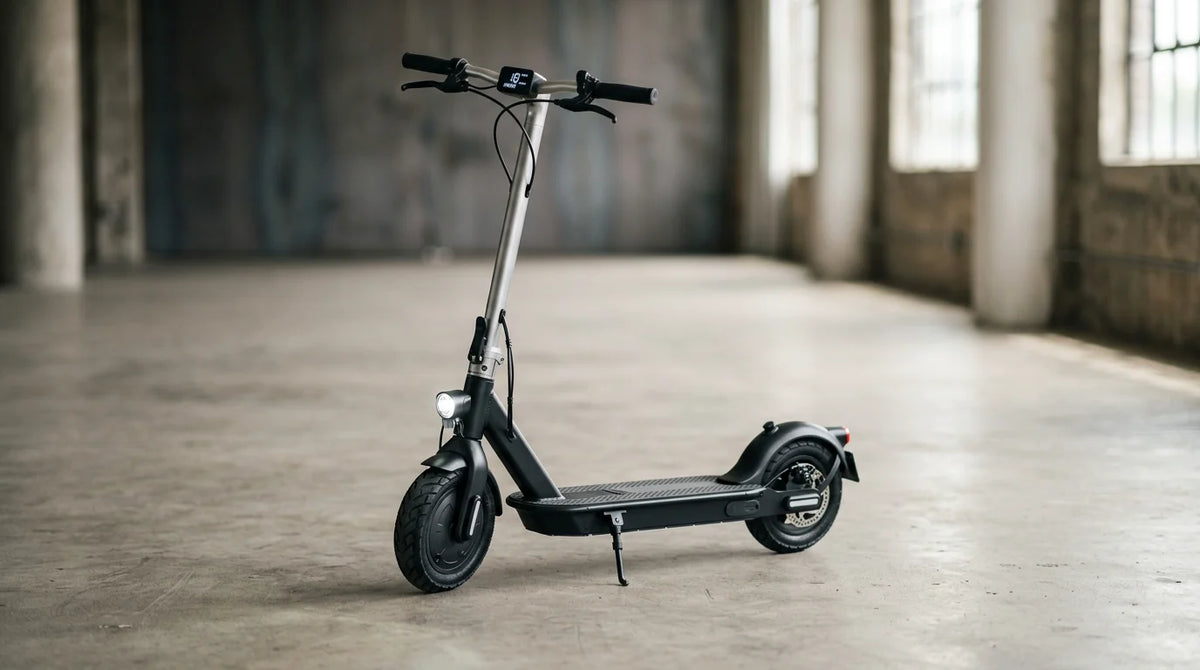
For riders who value design and craftsmanship as much as raw specification, a curated approach helps. Rather than sifting through hundreds of near-identical models, we present pieces such as our Moxie electric scooter, chosen for build quality and considered engineering rather than headline numbers alone.
Bringing Your Decision Together
A confident purchase follows a clear order. Define your distance, terrain, and carrying needs first; then filter models by range, motor power, braking, and weather rating; and only afterward weigh price and portability. Read every advertised range figure with healthy skepticism and favor tested performance where you can find it. Approached this way, an electric scooter buying decision stops being a gamble and becomes a straightforward match between a machine and the life you intend to live with it.
Take action with TheArsenale
Once you know the range, power, and build quality your route demands, the next step is finding a machine worthy of that specification. We curate high-end mobility so you spend less time filtering marketing claims and more time choosing between genuinely considered designs.

Explore our collection of premium electric mobility machines, assembled for riders who value craftsmanship and longevity. As a luxury mobility marketplace, we also offer Private Membership access to vehicles before they are listed publicly, along with free shipping, so your search begins with quality already established.
Frequently Asked Questions
How much should I spend on my first electric scooter?
For reliable daily commuting, most buyers are well served in the 500 to 1,500 dollar commuter band. Budget models under 500 dollars suit light, occasional use, while spending more is worthwhile only when hills, distance, or rider weight demand the extra capability.
How accurate are advertised range figures?
Advertised range is typically measured under ideal conditions and rarely reflects daily riding. A safe assumption is around 60 to 70 percent of the claimed distance once you account for rider weight, hills, weather, and riding mode.
Can I ride an electric scooter in the rain?
Only if it carries an IP rating of IP55 or higher, and even then with caution. A rating of IP54 or lower means you should avoid wet roads entirely, and no scooter should ever be submerged or hosed down.
Do I need a dual-motor scooter?
Not for flat urban commuting, where a single motor of 250 to 500 watts is usually sufficient. Dual motors help with steep hills, heavier riders, and stronger acceleration, but they add weight and consume the battery faster.
Where can I compare curated premium models?
Our range comparison and curated selection are a practical starting point when specifications alone feel overwhelming. We focus on build quality and considered engineering, including the Moxie electric scooter, so you can weigh design and longevity alongside the numbers.