1954 Mercedes-Benz W196 R Streamliner: Racing Icon
Few racing cars combine technical ambition, competition success, and visual impact like the 1954 Mercedes-Benz W196 R Streamliner. Its story also belongs to the wider lineage of Mercedes-Benz competition cars, including the 1954 Mercedes-Benz 300 SL, which helped re-establish the marque as a serious postwar sporting force.
For collectors assessing the car in 2026, the most recent major benchmark remains the February 1, 2025 sale of a W196 R Stromlinienwagen for €51,155,000. Bloomberg’s auction report identified the car as the first Streamliner version offered for private ownership.
Why the W196 R remains a landmark racing car
The W196 R represented Mercedes-Benz’s return to the highest level of Grand Prix racing after a long postwar absence. New Formula One regulations for 1954 created an opportunity for manufacturers to start again with clean-sheet designs. Mercedes-Benz responded with a purpose-built car engineered around speed, reliability, and adaptability.
The result was more than a fast single-seater. It was a complete racing system, combining a tubular space frame, inboard drum brakes, sophisticated suspension, and an advanced naturally aspirated engine. Juan Manuel Fangio drove the car to consecutive Drivers’ Championships in 1954 and 1955, while Stirling Moss joined the team for the second season.
The W196 R won nine of the twelve championship Grands Prix in which it competed. Across its short career, it also achieved victories in non-championship events. Its success was especially remarkable because the car was entered for only two seasons before Mercedes-Benz withdrew from international motorsport at the end of 1955.
Streamliner or open-wheel car: why configuration mattered
What makes the W196 R especially interesting is that it was not limited to one body style. Mercedes-Benz developed both an open-wheel configuration for slower, more technical circuits and the enclosed streamliner bodywork for fast tracks with long straights.
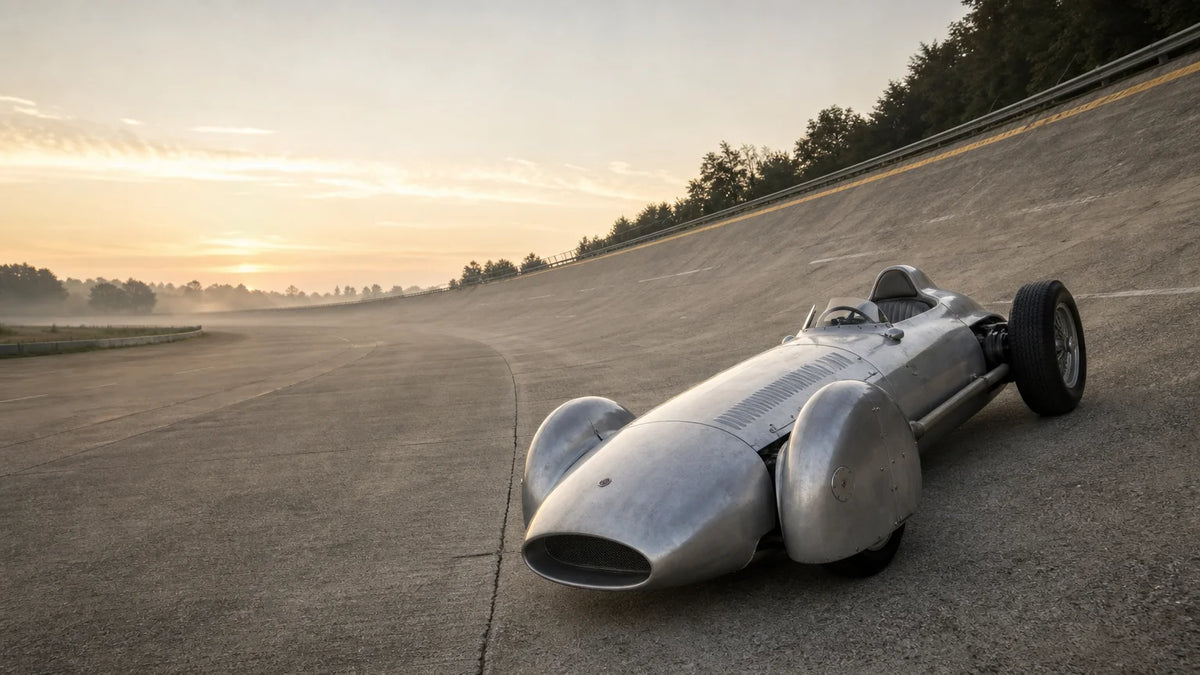
The Streamliner, also known as the Stromlinienwagen or Type Monza, enclosed the front wheels within a smooth, low-drag body. Its rounded nose, wide stance, and covered wheel arches reduced aerodynamic resistance at circuits such as Reims and Monza. The open-wheel body offered better visibility and more predictable behavior on winding circuits.
This approach shows how deeply Mercedes-Benz connected body design to circuit demands. The Streamliner was not simply a styling exercise. It was a removable aerodynamic solution developed for a precise competitive purpose. A modern overview from Car and Driver’s account also describes the W196 as a mid-1950s racing car whose enclosed body, center-seat layout, and lightweight construction made it instantly distinctive.

The body was also unusually light. Its Elektron magnesium alloy construction helped offset the additional mass of the enclosed panels. That balance between aerodynamic efficiency and minimum weight allowed the car to exceed 186 mph in period testing, depending on specification and gearing.
Chassis 00009/54 and its celebrated race history
Chassis 00009/54 illustrates the complexity of the W196 R program. Completed in December 1954, it began life with open-wheel bodywork and a long-wheelbase chassis. Its first competition appearance came at the 1955 Buenos Aires Grand Prix, a Formula Libre event where it used a larger three-liter engine connected to the later 300 SLR sports-racing program.
Juan Manuel Fangio drove chassis 00009/54 to victory in Buenos Aires after a two-heat contest. The car was then set aside while Mercedes-Benz concentrated on newer short-wheelbase cars for many of the 1955 races.
Its next major appearance came at the 1955 Italian Grand Prix at Monza. The car received Streamliner coachwork and was assigned to Stirling Moss. He qualified second behind Fangio, briefly took the lead, and later set the race’s fastest lap before retiring with a piston failure.
The chassis record confirms the significance of this sequence. One car connected Fangio’s Buenos Aires victory with Moss’s fastest lap at Monza, giving 00009/54 a dual-driver history that few surviving Grand Prix cars can match.
The engineering that made the W196 R exceptional
At the center of the car was a 2.5-liter naturally aspirated straight-eight engine. It used Bosch high-pressure direct fuel injection, dry-sump lubrication, dual ignition, and desmodromic valve gear. Unlike a conventional system, desmodromic operation mechanically controlled both the opening and closing of the valves.
This allowed the engine to operate at high revolutions without relying on traditional valve springs. At its 1954 debut, the engine produced approximately 257 horsepower. Continued development increased output toward 290 horsepower during the following season.
The engine was installed at an angle in the front compartment. This arrangement reduced the frontal profile and helped Mercedes-Benz package the long straight-eight within the narrow space frame. Power passed through a five-speed transaxle, while the inboard drum brakes reduced unsprung weight and improved aerodynamic packaging.
The suspension combined double wishbones and torsion bars at the front with a low-pivot swing axle at the rear. The system was technically sophisticated, although contemporary drivers found the car demanding. Narrow period tires could struggle to transmit the engine’s performance, particularly when the rear axle approached its handling limits.
That combination of innovation and difficulty is central to the W196 R’s character. It was not designed to flatter an inexperienced driver. It rewarded precision, preparation, and a clear understanding of changing track conditions.
Rarity, provenance, and the importance of chassis identity
Mercedes-Benz produced only a small number of W196 R chassis. Fourteen chassis numbers were assigned, although not every number represented a completed surviving car. At the end of the 1955 season, ten complete examples remained in running order, including four fitted with Streamliner coachwork.
For a collector, rarity alone is not enough. A significant car must also have a coherent story supported by factory records, competition documentation, mechanical inspection, and a credible ownership trail. The most important questions concern the identity of the chassis, the originality of its bodywork, the configuration used in period, and the relationship between its current components and its historical specification.
Chassis 00009/54 spent its post-racing life within institutional collections before entering private ownership in 2025. The sale price of €51,155,000 included the buyer’s premium. A contemporary pre-sale estimate had already placed the car above the €50 million threshold, reflecting the importance of its drivers, body configuration, and documented history.
These figures should not be treated as a universal valuation formula. A W196 R with different chassis history, incomplete documentation, non-original components, or restoration requirements would require a separate assessment. Auction results describe a specific transaction, not a guaranteed price for every related car.
How to evaluate a W196 R as a collector
The first question is not simply whether the car looks authentic. It is whether the entire object remains historically coherent. A careful evaluation should consider:
- Chassis provenance: confirm the identity, build sequence, race entries, and factory history.
- Body configuration: establish whether the Streamliner coachwork is original, period correct, or later fitted.
- Mechanical specification: inspect the engine, transaxle, suspension, brakes, and fuel system.
- Documentation: review factory correspondence, race records, restoration invoices, and museum files.
- Condition: distinguish preservation, sympathetic restoration, mechanical recommissioning, and complete reconstruction.
- Transaction terms: verify taxes, import duties, transport, insurance, storage, and any required technical work.

The most valuable examples are therefore not always the most cosmetically perfect. A preserved car with exceptional competition history may be more compelling than a heavily restored example with less certain provenance. For an international collector, jurisdiction, export arrangements, and specialist logistics also deserve attention before any offer is made.
Why this car still matters to a modern collection
The W196 R offers more than a famous name or a striking silhouette. It represents a concentrated moment when aerodynamic design, mechanical engineering, driver skill, and factory organization came together at the highest level of motorsport.
It also provides a direct connection to Mercedes-Benz’s racing heritage. The car’s visual language influenced later ideas about low-drag bodywork, enclosed wheels, and circuit-specific aerodynamics. Its engineering philosophy also helped shape the 300 SLR, the two-seat sports-racing derivative that competed in 1955.
For collectors building a broader automotive collection, the W196 R can serve as an anchor object. It connects prewar Silver Arrow thinking with postwar Formula One, while also explaining the technical relationship between a Grand Prix single-seater and a sports-racing car.
Our editorial perspective on Mercedes-Benz’s racing heritage places that continuity within a wider history of design, engineering, and cultural influence. The W196 R remains compelling because it is both a competition machine and a historical document.
Finding the right path for a rare-machine search
A car as scarce as the W196 R is rarely found through ordinary browsing. The search usually begins with a precise acquisition brief covering the desired period, body configuration, provenance standard, intended use, geographic location, and acceptable restoration scope.
We curate rare and future-oriented mobility objects through our international marketplace, with a network of more than 250 builders, designers, suppliers, and brands. Our team can also provide personal support for high-value machine inquiries, sourcing discussions, and acquisition planning.
Since 2017, we report more than 11,000 completed transactions, more than 9,000 clients worldwide, and more than 12,000 listed products. These figures describe our operating scale, while the suitability of any individual vehicle still depends on its documented history, condition, availability, and transaction terms.
For collectors who value design, engineering, rarity, and provenance across land, sea, and air mobility, this broader network can make the early research phase more efficient. It does not replace specialist inspection. It helps ensure that the search begins with a clear understanding of what matters most.
A lasting reference in racing history
The 1954 Mercedes-Benz W196 R Streamliner remains important because every major aspect of the car reinforces the others. Its aerodynamic body served a clear competitive purpose, its engine introduced advanced technology, and its drivers converted that potential into championship success. For collectors, the central lesson is simple: rarity matters most when it is supported by identity, provenance, authenticity, and an exceptional racing record.
Continue Your Mercedes-Benz Collection
If the W196 R has sharpened your interest in historically significant Mercedes-Benz design, the next step is to explore a road-going expression of the same era. A considered acquisition can begin with a model that combines iconic styling, engineering history, and lasting collector appeal.

We can help you explore curated mobility objects and connect the story of the W196 R with the broader world of rare machines. Discover the Mercedes-Benz 300 SL Coupe as a distinctive addition to a collection shaped by racing heritage and design excellence.
Frequently Asked Questions
What is the 1954 Mercedes-Benz W196 R Streamliner?
It is the enclosed-body version of Mercedes-Benz’s W196 R Formula One car, developed for high-speed circuits. The car used a center-seat layout, a 2.5-liter straight-eight engine, and advanced aerodynamic bodywork.
Why was the Streamliner body used?
The enclosed body reduced aerodynamic drag on fast circuits with long straights. Mercedes-Benz used the open-wheel configuration when visibility, cooling, and cornering behavior were more important.
How rare is the W196 R Streamliner?
Only a small number of W196 R chassis were built, and four complete examples were fitted with Streamliner coachwork at the end of the 1955 season. Individual rarity depends on chassis identity, body originality, competition history, and surviving documentation.
What makes chassis 00009/54 special?
Chassis 00009/54 was driven by Juan Manuel Fangio to victory at the 1955 Buenos Aires Grand Prix. Stirling Moss later drove it at Monza, where it achieved the fastest lap before retiring with mechanical failure.
Can TheArsenale help with a rare-machine search?
Yes. Our marketplace connects collectors with rare and future-oriented mobility objects, while our sales team provides personal assistance for machine inquiries and high-value acquisition discussions. Availability of any specific W196 R depends on the market, ownership history, and seller terms.