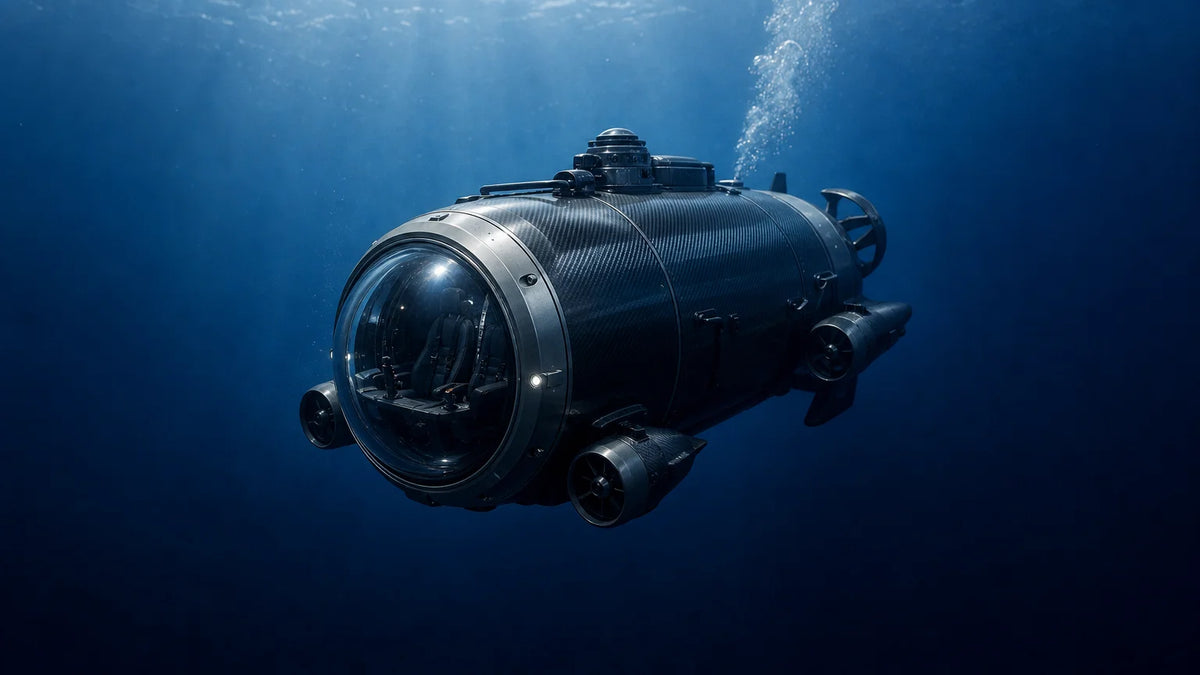
Carbon Fiber Submarine Hulls: Design, Safety, and Future
Our carbon-fiber monocoque paddle canoe illustrates why advanced composites attract marine designers. They can create light, rigid structures with distinctive performance characteristics. The harder question is whether a submarine with a carbon-fiber hull can manage the far greater compression found at depth.
If you search for “carbon fiber hull submarine,” you will find both ambitious engineering proposals and serious safety debates. A 2023 study indexed in a Defence Technology paper examined S-glass and carbon-fiber composites for submarine hull applications. That distinction matters because a promising material system is not automatically a validated passenger vehicle.
What does a carbon-fiber submarine hull actually do?
A submarine hull has two very different jobs. The outer structure manages equipment, propulsion, buoyancy, and hydrodynamic loads. The inner pressure hull protects occupants and sensitive systems from the surrounding water.
At the surface, pressure is close to one atmosphere. As depth increases, hydrostatic pressure rises from every direction. The hull therefore works primarily in compression, unlike many familiar carbon-fiber structures that are optimized for tension, bending, or vibration.
Carbon fiber itself is not a finished hull. It is a reinforcement made from extremely thin filaments. Engineers combine those filaments with a polymer resin, usually epoxy, to create a composite laminate.
The resulting material is directional. Fibers carry loads most effectively along their orientation. A cylinder may therefore require carefully selected axial, circumferential, and angled layers. The resin must transfer forces between those layers while resisting moisture, heat, impact, and repeated pressure cycles.
This is why the phrase “carbon fiber” is too broad for a meaningful safety assessment. A buyer or engineer must ask about the exact fiber type, resin system, laminate schedule, curing process, joints, interfaces, inspection method, and tested depth rating.
Why is carbon fiber attractive for underwater vehicles?
Carbon-fiber composites offer several characteristics that appeal to submersible designers. They combine low density with high specific stiffness, and they do not rust like conventional steel.
A 2025 review of fiber-reinforced composites in marine structures described applications across vessels, offshore systems, and underwater vehicles. The marine composites review also emphasized that performance depends on fiber architecture, resin behavior, and the intended loading conditions.
Lower structural weight can support more than speed. It may increase available payload, simplify transport, reduce the amount of buoyancy material required, or provide additional flexibility for batteries and life-support systems.
Corrosion resistance is another important benefit. Metal pressure vessels require careful protection, inspection, and maintenance, especially around dissimilar-metal joints. Composite structures avoid some corrosion mechanisms, although their interfaces and fittings may still contain metals that need protection.
Carbon fiber can also support unusual forms. Designers can tailor the laminate to produce a rigid cylindrical body, integrate curved surfaces, or create a lighter external shell around a separate pressure vessel.
These advantages explain the continuing research interest. They do not remove the central difficulty, which is the behavior of a thick composite shell under repeated external compression.

Why does deep pressure make the problem difficult?
Imagine placing an empty bottle deep underwater. The pressure does not push from one convenient direction. It acts across the entire surface and attempts to collapse the vessel inward.
A metal pressure hull can deform in ways that engineers have studied for decades. A composite hull behaves differently because it is anisotropic. Its strength changes with direction, layer arrangement, defects, temperature, moisture, and the condition of its bonded interfaces.
The main risks include buckling, delamination, resin cracking, fiber fracture, manufacturing voids, and local stress concentrations. Some defects may remain invisible from the outside while reducing the structure’s collapse margin.
Fatigue damage is particularly important. Each dive applies a pressure cycle, and each ascent removes it. Repeated cycles can enlarge small defects or change how loads move between layers.
Water exposure introduces another variable. Moisture can affect the resin and the bond between materials. Temperature changes can also create different expansion and contraction rates across carbon fiber, resin, titanium, acrylic, and other components.
Geometry matters as well. A near-perfect sphere distributes pressure efficiently, while a long cylinder can face more complex buckling behavior. End caps, viewports, hatches, penetrations, and bonded joints may become critical points in the load path.
For this reason, a deep-diving composite design requires more than a simple tensile-strength calculation. Engineers must evaluate collapse pressure, imperfections, damage tolerance, fatigue, joints, manufacturing variation, and the consequences of a failed component.
What did the Titan incident reveal about composite risk?
The Titan submersible became the most visible example of the risks associated with an experimental composite pressure hull. The vehicle imploded during a Titanic expedition on June 18, 2023, killing all five occupants.
A 2023 investigation by The New Yorker investigation reported that the carbon-fiber cylinder was developed under a six-week production timeline. That detail does not prove that a short schedule alone causes failure, but it illustrates why manufacturing time and independent verification matter.
The broader lesson is not that every composite hull is inherently unsafe. The lesson is that material selection must remain connected to the design process, production controls, inspection program, operational limits, and independent review.
In the Titan case, public criticism focused on the use of carbon fiber, but the engineering question is more precise. Was the complete pressure vessel designed, manufactured, tested, monitored, maintained, and operated with enough evidence to justify its intended mission?
A real-time monitoring system may provide useful information, but it should not replace structural qualification. Acoustic signals, strain measurements, pressure readings, and dive records can support decision-making. They cannot turn an inadequately validated structure into a certified one.
The incident also shows why marketing language can confuse buyers. A vehicle may use aerospace-grade or advanced composite materials without having the same qualification pathway as a certified aircraft component. The material name is only one part of the safety case.
How should you evaluate a credible composite submersible?
Start with the mission profile. A craft designed for shallow coastal observation faces different demands from one intended for repeated deep-ocean expeditions.
You should then request evidence for the stated operating depth. A credible technical package may include finite-element analysis, hydrostatic pressure tests, fatigue testing, material certificates, non-destructive inspection records, and documented acceptance criteria.
Non-destructive testing is essential because internal voids, weak bonds, delamination, and fiber misalignment may not be visible. Ultrasonic inspection, radiography, thermography, and other methods can reveal defects that ordinary visual checks miss.
Ask how the hull is inspected before and after pressure cycles. The answer should explain which regions are examined, what defect sizes are acceptable, how findings are recorded, and who has authority to withdraw the vehicle from service.
Look closely at interfaces. Titanium end caps, acrylic viewports, hatches, electrical penetrations, fasteners, and bonded joints can concentrate stress. A strong cylindrical laminate does not guarantee that the complete pressure boundary is equally strong.
Classification and certification deserve separate attention. Independent review can assess design assumptions, construction quality, testing, operating procedures, and maintenance. It does not eliminate every risk, but it creates a structured process for challenging unsupported claims.
A 2026 review of high-performance thermoplastic composites in underwater structures shows that research continues across materials, manufacturing methods, and marine applications. The 2026 composite materials review is a reminder that development remains active. Research progress should not be confused with universal approval for crewed deep-diving hulls.
Finally, evaluate the operator. A well-designed hull still requires disciplined mission planning, emergency procedures, crew training, support logistics, communication, and maintenance. The safest purchase decision considers the vehicle and the organization operating it as one system.
For a broader buying framework, our personal submarine buying guide can help you organize questions about mission, capacity, design, support, and acquisition requirements.
What alternatives exist to a full composite pressure hull?
Carbon fiber is not the only way to reduce weight or improve a submersible’s performance. Designers may use titanium, high-strength steel, aluminum in selected applications, syntactic foam, or hybrid construction.
A hybrid approach can place materials where they are most appropriate. For example, a metal pressure vessel may provide the primary occupant boundary, while composites form external fairings, equipment supports, buoyancy structures, or hydrodynamic covers.
Another option is to use composite materials in a carefully limited role. The pressure hull may remain metallic while carbon fiber supports non-pressure components. This can preserve some weight and corrosion benefits without assigning every deep-pressure load to a composite cylinder.
There is no universal answer because depth, payload, vehicle size, endurance, launch method, and operating environment all affect the design. A private coastal submersible may prioritize visibility and comfort. A research vehicle may prioritize sensors, endurance, and repeatable deployment.
The most important comparison is therefore not “carbon fiber versus metal.” It is whether the complete design has a defensible margin of safety for its declared mission.
What does this mean for personal submarine buyers?
Personal submersibles are often purchased for exploration, marine observation, private expeditions, or distinctive ownership experiences. Their technical requirements can vary widely, so a visually impressive hull should not be the only decision factor.
Ask whether the advertised depth is a tested operating limit, a theoretical collapse estimate, or an aspirational target. These terms describe different levels of evidence and should never be treated as interchangeable.
Also compare occupant capacity, life-support endurance, emergency recovery, launch and retrieval requirements, service intervals, spare parts, transport, crew training, and local operating permissions.
Our feature on the Nemo submarine by U-Boat Worx provides one editorial reference point for understanding how a personal submersible can be presented as a complete mobility object rather than a hull alone.
Design philosophies also differ between builders. Our coverage of Seamagine Aurora submarines offers another example of how visibility, passenger experience, engineering layout, and underwater access can shape the product concept.
These examples are useful for comparison, but they do not replace technical due diligence. Before committing to a vehicle, request written specifications and ask for clear answers about certification, inspection, operational support, and long-term maintenance.
What a Safer Design Standard Looks Like
A carbon-fiber hull can offer meaningful benefits when its architecture, resin system, interfaces, manufacturing process, and operating limits are properly controlled. The central issue is not whether carbon fiber sounds advanced. It is whether the complete pressure vessel has been independently analyzed, thoroughly tested, repeatedly inspected, and responsibly operated. For any carbon-fiber submarine hull, evidence should carry more weight than appearance, novelty, or marketing language.
Take action with TheArsenale
Choosing a personal submersible requires more than an interest in unusual design. You need a clear view of the mission, the engineering concept, the builder, the operating environment, and the level of support available after acquisition.

We curate future-oriented mobility objects and connect collectors with distinctive machines across land, sea, and air. To review available concepts and begin a more informed conversation with our team, Explore personal submarines through TheArsenale.
Frequently Asked Questions
Is carbon fiber suitable for a submarine hull?
It can be suitable for specific designs when the laminate, resin, joints, testing, and operating limits are properly validated. Suitability depends on the complete pressure vessel, not on the material name alone.
Why is external water pressure difficult for composites?
Deep water applies compression from every direction, while composite strength varies according to fiber orientation and laminate quality. Defects, buckling, delamination, and repeated pressure cycles can reduce the available safety margin.
What should you request before buying a personal submersible?
Request the tested operating depth, structural analysis, pressure-test evidence, inspection records, certification status, maintenance plan, emergency procedures, and support requirements. You should also distinguish a proven operating limit from a theoretical design estimate.
Are metal hulls always safer than carbon-fiber hulls?
No material is automatically safe without sound design, manufacturing, inspection, and operation. Metal hulls have a longer history in crewed deep-diving applications, while composite designs require especially careful validation because their failure modes and inspection needs differ.
Can TheArsenale help me explore personal submersibles?
Yes. TheArsenale curates personal submarines and other future-oriented mobility objects for collectors and enthusiasts. Its editorial resources can also help you compare concepts, builders, design priorities, and acquisition questions.