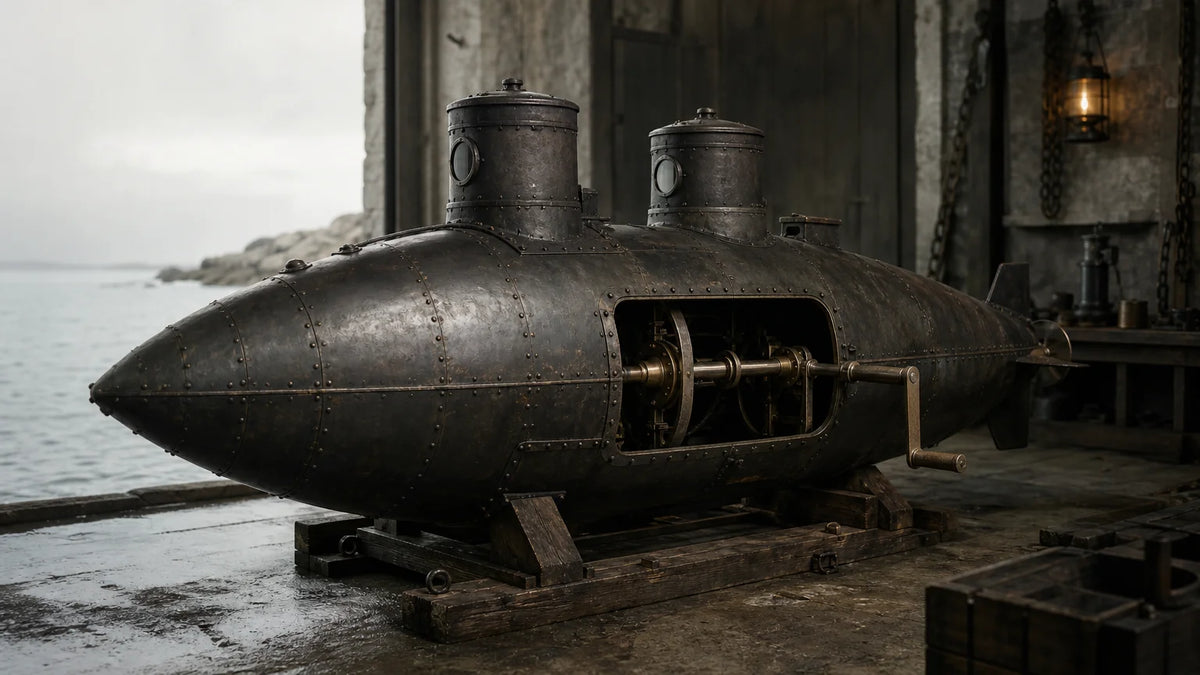
Hand Crank Submarine History, Design, and How It Worked
Why does a hand crank submarine still attract attention? It converts crew effort into underwater movement with very little separation between the person and the propeller. If you want to compare that historical logic with contemporary concepts, our DIY submarine plans provide a useful design-oriented starting point.
The term usually describes a small submersible powered by people turning a crank inside the hull. The Naval History record describes the H.L. Hunley as using a hand crank operated by seven crew members, while an eighth person piloted the boat. That arrangement reveals both the ingenuity and the serious physical demands of early underwater navigation.
What Is a Hand Crank Submarine?
A hand crank submarine is a human-powered underwater craft. Instead of relying on an electric motor, diesel engine, or nuclear reactor, it uses the crew's physical effort to rotate a mechanical drive system. The crank turns a shaft, the shaft transfers torque through the hull, and the propeller converts that rotation into thrust.
This arrangement is different from a simple diving bell or a submerged boat. A hand-powered submersible must control its buoyancy, direction, depth, ventilation, and propulsion at the same time. The result is a machine in which every movement depends on close coordination between the crew and the hull.
The concept also differs from a human-powered research cycle that uses pedals or another leg-driven mechanism. A crank allows a crew to use the arms and upper body while sitting inside a narrow pressure-resistant space. That choice can simplify the layout, although it can also create fatigue because the motion is repetitive and continuous.
How Did the Propulsion System Work?
Imagine a crew seated along the length of a narrow iron hull. Each person turns a handle connected to a common shaft. As the shaft rotates, gearing or direct mechanical connections transmit power toward the propeller. The pilot then combines forward thrust with steering controls and ballast adjustments.
The underlying principle remains relevant to underwater engineering. A NOAA research report on a human-powered submersible examined both rotary and linear drive systems, while measuring factors such as heart rate, rotational speed, and air consumption. These measurements show why propulsion is not only a mechanical question. It is also a question of human endurance, breathing, posture, and workload.
In a compact hand-powered design, the crank system must be efficient because the crew has limited energy. Friction in the bearings, poor alignment, an inefficient propeller, or excessive hull drag can quickly reduce performance. A well-considered system therefore balances mechanical simplicity with effective transfer of human power.
Why Was the Design So Demanding?
Consider the environment inside the hull. The crew works in a confined metal space, often with limited visibility, limited air, and little room to change position. At the same time, the machine must remain watertight and stable while moving beneath the surface.
The physical challenge is only one part of the problem. A hand crank submarine also creates a demanding operational environment. The crew must maintain a steady rhythm, communicate clearly, monitor depth, and respond to changes in trim. If one person loses pace, the entire propulsion system may become less effective.
Safety is equally important. A PLOS One analysis examined the H.L. Hunley and concluded that blast effects were consistent with fatal injuries to its crew. The finding illustrates a central principle of submersible design: a strong hull, controlled buoyancy, reliable ventilation, and an emergency plan are as important as propulsion.
For that reason, historical hand-powered submarines should not be treated as casual construction projects. The pressure hull and all penetration points require specialist engineering. A mistake in sealing, material selection, ballast, or structural calculation can have severe consequences.
What Does the H.L. Hunley Reveal?
The H.L. Hunley demonstrates how a hand-powered craft could become a serious military machine. Its crew did not simply turn a crank and hope to travel forward. They worked within a coordinated system involving propulsion, piloting, ballast tanks, hand pumps, hatches, and conning towers.
The design also shows the importance of separating propulsion from navigation. Seven people supplied the physical power, while the pilot focused on direction and control. That division reflects a practical response to limited space and limited technology.
The Hunley became historically significant because it proved that a small crewed submersible could approach and attack a surface vessel. Its story also underlines the risks of early underwater experimentation. The machine achieved an important technical milestone, but the crew did not return from the mission.
Its later recovery created a second chapter focused on conservation rather than combat. The Friends of the Hunley describes the vessel as an archaeological object preserved through continuing scientific work. That perspective matters because the submarine is not only a weapon or machine. It is also evidence of how nineteenth-century engineers approached propulsion, buoyancy, materials, and confined human environments.
Can Modern Personal Submarines Use the Same Idea?
A contemporary personal submersible may share the historical goal of carrying people below the surface, but its priorities are different. Modern concepts can use electric propulsion, battery systems, digital instrumentation, improved ballast control, and more advanced materials. These technologies reduce the physical burden on the occupants and make precise control more practical.
Even so, the hand crank principle remains valuable as a design reference. It makes the relationship between energy input and movement easy to understand. It also encourages designers to think carefully about drag, propeller efficiency, weight distribution, redundancy, and pilot workload.
If you are comparing historical mechanisms with contemporary ownership concepts, our personal submarine plans offer a more current framework for examining layout, purpose, and design direction. The key distinction is that modern personal submarines must be considered as complete systems, not simply as hulls with a propulsion device.
That complete system includes launch and recovery procedures, communication, emergency ascent, inspection, maintenance, and operational limits. It also includes the environment in which the craft will be used. A vessel intended for calm, shallow water faces different requirements from one designed for offshore exploration.
What Should You Examine Before Considering a Design?
Suppose you are evaluating a historical replica, a museum reconstruction, or a modern personal submarine concept. The most useful questions concern the entire operating system rather than the crank alone.
- Pressure hull: Is the hull designed and tested for its intended operating depth?
- Buoyancy control: Can the craft descend, maintain depth, and return to the surface in a controlled manner?
- Propulsion: Does the drive system provide predictable thrust without creating excessive fatigue or vibration?
- Pilot visibility: Can the operator navigate while monitoring depth, direction, and surrounding traffic?
- Emergency procedures: Are there reliable methods for surfacing, communicating, and evacuating?
- Support requirements: Can the vessel be transported, launched, recovered, inspected, and maintained safely?
A personal submarine kit may be useful for exploring the components and design language of a concept, but it does not replace professional engineering, testing, or regulatory review. For a broader look at how these objects fit within the world of curated mobility, our submarines collection places personal underwater machines alongside other rare forms of transportation.
Why Does the Idea Still Matter?
The lasting value of a hand crank submarine is not limited to its historical novelty. It shows how engineers can create movement from basic mechanical principles when energy, space, and materials are constrained.
It also offers a clear lesson in human-machine relationships. The crew is not separate from the propulsion system. Their strength, rhythm, communication, and endurance directly influence the vessel's performance. That connection makes the concept unusually easy to understand, even when the engineering challenges are complex.
For collectors, designers, and mobility enthusiasts, the subject connects maritime heritage with future-oriented transportation. It encourages a close look at how a machine is powered, controlled, experienced, and remembered.

A Practical Conclusion
A hand crank submarine is best understood as a complete human-powered system, not merely an underwater vehicle with a rotating handle. Its historical importance comes from combining propulsion, buoyancy, navigation, and crew coordination inside a remarkably constrained hull. When you evaluate a replica or modern concept, focus on structural integrity, controlled operation, emergency planning, and the relationship between human effort and mechanical performance.
Take action with TheArsenale
If the history of hand-powered submersibles has made you curious about personal underwater mobility, the next step is to explore designs that connect engineering, rarity, and individual experience. We help collectors and enthusiasts discover unusual machines through a curated mobility ecosystem.

Our selection includes personal submarines and other future-oriented vehicles presented for discovery and acquisition. To explore a contemporary option with a distinctive design direction, view our Nemo personal submarine and contact our team for further information.
Frequently Asked Questions
What is the difference between a hand crank submarine and a modern personal submarine?
A hand crank submarine relies primarily on human effort to turn a mechanical propulsion system. A modern personal submarine typically uses powered systems, advanced instrumentation, and more developed safety and support procedures.
How many people operated the H.L. Hunley?
The H.L. Hunley used seven crew members to operate its hand crank and an eighth person to pilot the boat. This division allowed propulsion and navigation duties to be handled separately.
Could you build a hand crank submarine today?
A technically accurate replica would require specialist naval architecture, structural engineering, materials expertise, and controlled testing. It should not be approached as an ordinary do-it-yourself project because pressure and buoyancy failures can be life-threatening.
Why did early submarines use hand cranks?
Early designers had limited access to compact, reliable underwater power systems. A hand crank provided a direct way to generate propulsion without relying on an engine, although it demanded considerable effort from the crew.
Where can you explore modern personal submarine concepts?
You can explore curated personal submarine concepts through TheArsenale. Our marketplace connects collectors and enthusiasts with unusual mobility objects, including underwater machines and other future-oriented vehicles.