How to Choose a High End Espresso Machine With Confidence
A high-end espresso machine should do more than look impressive on a counter. It should make your preferred drinks consistently, suit your preparation style, and remain rewarding after the first excitement fades. Before comparing materials or interfaces, define what you want from the ritual. Our luxury espresso machine buying guide can help you frame that decision around design, engineering, and long-term ownership.
The central choice is between control and convenience. Recent 2026 testing from TechRadar testing also emphasizes that buyers should match the machine to their preferred level of involvement, available counter space, and cleaning routine. A premium price only makes sense when those details support your real habits.
Start with the drinks and workflow you actually want
Begin with your morning routine, not a feature list. Do you mainly drink straight espresso, or do you prepare cappuccinos, flat whites, and lattes several times a day? Do you enjoy weighing coffee, adjusting a grinder, and steaming milk manually? Or do you want a refined result with fewer decisions?
A machine for occasional espresso has different priorities from one used for several milk drinks in succession. If you usually drink espresso without milk, brew temperature, pressure control, pre-infusion, and portafilter quality deserve the most attention. If you regularly prepare milk drinks, steam power, recovery time, wand control, and the ability to brew and steam efficiently become equally important.
A 2026 review framework from Tom's Guide treats convenience, learning curve, and day-to-day usability as meaningful parts of performance. That is an important principle for high-end buyers. A machine can offer advanced control, but those controls only create value when you are willing to use them.
- Choose manual control if you enjoy experimentation and want to adjust extraction variables yourself.
- Choose guided control if you want programmable settings without giving up fresh coffee and quality milk texturing.
- Choose simplicity if speed, repeatability, and easy cleaning matter more than brewing experimentation.

Choose the brewing architecture before the finish
The internal heating system shapes the machine’s behavior more than its exterior finish. High-end models generally use a single boiler, heat exchanger, dual boiler, thermoblock, or manual lever architecture. Each option reflects a different compromise between thermal control, steam performance, size, energy use, and operating style.
| Architecture | Strength | Best suited to | Main trade-off |
|---|---|---|---|
| Single boiler | Compact design and straightforward operation | Espresso drinkers who make occasional milk drinks | Brewing and steaming usually require a temperature change |
| Heat exchanger | Simultaneous brewing and steaming from one main boiler | Households that prepare frequent milk drinks | Temperature management may require more technique |
| Dual boiler | Independent brew and steam temperatures | Frequent users, entertainers, and experimentation | Larger footprint and greater ownership complexity |
| Manual lever | Direct control over pressure and extraction movement | Experienced users who value the brewing ritual | Slower workflow and a steeper learning curve |
A dual boiler is not automatically the right answer. It is valuable when you need stable brewing while steaming milk, prepare multiple drinks, or adjust temperature for different coffees. A heat exchanger may be more appropriate when you want strong steam performance but prefer a simpler internal layout.
Manual systems can produce an engaging and highly personal experience, but they demand more from the user. You need a capable grinder, accurate dosing, consistent preparation, and patience. The most expensive architecture is therefore not always the most suitable one. The right choice is the system that matches your desired balance of control and convenience.
Prioritize temperature stability and pressure regulation
Espresso extraction is sensitive to temperature and pressure. If the brew water fluctuates significantly, the same recipe can taste different from one shot to the next. If pressure is poorly regulated, water can move unevenly through the coffee bed, creating weak, bitter, or unbalanced results.
Look for a machine with a credible temperature-control system, such as a PID controller or another clearly explained regulation method. A PID can help maintain the selected brew temperature by making continuous adjustments. It does not replace fresh coffee, a precise grinder, or sound technique, but it can reduce one major source of inconsistency.
Pressure should be evaluated by regulation, not by the largest number printed on a product page. A pressure gauge can provide useful feedback, while an adjustable over-pressure valve or flow-control system can give experienced users more influence over the extraction. For broader context, the 2026 espresso buying framework highlights temperature control, pressure management, and portafilter compatibility as connected decisions rather than isolated specifications.
Pre-infusion is another feature worth understanding. It wets the coffee puck before full extraction pressure develops. This can improve preparation consistency, especially with lighter roasts or carefully developed recipes. However, pre-infusion only becomes a meaningful advantage when the machine gives you a practical way to control or repeat it.
Treat the grinder, portafilter, and accessories as one system
A high-end espresso machine cannot compensate for an inconsistent grinder. Espresso requires fine, repeatable particles and small adjustments. If the grind is too coarse, water may pass through the puck too quickly. If it is too fine, the shot may stall or become harsh.
For that reason, decide early whether you want a built-in grinder or a separate unit. Integration saves space and simplifies the workflow. A separate grinder usually gives you more flexibility, easier replacement, and a clearer upgrade path. It also prevents a grinder issue from affecting the entire coffee setup.
Portafilter size affects accessory choice and future flexibility. A commercial-style 58 millimeter system offers broad compatibility with baskets, tampers, distribution tools, and bottomless portafilters. Smaller formats can still perform well, but they may offer fewer compatible accessories.
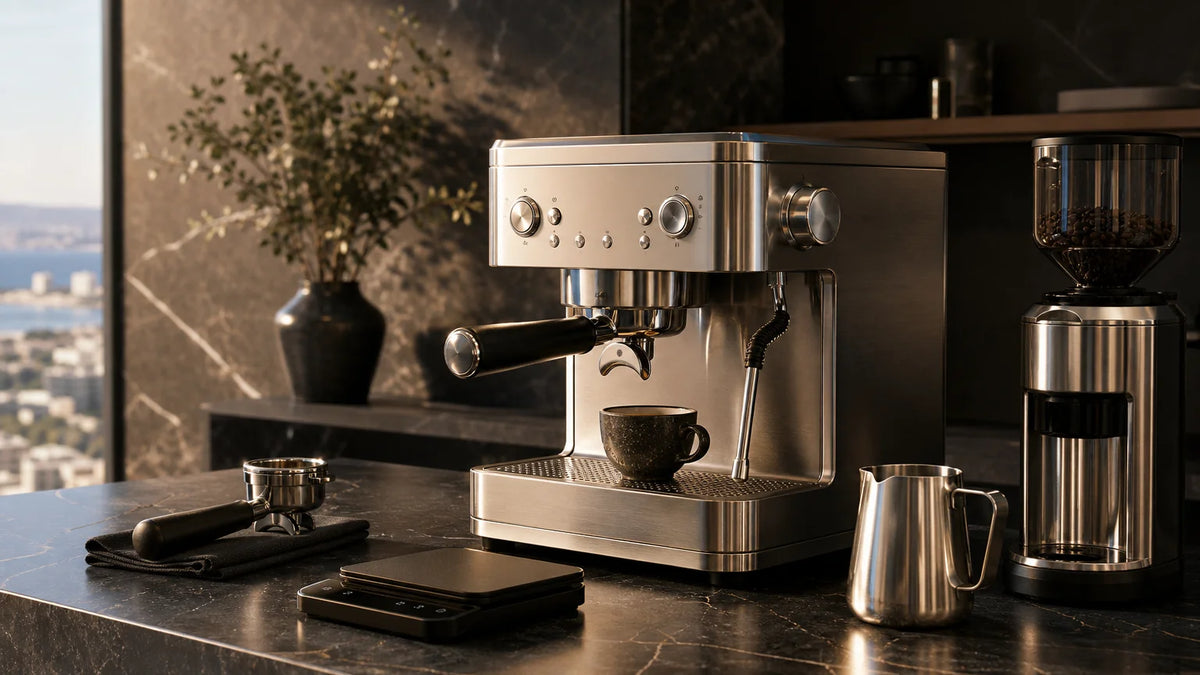
Also inspect what comes in the box. A serious setup may require a precision basket, tamper, scale, milk pitcher, water filtration, and cleaning tools. Include those items in the total cost before deciding whether a machine is genuinely high-end for your needs.
Our luxury coffee machine buying guide is useful when the purchase involves more than extraction alone. It considers the relationship between design, engineering, and the role the machine plays within a refined interior.
Check capacity, ergonomics, and installation requirements
Measure the space before you fall in love with a machine. Record available width, depth, height, cabinet clearance, and the space needed to refill the reservoir or remove the drip tray. A tall machine may fit beneath a cabinet but still become frustrating if the water tank cannot be accessed comfortably.
Consider the following practical questions:
- Can you reach the reservoir without moving the machine?
- Is the drip tray large enough for your daily use?
- Will the machine accept your preferred cups and travel mugs?
- Can you connect it to a water line, if that matters to you?
- Does the electrical configuration suit your country and installation?
- Is there enough space beside the machine for your grinder and accessories?
Capacity should reflect actual use rather than aspiration. A large boiler and reservoir can support entertaining, but they also add weight, heat-up requirements, and cleaning obligations. If you prepare two drinks each morning, a compact system may deliver a better experience than a commercial-style machine built for a much heavier workload.
Heat-up time deserves equal attention. Fast systems support spontaneous use, while larger boilers may reward scheduled operation and longer preparation windows. Neither approach is inherently superior. The right answer depends on whether you value immediate access or sustained performance during several consecutive drinks.
Evaluate maintenance, service, and total ownership
Ownership begins after delivery. Ask how often the machine requires backflushing, descaling, water-filter replacement, steam-wand cleaning, and group-head maintenance. A beautiful machine that is difficult to clean will eventually become less enjoyable to use.
Water quality is especially important. Hard water can accelerate scale formation and affect heating components. Before buying internationally, verify local water guidance, filter compatibility, voltage, warranty coverage, repair arrangements, and access to replacement parts.
Energy use also belongs in the ownership calculation. The 2025 ENERGY STAR report evaluates coffee-machine use across ready, standby, and off modes. That framework reinforces a practical point: ownership cost includes how the machine is operated, not only its purchase price.
Serviceability can matter more than an additional display or decorative feature. Look for clear maintenance instructions, accessible consumables, established service channels, and a warranty that applies in your market. If the machine is imported, confirm who handles repairs and how long common parts remain available.
For a high-value acquisition, personal advice can reduce the risk of choosing an impressive specification that does not suit your home. We support questions about machines and sourcing through direct consultation, which is particularly useful when design, rarity, and long-term ownership all matter.
Let the design matter, but make it earn its place
A high-end espresso machine is often visible every day. Its proportions, finish, controls, and materials contribute to the atmosphere of the room. Aesthetic appeal is therefore a legitimate selection criterion, provided it does not distract from the fundamentals of extraction and service.
Evaluate whether the design reflects your space and whether the visible controls support your workflow. Rotary knobs may feel more natural to you than a touchscreen. A classic silhouette may suit a traditional interior, while a sculptural machine may work better as a focal object in a contemporary setting.
Our designer espresso machine prices resource can help you separate the cost of visual distinction from the value of brewing performance. That distinction is useful when finishes, limited production, or unusual materials influence the final price.
For readers who view the machine as a collectible object as well as a coffee tool, our Koenigsegg-inspired titanium espresso machine illustrates how automotive design language can inform a home brewing object. Our wider marketplace connects collectors with rare and future-oriented machines, supported by a network of more than 250 builders, designers, suppliers, and brands. We also report more than 11,000 completed transactions since 2017, a company-reported scale indicator for high-value acquisitions.

Use a final decision checklist before you buy
Before committing, score each candidate against the same criteria. This prevents a striking exterior or impressive pump rating from overshadowing the features that determine daily satisfaction.
- Define your drinks: espresso, milk drinks, americanos, or a broad mix.
- Choose your workflow: manual, guided, or largely automated.
- Confirm the architecture: single boiler, heat exchanger, dual boiler, thermoblock, or lever.
- Verify control: temperature stability, pressure regulation, pre-infusion, and feedback.
- Budget for the system: grinder, water treatment, accessories, and maintenance.
- Measure the installation: counter space, electrical requirements, refill access, and ventilation.
- Check ownership support: warranty, parts, cleaning, descaling, and service.
- Assess the design: finish, proportions, controls, and how it belongs in your space.
Do not make the final decision from specifications alone. Read the manual, inspect the cleaning process, confirm regional support, and imagine preparing your most common drink on a busy morning. That practical test often reveals more than a long feature list.
Choose the machine that fits your ritual
The most reliable way to choose a high-end espresso machine is to work from your habits toward the technology. Start with the drinks you make, then match the heating architecture, temperature control, pressure regulation, grinder strategy, capacity, maintenance, and design to those habits. When the machine performs well and feels natural to use, its value extends beyond the first cup. The best choice is the one that gives you the control you want without imposing a workflow you will eventually avoid.
Make Your Coffee Setup More Distinctive
If your decision includes design, rarity, and the character of the object itself, a curated source can make the process more considered. We help collectors and enthusiasts explore unusual machines and high-value acquisitions through personal sales support and a global network of builders, designers, and brands.

For a singular centrepiece to your coffee ritual, explore our Aurum 18ct high-end espresso machine. Review the product details, consider how it fits your space and workflow, and contact our team if you require a more tailored answer.
Frequently Asked Questions
What makes an espresso machine high-end?
A high-end machine usually combines stable brewing performance, durable construction, strong milk-steaming capability, thoughtful ergonomics, and meaningful user control. Premium design, advanced materials, and service support may also contribute, but they should complement performance rather than replace it.
Do you need a dual boiler for excellent espresso?
No. A dual boiler is most useful when you prepare several milk drinks, need simultaneous brewing and steaming, or want precise independent temperature control. A well-designed single boiler or heat exchanger can be more suitable when your workflow is smaller or more focused on espresso.
Is a built-in grinder a good choice for a luxury setup?
A built-in grinder can simplify the counter and make the routine faster. A separate grinder usually offers greater flexibility, easier replacement, and more control over grind quality, so the better choice depends on whether convenience or long-term modularity is your priority.
How important is a 58 millimeter portafilter?
A 58 millimeter portafilter is widely used across professional-style equipment and offers broad accessory compatibility. Smaller formats can still produce excellent coffee, but a 58 millimeter system may provide a more adaptable path for future baskets, tampers, and distribution tools.
Can TheArsenale help you choose a high-end espresso machine?
Yes. We provide curated access to rare and design-led machines, along with direct answers for machine and sourcing questions. Our network of more than 250 builders, designers, suppliers, and brands can be relevant when your purchase involves unusual design, provenance, or a high-value acquisition.