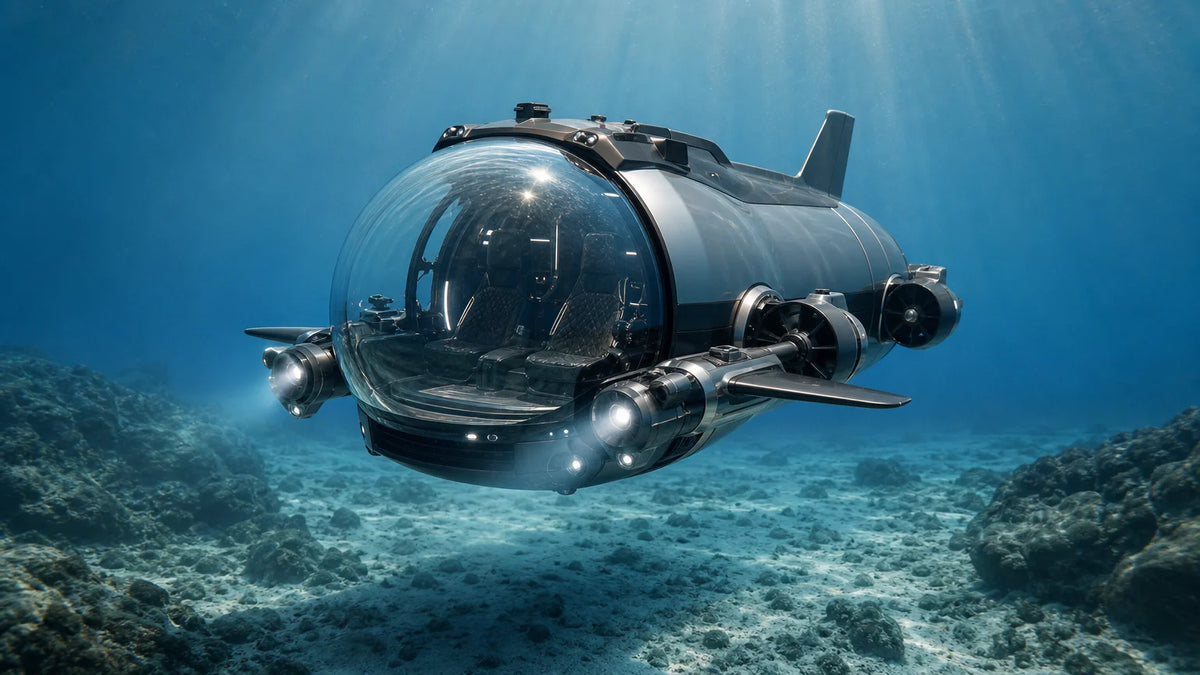
Personal Submarine Price: 2026 Costs, Models and Ownership
A personal submarine can cost less than a conventional yacht tender or considerably more than a luxury yacht. The answer to the personal submarine price question usually begins around the high six figures for a compact production craft, then climbs rapidly with depth, capacity, and customization. To see how those figures translate into real listings, review our personal submarine prices before comparing models.
Published 2026 market research also shows why no single average is reliable. One 2024 market estimate places the global personal submarine market at $1.14 billion in 2024 and forecasts continued growth through 2033. Those market totals describe industry activity, not a buyer’s invoice. Your real quotation depends on engineering specification, delivery scope, and operating environment.
How much does a personal submarine cost in 2026?
The short answer is broad: approximately $600,000 to more than $40 million. Compact production models occupy the lower end, while deep diving craft, large passenger submersibles, and bespoke expedition vessels occupy the upper end.
For many private buyers, the practical range is approximately $1 million to $5 million. This range can cover compact two-person craft, yacht-integrated leisure submersibles, and larger models with greater depth capability. The figure may exclude taxes, shipping, commissioning, support equipment, training, and custom engineering.
A compact owner-operated submersible may offer a transparent acrylic pressure hull, electric propulsion, limited passenger capacity, and a depth rating around 100 metres. A deep diving vessel requires a more demanding pressure hull, stronger systems, extensive testing, specialist classification, and more complex launch support.
At the top of the market, the submarine may function less like a recreational tender and more like a second yacht. Large passenger capacity, extended endurance, accommodation, specialist sensors, and dedicated support vessels can move the budget into eight figures.

Personal submarine price ranges by category
A useful way to compare prices is to separate the market by mission rather than by appearance. Two submarines may look similar from the surface while having completely different pressure ratings, endurance, certification, and support requirements.
| Category | Indicative 2026 budget | Typical capacity | Typical use |
|---|---|---|---|
| TheArsenale curated marketplace | Six figures to eight figures | 1 to 10 or more occupants | Personalized comparison, sourcing, and acquisition support |
| Compact production submersible | Approximately $600,000 to $1.5 million | 1 to 2 occupants | Reef exploration, yacht use, and owner operation |
| Luxury leisure submersible | Approximately $1 million to $5 million | 2 to 5 occupants | Private exploration and superyacht deployment |
| Deep diving or expedition craft | Approximately $5 million to $40 million or more | 2 to 10 or more occupants | Research, expedition, filming, and extended operations |
| Used or legacy submersible | Highly variable | Usually 1 to 5 occupants | Restoration, specialist projects, or lower entry cost |
The lower end should not be confused with a simple recreational purchase. Even a compact model can require a crane, launch cradle, battery servicing, operator training, and a suitable storage plan. A lower acquisition price may also reflect an older pressure hull, limited documentation, or a need for inspection before operation.
TheArsenale’s curated range is designed for buyers who need more than a generic listing. We can help compare specifications, availability, configuration, and intended use across different builders. Our personal submarines for sale collection provides a starting point for that process.
Why do depth rating and capacity change the quote?
Imagine choosing between a two-person submersible rated for shallow recreational dives and a three-person craft built for several hundred metres. The difference is not simply a larger cabin. It affects the pressure hull, acrylic structure, ballast system, propulsion, life support, emergency systems, testing, and classification.
Depth rating is one of the most important cost drivers. Water pressure increases with depth, so a craft designed for deeper operation needs stronger materials and more demanding engineering. That additional capability can increase the price even when the exterior dimensions remain relatively compact.
Passenger capacity also affects the quotation. More occupants require additional cabin volume, seating, life support, buoyancy management, reserve capacity, and emergency planning. A larger cabin can also increase weight, which may require stronger lifting equipment and a more capable support vessel.
Endurance creates another layer of cost. A short dive near a yacht requires a different battery system and life support specification from an extended expedition. Buyers should compare dive duration, recharge time, operating temperature, battery chemistry, and service intervals instead of looking only at maximum depth.
Customization can include interior finishes, seating layout, paint, lighting, cameras, sonar, navigation equipment, manipulator arms, communications, and yacht integration. These additions may be individually manageable, but the total can materially change the final invoice.
Is a used personal submarine cheaper than a new one?
A used submersible can have a lower purchase price, but the headline figure does not reveal its true acquisition cost. The condition of the pressure hull, battery system, seals, acrylic viewports, control electronics, ballast system, and life support equipment must be evaluated before a buyer can compare it with a new model.
Inspection history is especially important. Ask for the original technical documentation, classification records, maintenance logs, previous dive history, battery replacement records, and details of any modifications. A missing record can make insurance, certification, transport, and resale more difficult.
Refurbishment can also change the financial calculation. Replacing batteries, updating navigation equipment, renewing seals, repairing corrosion, or recertifying a pressure hull may require specialist work. The total may approach the price of a newer production model, particularly when the used craft has been stored for a long period.
New production models normally provide clearer configuration, builder support, training pathways, and documentation. They may also offer more predictable delivery and maintenance planning. A used model can still make sense when its provenance is strong and an experienced technical team validates the craft.
Buyers who want to evaluate these differences can use our personal submarine buying guide to structure questions around mission, storage, training, and support. The objective is not to find the lowest sticker price. It is to identify the lowest credible total cost for a safe and usable vessel.
What does ownership add beyond the purchase price?
The acquisition price is only the first part of the budget. A responsible ownership plan should include training, transport, storage, insurance, maintenance, inspections, launch and recovery equipment, support personnel, and possible classification or regulatory work.
A 2025 industry estimate suggests that annual maintenance for a luxury submarine can reach up to 10% of its initial purchase price. This is not a universal fee or a guaranteed annual bill, but the industry cost estimate illustrates why recurring expenses deserve attention before purchase.
Training and certification depend on the builder, vessel, operating location, and insurance requirements. Many manufacturers provide structured pilot training, while owners may also use a professional crew member or specialist operator. You should obtain the training pathway in writing before committing to a model.
Maintenance planning should cover batteries, pressure hull inspections, acrylic components, seals, thrusters, pumps, sensors, communications, and life support. Service intervals may depend on dive cycles, storage conditions, saltwater exposure, and manufacturer requirements.
Insurance may be more specialized than ordinary yacht coverage. Underwriters can assess the craft’s value, depth rating, operator experience, classification, storage arrangement, and planned operating waters. An insurer’s requirements may influence which model is practical for your programme.

Can your yacht carry and launch the submersible?
A personal submarine is not automatically compatible with the yacht that will carry it. The first physical questions concern garage dimensions, deck loading, crane capacity, lifting points, beam, height, weight, and the route from storage to the water.
Compact models may be designed for superyacht garages or tender bays. Larger craft may require a dedicated support vessel, specialist trailer, shore-based crane, or custom launch and recovery system. The cost of that infrastructure can materially change the apparent personal submarine price.
Check the complete handling process, not only the storage space. The yacht must be able to lift the submarine safely, lower it into the water, recover it after a dive, secure it during transit, and provide access for inspection and charging.
Weather and geography also matter. A craft stored in the Mediterranean may face different logistics from one operating in the Caribbean, the Pacific, or a remote expedition location. International transport, customs, import rules, local maritime requirements, and service availability should be assessed before delivery.
For a compact reference point, our Nemo submarine listing illustrates how a two-seat production submersible can be evaluated through price, configuration, capacity, depth, and deployment requirements rather than price alone.
How should you compare personal submarines before buying?
Start with the experience you want to create. A buyer seeking reef observation from a yacht needs a different craft from a researcher planning long-duration dives or a collector commissioning a bespoke machine.
- Define the mission. Identify whether the primary use is leisure, filming, research, tourism, yacht access, or expedition diving.
- Set the depth requirement. Choose a realistic operating depth rather than paying for capability you will rarely use.
- Confirm capacity. Decide whether the vessel is intended for solo operation, two-person dives, family use, guests, or professional crews.
- Review endurance. Compare dive duration, recharge requirements, reserve capacity, and surface support.
- Check deployment. Confirm storage, lifting, launch, recovery, transport, and support-vessel requirements.
- Request ownership costs. Ask for training, maintenance, inspection, insurance, classification, and delivery assumptions.
- Validate documentation. Review technical files, class records, service history, warranties, and builder support.
A 2026 competitive landscape report uses historical pricing data through 2025 and forecasts future development through 2033. Its methodology highlights an important point: market-level price trends are useful context, but they do not replace a configuration-specific quotation. The 2026 market report should therefore be read as sector context, not as a fixed retail price list.
The most efficient comparison usually combines technical data with direct acquisition advice. Ask each supplier to quote the same assumptions, including capacity, depth, training, delivery location, launch equipment, and support. This makes it easier to identify whether one apparently lower price simply excludes essential ownership requirements.
Choose the capability you will actually use
Personal submarine pricing reflects engineering ambition more than a simple luxury markup. Compact craft can provide remarkable underwater access at a high six-figure or low seven-figure budget, while deeper, larger, and more customized vessels require a substantially greater commitment. Before comparing brands, define your mission, depth, passenger capacity, yacht integration, and long-term support plan. A credible budget should include the complete operating system around the submersible, not only the vessel itself.
Take action with TheArsenale
Choosing a personal submersible involves more than locating an attractive photograph or a headline price. You need to compare depth ratings, cabin layouts, builder specifications, deployment requirements, delivery scope, and ownership considerations against the way you intend to explore.

We curate rare and future-oriented mobility objects from an international network of builders and brands. Our sales team can help you review available models, clarify configuration questions, and identify a suitable route for acquisition. When you are ready to assess the current selection, explore our personal submarines and contact us for a tailored conversation.
Frequently Asked Questions
What is the typical price of a personal submarine?
Compact production submersibles can begin around the high six figures, while many recreational two-person models fall within the low seven-figure range. Deep diving, customized, and large passenger vessels can reach eight figures.
What affects the price of a private submersible most?
Depth rating and passenger capacity are usually the main drivers. Pressure hull engineering, endurance, propulsion, certification, equipment, customization, and yacht integration can also change the final quotation.
Are used personal submarines less expensive?
They can have a lower purchase price, but inspection, refurbishment, recertification, batteries, documentation, and insurance may reduce the apparent saving. A used craft should be assessed by qualified technical specialists before purchase.
Can a personal submarine be stored on a yacht?
Some compact models are designed for superyacht storage, but compatibility depends on dimensions, weight, crane capacity, garage access, and launch equipment. Larger vessels may require a dedicated support ship or shore-based infrastructure.
Does TheArsenale help buyers compare personal submersibles?
Yes. We curate personal submarines and provide sales assistance for buyers comparing models, specifications, availability, and acquisition requirements. Our team can help connect your intended use with an appropriate configuration and builder.