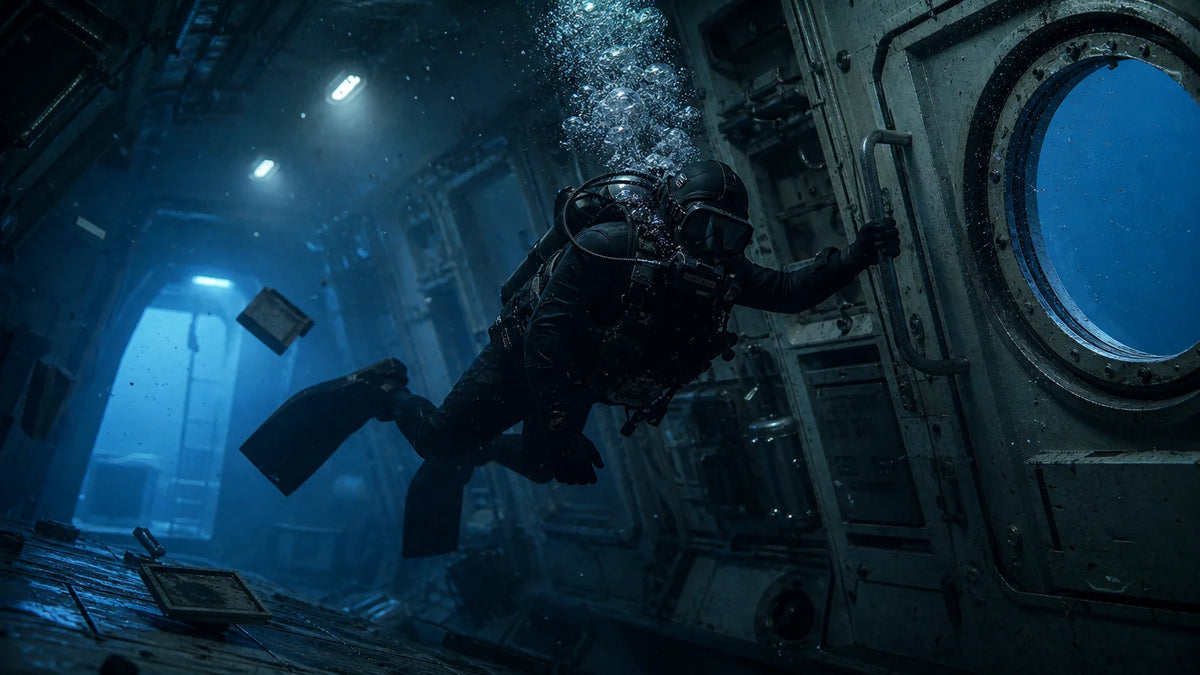
Stunt Submarine: How Underwater Film Action Is Built
What makes a stunt submarine convincing is not simply placing an actor inside a boat. The strongest sequences combine physical movement, water pressure, restricted visibility, breathing equipment, and carefully controlled danger. If you want to compare cinematic imagination with real recreational machines, our Jet Shark submarine offers a useful example of how unusual marine mobility can become a tangible design object.
In 2025, Mission: Impossible: The Final Reckoning used a submerged submarine environment as one of its central action settings. The production focused on practical underwater photography, direct communication between divers and performers, and a set that could create unpredictable movement. The American Society of Cinematographers described how the crew used underwater communication systems and writing pads to coordinate the sequence.
What is a stunt submarine?
A stunt submarine is a film or television apparatus designed to make underwater action appear immediate, physical, and dangerous. It may be a full-scale set, a partial vehicle, a controlled submersible, or a combination of these elements. The term does not necessarily describe a certified passenger submarine intended for regular operation.
In practice, filmmakers separate the dramatic problem from the transportation problem. The dramatic problem is how a performer moves through a confined, flooding, unstable environment. The transportation problem is how the crew can create that movement repeatedly while protecting the performer, camera operators, divers, and technicians.
This distinction explains why a film submarine can look more extreme than a personal submersible. A production may recreate a pressure-free interior inside a tank, then manipulate the set with mechanical movement, water flow, lighting, debris, and sound. A personal submarine, by contrast, must be designed around buoyancy, structural integrity, propulsion, visibility, life support, recovery, and an approved operating envelope.
The best underwater stunt design makes these systems feel connected. A door opens, water rushes through, the interior shifts, and the performer must respond. The audience sees a chain of physical consequences rather than an isolated special effect.
How do filmmakers build underwater danger?
Consider the production challenge from the inside. A performer cannot rely on ordinary dialogue, normal breathing, or unrestricted movement. Visibility can change within seconds, communication becomes slower, and every object must be tested for its behavior in water.
For the 2025 Mission: Impossible sequence, the crew used a practical underwater environment rather than treating the submarine as an entirely digital location. The director entered the water to improve communication with the cast and crew. That choice addressed a common weakness in underwater filming, where a director above the surface may have limited awareness of the set’s real spatial conditions.

A rotating submarine set can create visual danger without requiring a real submarine to operate at depth. Mechanical rotation changes the performer’s orientation, while water movement adds resistance and unpredictability. The result is a scene in which the environment itself becomes an antagonist.
Safety planning remains central. Divers must be positioned near the performer, rescue routes must remain clear, and every movable object must be tested under different water conditions. Props that seem harmless in air can become heavy, unstable, or difficult to control underwater.
The production also has to preserve continuity. Water turbulence, bubbles, lighting, debris, and performer movement must remain consistent between takes. A practical set provides physical realism, but it also creates additional variables that the production team must measure and manage.
Which parts are real, and which are cinematic?
The most convincing underwater action usually combines several techniques. A full-scale interior gives the performer genuine surfaces to grip. A gimbal or moving platform creates real changes in orientation. Controlled water flow produces resistance. Visual effects then extend the environment beyond what the camera can capture directly.
That combination is different from claiming that an actor is operating a complete submarine. The visible cabin may be a set, while the exterior shots use a model, a digital environment, or a separate marine vehicle. The audience receives one continuous experience, even though the production may use several physical systems.
For viewers interested in marine design, this distinction is useful. A film prop prioritizes controlled drama, camera access, repeatability, and visual clarity. A recreational submersible prioritizes predictable operation, occupant protection, maintenance, and compliance with applicable rules.
Our Seabreacher dolphin submarine illustrates another design direction. Instead of recreating the enclosed, industrial atmosphere of a movie submarine, it treats underwater movement as an active, highly visual experience inspired by marine-animal motion.
The difference is not merely aesthetic. A cinematic machine is judged by the intensity of the image. A real machine must also answer practical questions about its operating depth, launch method, crew requirements, inspection schedule, emergency procedures, and permitted waters.
How does a stunt submarine differ from a personal submersible?
The first difference is purpose. A stunt apparatus exists to produce a controlled sequence for an audience. A personal submersible exists to carry people or equipment through water within a defined operational envelope.
The second difference is certification and accountability. A film set can isolate risk within a controlled facility, with specialist divers and emergency teams close by. A personal submersible may need to operate from a vessel, marina, research platform, or coastal location. Its owner must consider transport, deployment, weather, local permissions, crew competence, and recovery.
Passenger safety has been studied for decades. A United States Department of Transportation report from 1989 examined passenger-carrying submersibles through system safety analysis, including hazards involving passengers, underwater structures, and tourism. The DOT safety analysis remains a useful reminder that underwater mobility requires a systems approach rather than a single focus on the pressure hull.
The third difference is the relationship between the occupant and the machine. A film performer may be trained to respond to choreography, hand signals, and rehearsed escape procedures. A private owner or passenger needs a machine whose systems remain understandable and manageable throughout the planned dive.
When evaluating personal underwater mobility, you can use our personal submarine buying guide to organize questions around design, intended use, operating conditions, and acquisition considerations. The same disciplined approach helps separate a genuine mobility object from a visually appealing concept that lacks practical information.
What should you evaluate before considering ownership in 2026?
Start with the operating context, not the appearance. A compact submersible intended for sheltered coastal waters has different requirements from one designed for deeper offshore operation. Capacity, dive duration, launch support, visibility, propulsion, and emergency recovery all influence the ownership experience.
Regulation is also location-specific. In 2026, Transport Canada published requirements for passenger submersibles operating in Canadian waters. The bulletin addresses issues such as construction standards, reporting, authorized representatives, and personnel requirements. The Transport Canada guidance shows why a machine cannot be assessed separately from the jurisdiction in which it will operate.
A responsible evaluation should cover at least five areas:
- Intended mission, such as recreation, exploration, research, filming, or yacht support.
- Operating envelope, including depth, duration, water conditions, temperature, and visibility.
- Structural and life-support systems, including inspection, testing, redundancy, and maintenance requirements.
- Deployment logistics, including the support vessel, crane, platform, launch area, and recovery plan.
- Training and oversight, including who operates the machine and how emergencies are managed.
Recent safety investigations reinforce the importance of evidence. In 2026, the Transportation Safety Board of Canada reported that the Titan submersible’s hull properties had not been adequately tested against the theoretical specification used in its design. The 2026 TSB report demonstrates why testing, engineering practice, and independent review matter more than visual novelty.
For a curated starting point, our submarine collection brings together underwater mobility objects for readers who value design, rarity, engineering, and future-oriented transportation. A collection can help you identify the type of machine that matches your ambitions before you begin a detailed acquisition process.
What makes underwater action credible?
A convincing stunt submarine works because it respects physical cause and effect. Water resists movement, confined spaces limit escape, equipment affects performance, and every mechanical change creates a new problem. Film productions use sets, gimbals, divers, communication systems, models, and visual effects to create that experience safely enough to repeat. Real submersibles require a different discipline, centered on engineering evidence, operational limits, training, and local regulation. Whether you are studying a film sequence or considering an underwater machine, the most useful question is not how spectacular it looks. It is whether the design, support systems, and operating plan are clear enough to justify confidence.
Take action with TheArsenale
If the appeal of a stunt submarine lies in its combination of engineering, rarity, and cinematic presence, you may be looking for more than a conventional boat. You may want a carefully selected mobility object that connects advanced design with an exceptional experience on the water.

We curate rare mobility machines for collectors and enthusiasts, including personal submarines and other future-oriented objects. To explore one option and discuss its specifications, intended use, and acquisition process, view the Nemo personal submarine with our team.
Frequently Asked Questions
Is a stunt submarine a real submarine?
Sometimes, but not always. It is often a combination of a full-scale set, a controlled underwater platform, specialist diving equipment, models, and visual effects rather than one complete operational submarine.
Was the submarine action in The Final Reckoning filmed underwater?
The 2025 production used practical underwater environments and underwater communication methods for key parts of the sequence. Additional techniques may have been used to extend the location, improve safety, or connect separate shots.
Can a personal submersible be used like a movie stunt machine?
No. A personal submersible is designed for a defined operating envelope, not for uncontrolled movement, dramatic flooding, or repeated exposure to stunt conditions. Its use should follow the builder’s procedures, crew requirements, and applicable local rules.
What is the most important feature in a personal submarine?
There is no single feature that determines suitability. Structural design, life support, visibility, control systems, recovery planning, maintenance, training, and operating limits must be assessed together.
Where can I explore personal submarine options?
Our submarine collection presents curated underwater mobility objects for collectors and enthusiasts. You can also review our buying guide to clarify your intended use and the questions to ask before contacting a specialist.