How to Choose a Watch Winder: A Collector's Guide 2026
An automatic watch left idle can stop within roughly two days, forcing you to reset the time and date before wearing it again. For a single timepiece this is a minor inconvenience; for a growing collection, it becomes a genuine maintenance concern. If you value convenience and mechanical longevity, a dependable winder belongs alongside a curated watch winder with 8-watch capacity and the rest of your setup.
Understanding how to select the right watch winder is easier once you know what the device actually does and why demand keeps climbing. The luxury timepiece sector continues to expand, with the global luxury watch market expected to reach 44.26 billion US dollars by 2030. As collections grow, so does the need for equipment that preserves them properly.
Why a Watch Winder Matters for Automatic Timepieces
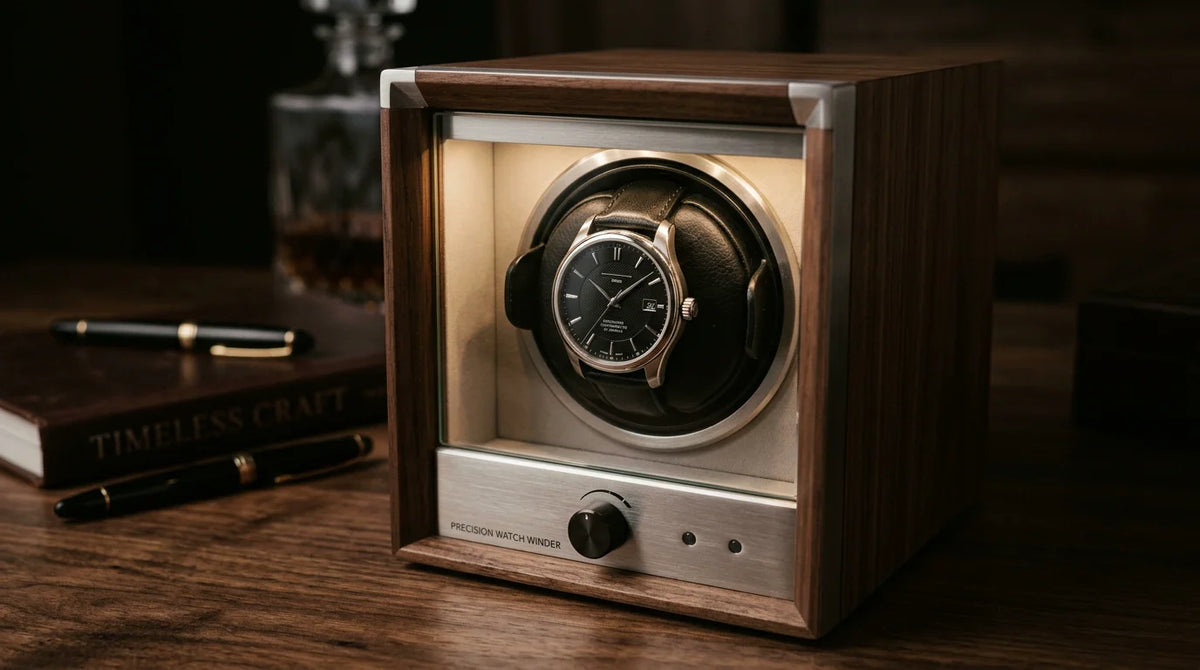
A watch winder is a motorized device that rotates an automatic watch to keep its mainspring wound while the watch is not being worn. Automatic movements rely on wrist motion to power themselves. When a self-winding watch sits unused, the mainspring gradually unwinds and the watch stops, requiring you to reset it and, on complicated pieces, to reprogram calendars and moon phases.
This is precisely the friction that knowing how to choose a watch winder resolves. The category is far from niche today: the automatic watch winder market was valued at 1,738 million US dollars in 2025 and is projected to grow steadily through the following decade, driven by rising ownership of mechanical watches and expanding collector bases.
Keeping a watch running also has a functional benefit. Continuous, gentle motion helps distribute the lubricants inside the movement, which can otherwise settle when a timepiece remains stationary for long periods. For anyone who rotates between several pieces, a winder removes the repetitive task of manual winding.

The Core Criteria That Guide Your Decision
Before comparing models, define what your collection actually requires. Not every automatic watch needs the same treatment, and buying more capability than you need wastes money, while buying too little leaves watches stopped.
Focus your evaluation on four measurable factors:
- Rotation direction: clockwise, counterclockwise, or bidirectional, since different movements wind in different directions.
- Turns per day (TPD): the number of rotations a movement needs, commonly between 650 and 900 for many automatics.
- Capacity: how many timepieces you need wound simultaneously, now and as your collection grows.
- Build quality and noise: reliable motors, protective cushions, and near-silent operation for bedroom or office placement.
If you are still assembling your setup, browsing dedicated watch accessories and winders helps you match a winder to the display style and materials you already favor.
Matching Rotation Settings to Your Movement
Rotation is the single most technical part of the decision. Each automatic movement has a recommended winding direction and a target number of turns per day. Set the winder incorrectly and the watch may remain underwound; set it excessively and you place needless wear on the mechanism.
A quality winder should therefore offer programmable settings rather than a single fixed speed. Look for adjustable TPD values and a choice of direction, ideally with rest intervals that mimic natural wear rather than continuous spinning. You can typically find the correct figures in your watch manual or from the manufacturer.
The best rotation program is not the fastest one; it is the one that mirrors how the watch behaves on your wrist across a normal day.
Independent programming per position becomes essential when a winder holds several watches, because a dive watch and a perpetual calendar rarely share the same winding needs.
Capacity: Single Versus Multiple Watch Winders
Capacity should reflect both your current collection and your realistic growth over the next few years. Single winders suit owners with one or two frequently worn automatics, offering precise control at a modest footprint. Multiple winders serve collectors who rotate across many pieces and want each one ready simultaneously.

Segmentation reflects this range. The market is divided into single, double, quad, and larger modular units, so the right choice depends squarely on collection size. A common mistake is buying a single winder and outgrowing it within a year.
| Configuration | Ideal collection size | Independent programming | Best suited for |
|---|---|---|---|
| Single winder | 1 to 2 watches | Limited | Occasional rotation |
| Double / Quad winder | 2 to 4 watches | Usually per pair | Active rotation |
| Our 8-watch capacity winder | Up to 8 watches | Yes, per module | Serious collectors seeking display-grade storage |
For those building a broader setup, pairing a high-capacity winder with a high-end watch collection creates a cohesive display rather than a scatter of devices.
Build Quality, Noise, and Long-Term Value
A winder runs quietly for years or fails noticeably within months, and the difference is materials and motor engineering. Prioritize sturdy construction, a reliable low-noise motor, and cushioned holders that protect case backs and bracelets from scratches. Because winders often sit in bedrooms, near-silent operation is not a luxury but a practical requirement.
Value also tracks the wider market. The dedicated watch winder segment was valued at 250 million US dollars in 2024, with growth propelled by rising demand for luxury timepieces and greater awareness of proper watch maintenance. As pieces appreciate, protecting them with quality equipment is a sound decision rather than an indulgence.
Finally, weigh presentation. A winder that doubles as a display object earns its place on a shelf, whereas a purely functional box tends to be hidden away. The right balance depends on whether you view your winder as storage, as furniture, or as both.
Bringing Your Decision Together
Deciding how to choose the right watch winder comes down to disciplined matching rather than chasing features. Confirm the rotation direction and turns per day your movements require, size the capacity to your collection with modest room to grow, and insist on quiet, well-built mechanics that protect each case. When those three elements align, your automatic watches stay accurate, lubricated, and ready to wear, and the device becomes a lasting part of how you care for your timepieces rather than a purchase you soon replace.
Take action with TheArsenale
Once you understand what your movements need, the next step is choosing timepieces and accessories worthy of that care. We curate mobility and collectible pieces for enthusiasts who value engineering and presentation in equal measure, and our watch selection reflects that same standard.

Explore our curated watch collection to find automatic pieces that deserve a place in your winder, backed by free shipping and a team that typically replies in under thirty minutes. Whether you are refining an existing collection or beginning a new one, we are here to help you acquire with confidence.
Frequently Asked Questions
Do all automatic watches need a watch winder?
No. If you wear a single automatic watch daily, your wrist motion keeps it wound naturally. A winder becomes valuable when you own several pieces and rotate between them, since idle watches will otherwise stop and require resetting.
What does turns per day (TPD) mean?
Turns per day is the number of full rotations a winder completes over 24 hours to keep a movement wound. Many automatic watches need between roughly 650 and 900 TPD, though you should confirm the exact figure in your watch manual.
Can a watch winder overwind my watch?
Modern automatic movements include a slipping clutch that prevents overwinding, so a correctly programmed winder is safe. Excessive continuous rotation adds unnecessary wear, however, which is why adjustable settings and rest intervals are preferable.
How many watches should my winder hold?
Choose capacity based on your current collection plus realistic growth. Single winders suit one or two watches, while our 8-watch capacity winder serves collectors who want several timepieces wound and displayed at once.
Are quiet watch winders worth the extra cost?
Yes, particularly if the winder sits in a bedroom or office. A low-noise motor and quality construction also tend to indicate greater durability, which protects both your investment and your timepieces over time.