The Complete Space Memorabilia Buying Guide for Collectors
In 2022, a single flight jacket worn by Buzz Aldrin to the Moon and back sold for a record-breaking sum, proving that objects which have left Earth command extraordinary prices. That result reframes how newcomers should approach this field. This space memorabilia buying guide exists because enthusiasm alone will not protect your money. For a curated starting point, you may consider our Saturn V memorabilia piece as an example of provenance-led collecting.
The category spans everything from mass-produced stamps to flown lunar hardware, and the gap between the two is enormous. According to Robb Report, that Aldrin jacket reached roughly $2.7 million. Understanding why some artifacts appreciate while others stagnate is the foundation of every sound acquisition decision you will make.
What counts as space memorabilia worth collecting
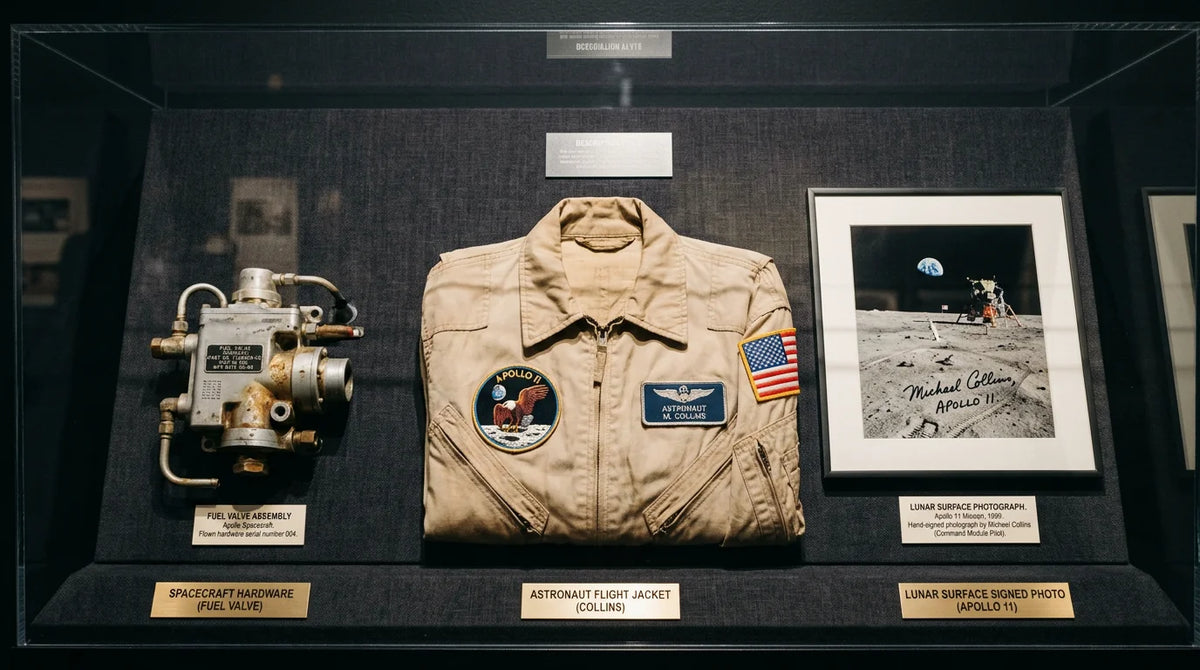
Space memorabilia includes anything connected to space travel, transport, or research. The most valuable pieces carry a personal or physical link to a mission. Flown artifacts, astronaut-worn gear, spacecraft hardware, and signed material sit at the top of the hierarchy. Mass-produced commemoratives sit at the bottom.
Auction specialists confirm this hierarchy. Sotheby's notes that sales feature flown mission artifacts, astronaut-worn gear, spacecraft hardware, engineering models, space photography, and signed material. The closer an object sits to an actual mission, the stronger its long-term appeal tends to be.

Apollo-era items remain the most sought-after category, with Apollo 11 attracting the widest interest. However, some experienced collectors deliberately favor later Apollo flights, where competition is thinner and value can be stronger.
Provenance beats certificates every time
Here is the counter-intuitive truth that experienced collectors repeat: a certificate of authenticity means very little. Anyone can design and print one. What matters is a documented chain of ownership that traces an object back to its source. Trust the seller and the paper trail, not a decorative document.
This distinction is not academic. The famous Vostok 3KA-2 capsule that sold for $2,882,500 carried a credible institutional history despite a gap in its records. Value collapses the moment an object's story cannot be verified. Flown medallions such as Robbins medals frequently arrive without certificates, yet remain desirable because their production and distribution are well documented.
When you evaluate a piece, request the full ownership history, compare it against published auction catalogues, and cross-reference hardware against photographs of the same material installed on a spacecraft. If the seller cannot support the story, treat the object as unproven.
How to verify authenticity before you buy
Signatures, patches, and photographs are the easiest items to counterfeit, so they demand the most scrutiny. A prudent default position is to assume every object is fake until the evidence proves otherwise. This mindset protects your budget far better than optimism.
Signed material carries particular risk because autopen machines and studio assistants have reproduced signatures for decades. Even genuine autographs vary between examples, so compare any signature against multiple verified references. Where possible, obtain autographs in person or from a source you personally trust.
Larger technical objects are harder to fake, which partly explains their premium. As New Atlas reported, an Apollo Guidance Computer interface unit set a record of $210,261 in 2019, up from a previous high of $93,750, underscoring how rapidly verified hardware can appreciate. Rarity and manufacturing complexity make such pieces difficult to reproduce convincingly.
Buy the item, not the story. A compelling narrative is no substitute for documented evidence and physical inspection.
Where to buy and what fees to expect
You have several routes: established auction houses, specialist dealers, scholarship foundations, and direct sales from individuals connected to programs. Each channel carries a different risk and cost profile. Major auction houses offer strong authentication but add a significant buyer's premium, typically between 15 and 20 percent of the hammer price.
Online marketplaces widen your options but raise the counterfeiting risk, particularly for patches, autographs, and photographs. Reputable dealers active on those platforms usually sell genuine material and often offer refunds if authenticity is later questioned. For collectors who prefer curated provenance over open bidding, we present pieces such as our Space Shuttle Atlantis memorabilia with documented sourcing in mind.
Budget beyond the purchase price. Factor in tracked shipping, insurance, import duties, and the buyer's premium before you bid. These costs can add a substantial percentage to your final outlay, so build them into your maximum bid from the start.
Legal and export considerations you cannot ignore
Some artifacts cannot legally cross borders. Under United States export controls, certain items such as space shuttle tiles and specific rocket components fall under strict regulation and may not be exported. International buyers should confirm eligibility before committing to any purchase.
Ownership legitimacy matters as much as export rules. Not all NASA property was released with permission, and the agency has reclaimed items that entered the market improperly. If an object was never lawfully deaccessioned, you risk losing both the artifact and your money if authorities intervene.
Before any high-value transaction, confirm the seller's legal right to sell, use a payment method that offers buyer protection, and keep written records of every communication. These precautions preserve your recourse if a dispute arises later.
Comparing your main buying channels
Different channels suit different collectors. The table below summarizes the trade-offs across authentication strength, added fees, and curation, with our own curated approach included for context.
| Channel | Authentication | Typical added cost | Curation level |
|---|---|---|---|
| Major auction houses | Strong | 15 to 20 percent premium | Moderate |
| Open online marketplaces | Variable | Low to moderate | Low |
| Specialist dealers | Strong | Built into price | High |
| TheArsenale curated pieces | Provenance-led | Transparent, free shipping | High |

For collectors drawn to astronaut-worn gear, spacesuit-related pieces carry an especially strong personal connection. If that category appeals to you, consider our EMU spacesuit memorabilia piece as a reference point for what documented sourcing looks like.
Bringing it all together
Approaching a space memorabilia purchase with discipline transforms a risky hobby into a rewarding one. Prioritize documented provenance over decorative certificates, scrutinize every signature, and reserve your largest budgets for flown hardware and astronaut-worn gear whose histories can be verified. Account for premiums, shipping, and export rules before you bid, and never let a compelling story override physical evidence. The collectors who thrive are those who research relentlessly, buy from trusted sources, and accept that patience is the surest path to a collection that holds both meaning and value.
Take action with TheArsenale
Building a collection you can trust begins with sources that prioritize provenance and transparency. If you want to explore verified pieces without navigating open bidding alone, we can help you focus on artifacts with documented histories and clear sourcing.

Explore our NASA past and present memorabilia collection to see curated pieces presented with sourcing in mind. As a luxury mobility and collectibles marketplace, we combine careful curation with free shipping and a responsive sales team that typically replies in under thirty minutes, so you can make considered decisions with support at every step.
Frequently Asked Questions
Is a certificate of authenticity enough to trust a purchase?
No. A certificate is easily produced by anyone and carries little weight on its own. A documented chain of ownership traced back to the source is far more reliable than any printed certificate.
What space memorabilia holds value best over time?
Flown mission artifacts, astronaut-worn gear, spacecraft hardware, and well-documented signed material tend to hold value most reliably. Apollo-era items attract the widest interest, though later Apollo flights can offer strong value with less competition.
How much should I budget beyond the purchase price?
Plan for a buyer's premium of roughly 15 to 20 percent at major auction houses, plus tracked shipping, insurance, and any import duties. Build these costs into your maximum bid before you commit.
Are there items I am not allowed to buy or import?
Yes. Certain United States artifacts, such as space shuttle tiles and specific rocket parts, fall under export controls and may not leave the country. Some NASA property was also never lawfully released and can be reclaimed.
Where can I start collecting with lower risk?
Begin with reputable dealers, established auction houses, or curated marketplaces that emphasize provenance. Our NASA-focused collection presents pieces with documented sourcing in mind, which helps newcomers avoid the counterfeiting risks common on open platforms.