Wooden Paddleboard Price: A 2026 Buyer's Cost Guide
A hollow wooden board and a molded veneer board may look similar on the water, yet their price tags can differ by thousands of dollars. Buyers often discover that the range spans from around 1,700 to well beyond 5,000 US dollars, and understanding that spread matters before you commit. If you are weighing craftsmanship against budget, it helps to understand how much a luxury paddleboard costs before comparing options.
The price of a wooden paddleboard reflects real variables: solid-wood versus veneer, hollow versus foam core, and factory versus workshop production. Demand is climbing, too. The global stand-up paddleboard market was valued at around 2.10 billion US dollars in 2026, according to Coherent Market Insights, which sustains a steady flow of premium builders and pricing tiers.
What Determines the Wooden Paddleboard Price
The exact wooden paddleboard price you pay is rarely arbitrary. It follows a handful of measurable factors that separate a mass-produced board from a workshop-built one.
- Construction method: hollow wooden frames with a rib-and-spine interior cost more than foam cores wrapped in a thin veneer.
- Wood type: sustainably sourced cedar, paulownia, and bamboo carry different material costs.
- Finish and reinforcement: UV-stable epoxy and multi-layer fiberglass add durability and price.
- Customization: bespoke skins, colored epoxy highlights, and made-to-spec dimensions raise the total.
- Included accessories: a handmade wooden paddle, fins, and a deck pad are sometimes bundled, sometimes not.
Because these variables stack, two boards of identical length can differ significantly in cost. When you want to shortlist options quickly, our guide to the best luxury paddleboards to compare prices narrows the field.
Price Ranges to Expect in 2026
Consider a typical shopper comparing three tiers. At the accessible end, wood-veneer boards molded over a foam core sit near the lower band. Artisan hollow-wood boards occupy the middle, and fully custom or luxury curated boards define the ceiling. The table below organizes these tiers by construction and typical positioning.
| Tier | Construction | Typical 2026 range (USD) | Best for |
|---|---|---|---|
| Entry wood-veneer | Foam core with bamboo or wood veneer | 1,700 to 2,600 | Beginners seeking looks and value |
| Artisan hollow-wood | Cedar rib-and-spine, no foam | 2,600 to 5,200 | Enthusiasts wanting craftsmanship |
| Luxury curated (our marketplace) | Designer collaborations, premium finishes | Premium, quote-based | Collectors and design-led buyers |
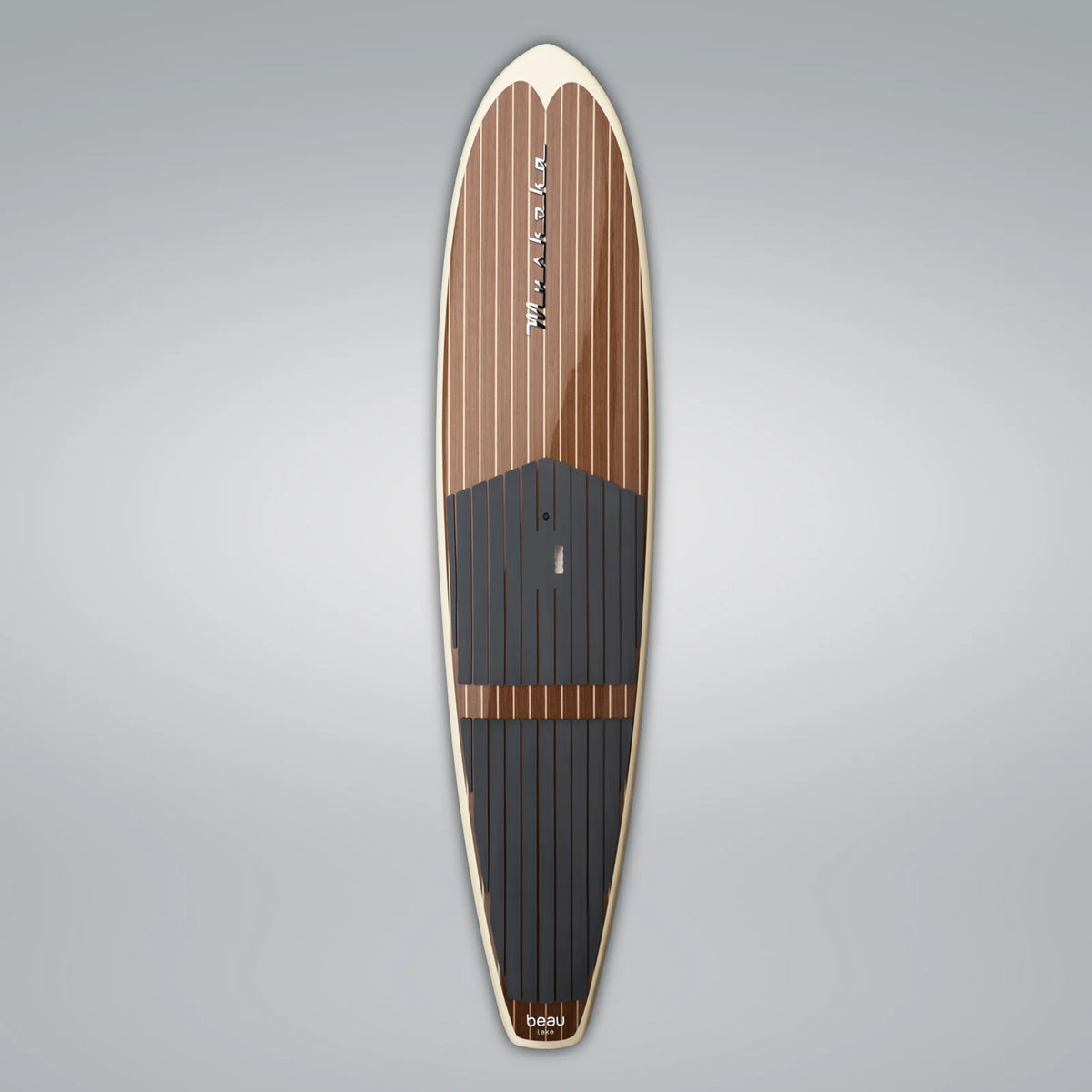
Our curated tier is where design partnerships stand out. The Wavellon paddle board (buy now) illustrates how a collaboration board blends performance materials with a distinctive finish, alongside free shipping across our catalogue.
Why Wooden Boards Cost More Than Inflatables
Why does a wooden board command a premium over an inflatable of the same length? The answer lies in labor and materials. Inflatables dominate volume sales because they are portable and easy to store. In fact, roughly 62 percent of users prefer inflatable boards while 38 percent choose solid boards, according to Business Research Insights.
Solid wooden boards, by contrast, require hand-shaping, veneer layering, and heat-molded compression. Each step adds hours of skilled work that an inflatable simply does not need. That craftsmanship, rather than raw volume, is what a wooden SUP price ultimately reflects. The trade-off is a rigid, higher-performance ride and a board that doubles as a display piece indoors.

Materials and Craftsmanship Behind the Cost
Picture a workshop where a hollow cedar frame is built rib by rib before any skin is applied. That approach eliminates foam entirely and relies on the wood structure for flotation, which is labor-intensive and pushes the price upward. Other builders use a hand-shaped foam core sandwiched between veneer and fiberglass, a lighter and often more affordable technique.
Reinforcement choices matter just as much. Paulownia and bamboo veneers paired with carbon and multi-layer fiberglass improve strength-to-weight ratios and justify a higher solid wood paddleboard cost. For buyers who prioritize aesthetics alongside performance, a design-forward option such as the Vilebrequin paddleboard (premium option) shows how finish and branding factor into premium pricing.
Demand, Participation, and What It Means for Prices
Rising participation supports the premium end of the market. Approximately 5.14 million people took part in stand-up paddleboarding in the United States in 2026, according to Verified Market Reports. As the activity matures, more paddlers upgrade from entry inflatables to premium solid boards.
This upgrade cycle keeps demand strong for higher-priced wooden models. When enthusiasts seek performance, longevity, and a board worth displaying, they accept the higher price a quality wooden build carries. Buyer demographics reinforce this, with most purchases concentrated among younger, active adults willing to invest in gear.
Getting Value for Your Money
How do you avoid overpaying while still buying quality? Start by matching the board to your use. A casual weekend paddler rarely needs a fully custom hollow-wood build, whereas a committed rider may. Compare included extras, because a bundled handmade paddle or premium deck pad can offset a higher sticker price.
Established makers set useful benchmarks. Brands such as Red Paddle Co., Naish, and Starboard are named among major vendors by Mordor Intelligence, which helps you gauge fair pricing across the category. Warranty length, wood sourcing, and finish quality are the details that separate genuine value from a superficial bargain.
Final Thoughts on Wooden Paddleboard Pricing
The wooden paddleboard price you should expect in 2026 depends less on length and more on how a board is built and finished. Entry veneer boards start near 1,700 US dollars, artisan hollow-wood models reach 5,200, and luxury curated pieces sit above that band. Decide how you will use the board, weigh the included accessories, and prioritize construction quality and warranty over the lowest number. A well-chosen wooden board rewards that patience with years of performance and lasting visual appeal.
Take action with TheArsenale
If a wooden board that performs on the water and looks striking on display matches what you are after, the next step is exploring a curated selection rather than sifting through generic listings. We bring design-led boards and premium collaborations into one place, so you can compare finish and pricing with clarity.

Browse our water-sport paddleboards to review premium builds, designer collaborations, and free shipping across the range. Our team replies quickly to enquiries, so you can move from comparison to confident purchase without delay.
Frequently Asked Questions
How much does a wooden paddleboard cost in 2026?
Most wooden paddleboards range from roughly 1,700 to 5,200 US dollars in 2026. Entry-level veneer boards sit at the lower end, while hand-built artisan and fully custom models occupy the top of that range.
Why are solid wooden boards more expensive than inflatables?
Solid wooden boards require hand-shaping, veneer layering, and heat-molded compression, which add many hours of skilled labor. Inflatables are produced at higher volume and lower unit cost, which is why they dominate sales.
Does a wooden paddleboard include a paddle?
It depends on the maker. Some artisan builders include a handmade wooden paddle with each board, while others price the paddle and accessories separately, so always confirm what is bundled before buying.
Are wooden paddleboards worth the higher price?
For paddlers who value rigidity, glide, and longevity, a quality wooden board justifies its cost. Many owners also treat it as a display piece indoors, which adds value beyond performance alone.
Where can I compare premium wooden paddleboards?
You can review design-led and collaboration boards within our water-sport collection, which places premium options side by side. This makes it easier to weigh finish, construction, and pricing in one place.