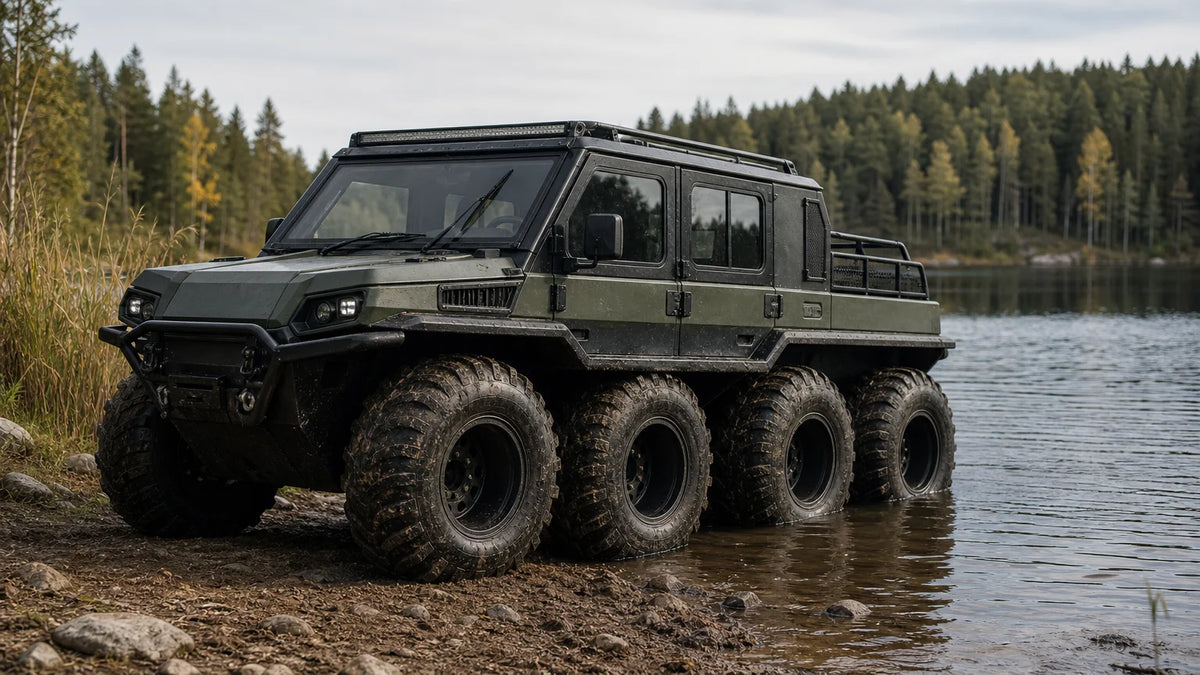
Amphibious ATV for Sale: A Practical Buyer Guide for 2026
If you are searching for a amphibious ATV for sale, begin with the terrain rather than the styling. A compact 6x6 may suit private land, hunting routes, and shallow crossings, while a larger utility vehicle may better serve rescue, industrial, or remote-access work. To explore an extreme reference point, review our Sherp N 1200 amphibious all-terrain vehicle.
Amphibious vehicles combine flotation with off-road traction, but those priorities create trade-offs. A 2021 buyer guide from J.D. Power’s buying guide describes common features such as lightweight body tubs, specialized tires, differential steering, and six or more wheels. Those features help a vehicle float and move through soft ground, but they can also affect speed, handling, and ride comfort.
What makes an amphibious ATV different?
An amphibious ATV is designed to travel across land and water without relying on a trailer or a separate boat for every crossing. Its body generally contributes to buoyancy, while the wheels or dedicated propulsion system provide movement in water. The vehicle is therefore a compromise between an off-road machine and a small utility boat.
The most important distinction is not the number of wheels alone. It is the relationship between the flotation body, tire design, ground clearance, steering method, and water propulsion. A vehicle may float successfully but perform poorly in current, deep mud, or steep banks. Another model may climb difficult terrain but require calm water and careful loading.
Common applications include hunting, fishing, agricultural access, flood response, surveying, remote maintenance, recreation, and emergency support. The correct choice depends on whether water crossings are occasional obstacles or a central part of the vehicle’s work.
Which configuration fits your terrain?
Imagine two buyers approaching the same flooded trail. One needs a light vehicle for occasional crossings and equipment transport. The other needs multiple seats, longer range, recovery equipment, and reliable access across marshland. Their ideal specifications will be very different.
6x6 and compact utility models
A compact amphibious 6x6 can provide a practical balance between maneuverability, flotation, and cargo capacity. Six wheels distribute weight across soft ground and may help the vehicle maintain contact in mud, snow, or uneven terrain. A shorter body can also make storage, trail access, and low-speed handling easier.
Compact models are often appropriate for private estates, outdoor recreation, hunting, fishing, and light property work. Check the seating arrangement carefully. Some vehicles prioritize cargo space, while others use the available interior for additional passengers.
8x8 and heavy-duty platforms
An 8x8 layout usually increases the contact area and can support a longer body. That may benefit buyers who need more payload, additional seats, or greater stability in soft terrain. The trade-off is increased weight, turning effort, transport complexity, and maintenance responsibility.
Before choosing a larger platform, measure your access routes. Confirm the width of gates, the capacity of trailers, the height of storage buildings, and the availability of recovery equipment. More wheels do not automatically make a vehicle suitable for every water environment.
Tracked, wheeled, or specialized propulsion
Wheeled systems are usually easier to service and may provide more familiar driving characteristics. Tracked systems can suit specialized terrain, but they may bring higher maintenance demands and different transport requirements. Some amphibious vehicles use wheel rotation in water, while others add a dedicated marine propulsion system.
Ask how the vehicle turns in water, how it brakes on a slope, and how it exits a muddy bank. These questions reveal more than a top-speed figure. If you want to compare an unusual mobility object with a different design philosophy, you can review our Equad ATV as part of a wider exploration of specialist machines.
What should you budget in 2026?
There is no single reliable 2026 price for an amphibious ATV. Pricing changes substantially according to size, engine, seating, water propulsion, attachments, condition, freight, preparation, and local taxes. A vehicle intended for occasional recreation will sit in a different category from a commercial platform built for rescue or remote operations.
New vehicles may involve direct quotation rather than a public online price. Used machines can appear less expensive, but their acquisition cost may increase after inspection, transport, refurbishment, registration work, and replacement of specialist components. This is why a low advertised price should be treated as an entry point, not a complete ownership estimate.
Prepare a complete budget that includes:
- Purchase price or acquisition quote
- Freight, import charges, and local taxes
- Trailer, winch, recovery, and storage equipment
- Initial servicing and fluid replacement
- Tire, track, hull, or bilge-system inspection
- Registration, insurance, and local compliance costs
- Training and operator safety equipment
For a broader view of how specialist mobility objects are priced, consult our amphibious vehicle pricing guide. The most useful comparison is not the cheapest listing. It is the total cost of acquiring a vehicle that fits your operating conditions.
How do you inspect a used amphibious ATV?
A used vehicle can represent an interesting opportunity, particularly when a discontinued model has a strong mechanical community. It can also conceal corrosion, improvised repairs, unavailable parts, title problems, or damage from improper water use.
A 2025 Bring a Trailer auction illustrates why detailed inspection matters. A vintage Coot amphibious ATV sold for $5,100 in December 2025, but the listing also noted gearbox leakage and the absence of title or registration. The vehicle was offered for off-road use only, as described in the auction listing.
Inspect the hull and flotation system
Look for cracks, repairs, deformation, punctures, and water intrusion. Examine seams, drain points, bilge pumps, access panels, and any areas that may retain moisture. Ask whether the hull has been repaired after impact or prolonged exposure to chemicals and saltwater.
Inspect the drivetrain and steering
Check the engine cold, not only after the seller has warmed it. Listen for unusual noises, inspect fluid condition, and test engagement of every gear. On differential-steering systems, confirm that both sides respond smoothly and that the vehicle does not pull unexpectedly.
Examine chains, sprockets, axles, bearings, brakes, belts, and universal joints. Specialist parts can be more difficult to source than conventional ATV components. Obtain a written parts plan before purchase if the model is older or uncommon.
Test the vehicle in relevant conditions
A dry parking-lot demonstration cannot confirm water performance. If possible, arrange a controlled test on land and in calm, permitted water. Observe loading, entry, turning, drainage, exit from the bank, and recovery after a simulated loss of traction.
Do not test an unfamiliar vehicle alone. Use flotation equipment, a recovery plan, and a second vehicle or crew when conditions require it. A successful demonstration should confirm the vehicle’s behavior, not encourage unnecessary risk.
What legal and operational checks matter internationally?
An amphibious ATV may be treated differently depending on where it operates. Road registration, off-road access, waterway restrictions, marine rules, insurance, import documentation, and environmental requirements can all affect ownership. The vehicle’s classification may also change between private recreation, commercial work, rescue operations, and public-sector use.
Before paying a deposit, verify the following with the relevant local authorities and the seller:
- Whether the vehicle may be used on public roads
- Whether a title, bill of sale, or import certificate is sufficient
- Whether water use requires registration or specific equipment
- Whether the intended waterways permit motorized access
- Whether the vehicle needs operator training or a special license
- Whether insurance covers both land and water operation
- Whether replacement parts and technical support are available locally
International buyers should also confirm shipping dimensions, fuel-system requirements, customs classification, and delivery responsibilities. Do not assume that a vehicle legally sold in one country can be operated in another without additional approvals.
Operational planning matters as much as legal compliance. Define the maximum water depth, current, slope, temperature, payload, and distance that the vehicle must handle. These limits form its operating envelope, and they should guide the specification you purchase.
How can you compare rare machines more intelligently?
When the vehicle is unusual, the buying process should include more than a specification sheet. You may need help identifying the right category, evaluating the builder, confirming availability, arranging an inspection, or comparing a recreational machine with a commercial platform.
Our network focuses on rare and future-oriented mobility objects across land, sea, and air. For readers considering a high-value acquisition, our Gibbs Terraquad amphibious UTV provides another reference for comparing design, intended use, and engineering ambition.
We also support a more curated acquisition process for collectors and enthusiasts. That can be useful when a vehicle is not widely listed, when the purchase requires direct consultation, or when the buyer values provenance and design alongside utility.
The best comparison process begins with a written brief. Record your terrain, water conditions, passenger count, payload, transport method, storage plan, service region, and budget. Then remove every model that fails a non-negotiable requirement before comparing styling or optional equipment.
Choose capability before appearance
Finding the right land and water vehicle requires a clear view of your terrain, payload, water conditions, ownership budget, and legal obligations. Compare flotation, propulsion, serviceability, documentation, and recovery planning before focusing on rarity or visual impact. A careful inspection and a realistic operating brief will help you avoid paying for capability that your use case does not require.
Take action with TheArsenale
When a conventional utility vehicle does not match your ambitions, a specialist amphibious machine may offer a more distinctive route across difficult terrain. TheArsenale helps collectors and mobility enthusiasts explore rare machines through curated discovery, direct sales assistance, and high-value acquisition support.

Review our Sherp amphibious ATV when you need a serious reference for remote access, rugged terrain, and land and water mobility. You can contact our team to discuss availability, intended use, and the next steps for a tailored acquisition.
Frequently Asked Questions
What is an amphibious ATV used for?
An amphibious ATV is used for travel across difficult land and water environments. Common applications include recreation, hunting, fishing, agriculture, surveying, emergency access, and remote maintenance.
Is a 6x6 or 8x8 amphibious ATV better?
A 6x6 may be easier to maneuver, transport, and store. An 8x8 may provide more flotation, seating, and payload capacity, but it can also add weight and maintenance requirements.
Should I buy a new or used amphibious ATV?
A new vehicle may provide clearer support, documentation, and parts availability. A used vehicle can reduce the purchase price, but you should allow for inspection, repairs, registration checks, and specialist maintenance.
Can an amphibious ATV be driven on public roads?
Road use depends on the vehicle’s classification and the laws of the jurisdiction where you intend to operate it. Confirm registration, insurance, equipment, licensing, and import requirements before purchase.
Can TheArsenale help me find a specialist amphibious vehicle?
Yes, we provide curated access to rare mobility objects and personalized assistance for high-value acquisitions. Our team can discuss your intended terrain, preferred vehicle type, and sourcing requirements.