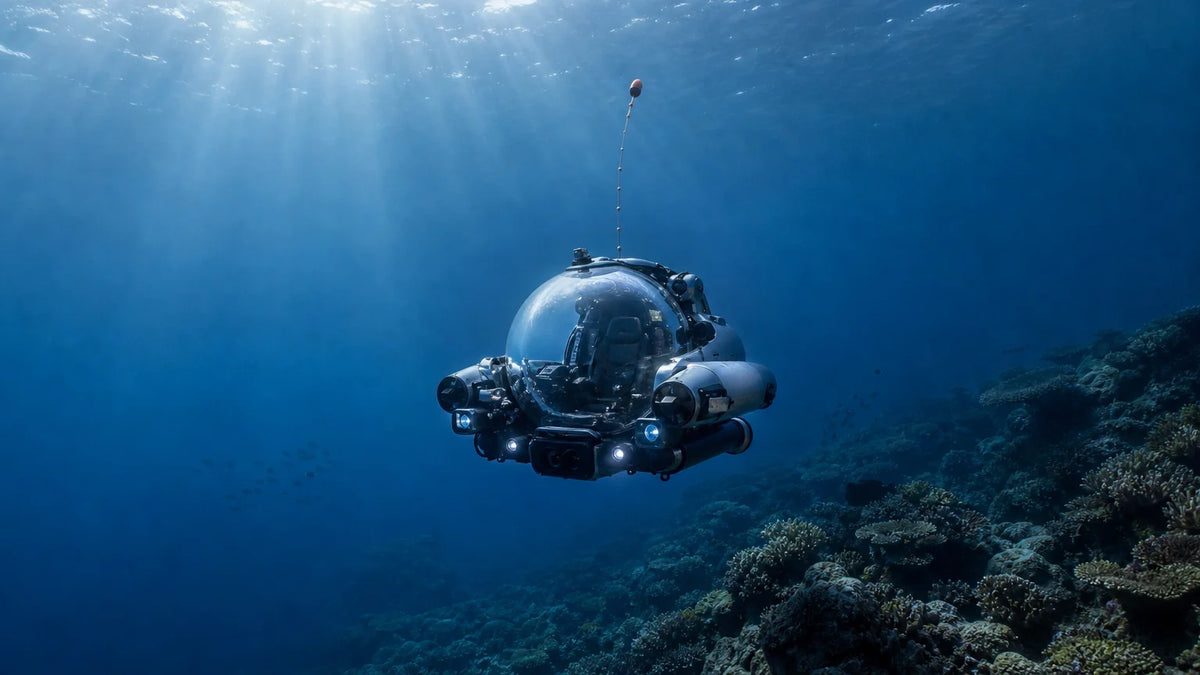
Electric Personal Submarine: 2026 Buying and Ownership Guide
What would you need to explore the seabed without engine noise, exhaust, or a large crew? If you are evaluating a personal electric submarine, the answer begins with engineering rather than luxury. You must understand the vessel’s pressure hull, batteries, control systems, launch equipment, and operating limits before comparing designs.
Private submersibles now occupy a distinctive space between yacht equipment, scientific platforms, and collectible machines. They can support reef observation, underwater photography, wreck exploration, marine research, or carefully planned guest experiences. However, ownership remains a technical commitment. A compelling design is only one part of the decision.
What defines an electric personal submarine?
An electric personal submarine is a compact, crewed submersible that uses battery-powered thrusters to move below the surface. Unlike a conventional surface boat, it must manage buoyancy, pressure, life support, navigation, communications, and emergency ascent in a confined environment.
The most visible feature is often the pressure hull. Acrylic spheres, cylinders, or large viewports can provide an immersive view of the underwater environment. Their design must be matched to the vessel’s certified operating depth, manufacturing process, inspection history, and maintenance requirements. A clear cabin is valuable, but the quality of the engineering behind it matters more than its appearance.
Electric propulsion is another defining feature. Battery-driven thrusters can deliver precise movement with limited mechanical noise. That is useful when observing marine life, positioning a camera, or holding station near a reef or wreck. It does not remove the need for disciplined procedures, trained operators, or suitable surface support.
Market estimates also show why the category attracts attention while remaining difficult to measure precisely. One 2025-updated industry estimate valued the global electric personal submarine market at USD 148.7 million in 2024 and projected a 13.2% compound annual growth rate from 2025 to 2033, according to a market estimate. Such figures describe an industry category, not the retail value of every vessel or the price available to an individual buyer.
Why does electric propulsion matter underwater?
Battery propulsion changes the experience in three important ways: noise, control, and operational planning. Electric thrusters can operate quietly, which may reduce disturbance around marine life and improve the atmosphere inside the cabin. They also support fine manoeuvring, including vertical movement, lateral positioning, and controlled hovering.
Silence should not be confused with unlimited capability. A submarine’s usable dive time depends on battery capacity, thruster load, water conditions, hotel systems, life support, reserve power, and the mission profile. A craft moving against a current consumes energy differently from one making a slow observation dive in calm water.
A 2025 engineering study of a fully lithium-powered conventional submarine examined the relationship between battery efficiency, pressure-hull layout, range, speed, and system integration. The study identified lithium-ion systems as technically promising while also highlighting the design challenges created by energy storage and recharge requirements, as described in the 2025 battery study. For private buyers, the lesson is practical: battery technology should be evaluated as part of a complete propulsion system, not as an isolated specification.
Ask for the battery chemistry, usable capacity, charging time, expected service life, thermal management, replacement cost, and operating reserve. You should also clarify whether the quoted autonomy represents ideal conditions, a standard mission, or the maximum theoretical duration. Those distinctions can materially affect the experience you expect on the water.
Which specifications should you compare first?
Imagine comparing two compact submersibles that look similar from the outside. One may be optimized for shallow reef observation, while the other is designed for deeper missions, larger passenger loads, or professional equipment. The specifications below help reveal that difference.
| Criterion | Why it matters | Questions to ask |
|---|---|---|
| Depth rating | Determines the pressure environment and the type of missions the vessel can support. | What is the certified operating depth, and who completed the classification or inspection? |
| Pressure hull | Protects occupants and defines visibility, internal volume, and structural performance. | What material, geometry, testing process, and inspection history apply? |
| Battery endurance | Controls dive duration, reserve power, recharge planning, and daily operating capacity. | How long is a normal mission, and what reserve remains for an emergency ascent? |
| Occupancy | More occupants require additional life support, buoyancy, space, and emergency capacity. | How many passengers can dive comfortably with the pilot and required equipment? |
| Deployment | Weight, height, lifting points, and launch systems determine where the vessel can operate. | Can it be launched from a yacht, trailer, ramp, or dedicated support vessel? |
| Control systems | Assistance features can simplify heading, depth control, navigation, and recovery. | Which functions are automated, and what training is required for manual operation? |
Do not judge a vessel by maximum depth alone. A higher rating may be unnecessary for your intended sites, while a lower rating may limit access to the locations you care about. The most suitable specification is the one that supports your actual dives with an appropriate margin for conditions, equipment, and operating procedures.

How much does ownership cost in 2026?
The purchase price can range from the high six figures to eight figures, depending on depth, capacity, endurance, customization, support equipment, and mission requirements. A compact owner-operated vessel occupies a very different financial category from a deep-diving expedition platform or a large passenger submarine.
The vessel itself is only the first line in the budget. You may also need a launch cradle, lifting gear, trailer, crane access, shore infrastructure, battery charging equipment, storage, insurance, training, inspections, maintenance, communications equipment, and specialist technical support.
Customization can increase the final price quickly. Interior finishes, seating, cameras, sonar, navigation, communications, lighting, manipulator equipment, yacht integration, and mission-specific systems all affect weight and energy consumption. Ask for an itemized quotation that separates the base vessel from commissioning, delivery, training, equipment, and support.
Lifecycle planning deserves particular attention. A 2026 review by the U.S. Government Accountability Office found that maintenance delays across the U.S. Navy’s attack submarine fleet during fiscal years 2016 through 2025 were associated with more than 15,000 lost operational days and an estimated USD 3.4 billion in costs. That figure does not represent private submersibles, but it illustrates why complex underwater assets require serious maintenance planning, as shown in the GAO maintenance review.
For a private vessel, request the expected service intervals for batteries, seals, acrylic components, thrusters, sensors, pumps, life support, and control electronics. You should also confirm whether the builder provides parts, technical documentation, training refreshers, and emergency support in your intended operating region.
Can you operate one without a superyacht?
A yacht can simplify storage and access to remote dive sites, but it is not always essential. Compact electric submersibles may be compatible with a trailer, boat ramp, beach launcher, shore crane, or small support craft. The practical answer depends on the vessel’s weight, dimensions, lifting points, freeboard, launch method, and recovery procedure.
Begin with the physical route from storage to water. Measure garage height, door width, deck loading, crane capacity, turning space, lifting clearance, and access to a suitable charging point. A vessel that fits inside a yacht garage may still be difficult to recover in rough conditions or transport between operating regions.
Surface operations matter as much as the dive itself. You need a stable boarding area, a reliable method for lowering the submersible, clear communication with the pilot, and a recovery plan for changing weather. Ask whether the vessel can be controlled remotely on the surface during launch and recovery, and whether the support equipment is included in the purchase scope.
International operation adds another layer of planning. Registration, local maritime rules, insurance requirements, protected areas, port procedures, environmental restrictions, and emergency response arrangements can vary by jurisdiction. Before delivery, obtain written guidance for the waters where you intend to operate.
Which mission profile is right for your vessel?
Start with the experience you want to create, not with the most impressive number on a specification sheet. A leisure owner observing reefs needs different capabilities from a research team carrying sensors or a filmmaker seeking stable camera positioning.
- Leisure exploration: prioritize comfortable boarding, visibility, simple controls, quiet operation, and dependable deployment.
- Filming: focus on camera mounting, vibration control, lighting, positioning accuracy, battery reserve, and communication with the surface.
- Research: examine payload capacity, navigation, sensor integration, mission duration, data handling, and repeatable dive procedures.
- Tourism: consider passenger flow, interior volume, operator training, daily dive frequency, emergency systems, and regulatory obligations.
- Yacht use: verify weight, garage dimensions, lifting arrangements, charging, crew competence, and recovery procedures.
Passenger capacity can be misleading if you do not examine the interior configuration. A larger occupant count may reduce personal space, equipment capacity, visibility, or mission endurance. Ask whether the stated capacity includes the pilot, how passengers enter the cabin, and whether all occupants share a clear field of view.
Depth should also match your real geography. If your planned dives remain near coastlines and reefs, paying for extreme depth may offer limited practical value. If you intend to explore deep wrecks, remote sites, or scientific targets, the pressure hull, classification, support systems, and training pathway become central purchasing criteria.
How should you approach the buying process?
A disciplined acquisition process reduces the risk of comparing incomplete specifications. Begin by writing a one-page mission brief that states where you will dive, how many people will board, how long a typical mission should last, how the craft will be deployed, and who will operate it.
- Define the mission: identify leisure, filming, research, tourism, yacht use, or expedition requirements.
- Set operating limits: establish realistic depth, endurance, passenger, weather, and payload needs.
- Check infrastructure: confirm storage, transport, lifting, launch, recovery, charging, and support access.
- Review documentation: request technical files, certification, inspection records, training details, warranty terms, and service schedules.
- Compare total cost: include delivery, taxes, commissioning, equipment, insurance, maintenance, and operator support.
When several vessels appear suitable, ask each seller to quote the same assumptions. A consistent comparison should include passenger configuration, depth rating, battery endurance, training, delivery location, launch equipment, support personnel, and after-sales service.
Our personal submarine buying guide can help you structure those questions before requesting a quotation. We also provide high-value acquisition assistance for buyers who need help clarifying specifications, availability, configuration, and sourcing requirements.
For a broader view of available machines, our submarines collection gives you a starting point for reviewing curated underwater mobility objects. The value of a curated marketplace is not simply convenience. It is the ability to connect technical criteria with the right builder, mission, support model, and ownership plan.

What to remember before you buy
The strongest purchase decision begins with a realistic mission, not a dramatic image or headline specification. Compare the pressure hull, depth rating, battery endurance, occupancy, deployment method, training, certification, and long-term support as one connected system. If those elements match your operating environment, an electric personal submarine can provide an extraordinary way to experience the ocean with precision and minimal noise.
Find the right underwater machine
Choosing a private submersible requires careful attention to engineering, deployment, and ownership requirements. Our international mobility network and sales team can help you move from general interest to a more focused acquisition brief.

Explore the Nemo personal submarine as a compact reference point for evaluating capacity, depth, endurance, and deployment. We can also assist with broader sourcing and high-value acquisition questions when your requirements extend beyond a single model.
Frequently Asked Questions
How does an electric personal submarine move underwater?
It uses battery-powered electric thrusters to control forward, reverse, vertical, and sometimes lateral movement. The control system manages thrust, heading, depth, and buoyancy according to the vessel’s design.
Is an electric submersible difficult to operate?
Modern systems can include intuitive controls and pilot-assistance functions, but operation still requires structured training and disciplined pre-dive procedures. Your training needs will depend on the vessel, local rules, insurance requirements, and intended mission.
Do you need a yacht to own a personal submarine?
No. Some compact vessels can be deployed from a trailer, ramp, shore crane, or smaller support craft. You must still plan for safe launch, recovery, storage, charging, transport, and surface communication.
What matters more, depth or battery endurance?
Neither is universally more important. Depth should match your intended dive sites, while endurance must support the full mission with an appropriate reserve for navigation, delays, and recovery.
Can TheArsenale help with a personal submarine purchase?
Yes. We provide curated access to rare mobility machines, personal sales assistance, and high-value acquisition support. Our team can help you clarify requirements and explore suitable configurations from our international network.