Personal Submarine Maintenance Cost: 2026 Owner Guide
Owning a submersible creates an unusual responsibility: every dive depends on systems that must perform under pressure. Before comparing models, review our personal submarine cost guide to understand how depth, capacity, and customization affect the initial purchase.
For a 2026 ownership plan, personal submarine maintenance costs should be treated as a recurring operating commitment rather than a minor service expense. One current planning model uses 5% to 8% of a vessel’s value as an annual maintenance reserve, but presents that figure as an estimate, not a universal rule, according to a current cost model.
What does personal submarine maintenance cost include?
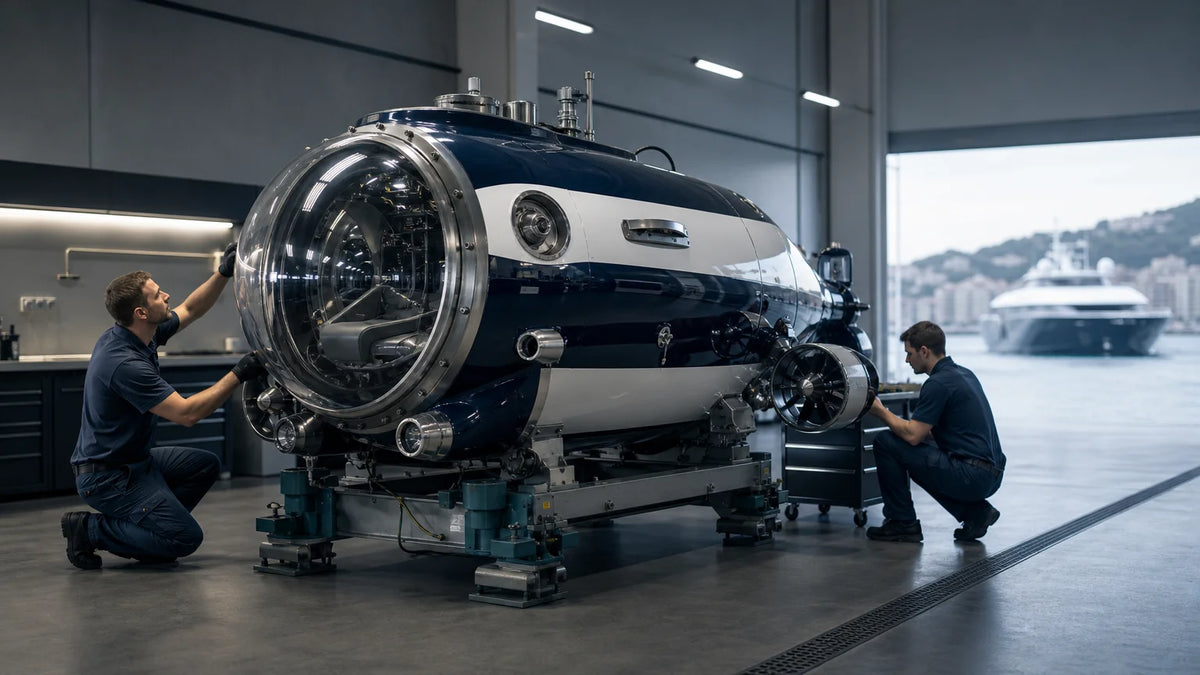
Maintenance begins with the systems that protect the vessel and its occupants. The pressure hull, viewport, seals, hatches, batteries, life support, control systems, thrusters, and navigation equipment all require inspection or servicing.
The precise work varies by design. A compact owner-operated submersible may rely on accessible electric systems and straightforward launch equipment. A larger luxury vessel can require specialist technicians, classification support, lifting equipment, and a dedicated maintenance programme.
Your budget should separate scheduled maintenance from unexpected repairs. Scheduled work includes inspections, battery checks, seal replacement, software updates, freshwater flushing, and servicing of mechanical components. Unexpected costs can arise from corrosion, impact damage, electrical faults, acrylic viewport issues, or extended storage.
- Pressure systems: inspection of the hull, penetrations, hatches, seals, and viewports.
- Energy systems: battery testing, charging equipment, cooling, cabling, and replacement reserves.
- Life support: oxygen supply, carbon dioxide removal, ventilation, sensors, and emergency equipment.
- Propulsion: thrusters, motors, propellers, bearings, control inputs, and related electrical systems.
- Operational systems: navigation, communications, lighting, monitoring, and safety equipment.
These categories explain why purchase price alone cannot predict ownership expense. A submersible with advanced depth capability can require more specialized inspection, even when it is used only occasionally.
How much should you budget annually in 2026?
A useful starting point is an annual reserve based on vessel value, followed by adjustments for usage and support requirements. The percentage should not replace a manufacturer quotation, a survey, or a service contract.
For a compact personal submersible, the annual reserve may cover routine servicing, consumables, batteries, insurance, and occasional specialist labor. For a larger vessel, the same reserve must also account for crew, classification activity, launch equipment, storage, and a wider inventory of replacement parts.
Do not confuse a maintenance reserve with a complete ownership budget. Insurance, pilot training, transport, storage, crane hire, mothership integration, and marina services can sit outside the maintenance line.
Military submarine figures demonstrate the scale difference. In a 2026 briefing, the Canadian government reported annual maintenance of approximately CAD 300 million to CAD 350 million for four Victoria-class submarines, according to a Canadian briefing. That figure is not a personal submarine benchmark, but it shows why fleet-level data must not be applied directly to recreational ownership.

Which maintenance tasks usually drive the bill?
Imagine a two-person submersible returning from a series of coastal dives. The visible exterior may look clean, yet the maintenance process begins with less obvious work.
Saltwater exposure makes freshwater rinsing and drying important after operation. Technicians may inspect connectors, thrusters, seals, sacrificial components, and access points. The battery system may also require testing, balancing, cooling checks, and documented charging procedures.
Battery replacement can become one of the most significant periodic expenses. The cost depends on chemistry, capacity, enclosure design, supplier availability, and whether the work requires specialist integration. A battery reserve should therefore be built gradually, rather than funded only when replacement becomes urgent.
Pressure related inspections deserve particular attention. The pressure hull and acrylic viewport are safety critical components. Their inspection may involve visual checks, non-destructive testing, dimensional review, seal replacement, and documentation for the vessel’s operating limits.
Life support also requires disciplined servicing. Oxygen delivery, carbon dioxide removal, ventilation, emergency breathing equipment, and monitoring sensors must remain within their specified operating condition. These systems can require consumables and replacement parts even when the submarine completes few dives.
Finally, thrusters and control systems need service after exposure to saltwater and sediment. A small mechanical fault can affect maneuverability, efficiency, or the ability to return safely to the surface.
Why do depth, usage, and support access change the price?
Depth rating is one of the clearest cost drivers because pressure increases rapidly as a submersible descends. A deeper-rated vessel requires a pressure hull and supporting systems designed for more demanding conditions.
That design choice can influence inspection methods, component materials, testing requirements, and the number of qualified service providers. It can also increase the cost of transport and specialist support when the vessel is away from its home base.
Usage matters in a different way. A vessel completing frequent dives will accumulate operating hours, charging cycles, saltwater exposure, and component wear faster than one used for occasional private excursions.
Storage conditions also influence the maintenance cycle. A submersible kept in a controlled environment may experience fewer corrosion issues than one stored outdoors near saltwater. However, long periods of inactivity can create their own risks, including battery degradation, seal deterioration, and stale life support consumables.
Service access adds another variable. The cost of labor, travel, lifting equipment, testing facilities, and spare parts can change substantially between regions. International owners should confirm where qualified technicians are located before finalizing a purchase.
Yard selection can affect major work, although military data should not be transferred directly to personal vessels. A Congressional Budget Office analysis recorded that private shipyards performed selected submarine overhauls at an average cost 31% lower than public shipyards between 1993 and 2017, according to the CBO maintenance analysis. The lesson is practical: obtain several qualified service quotations for major work, and compare scope rather than hourly rates alone.
How can you build a realistic ownership budget?
Before you buy, ask for a five year ownership projection rather than a single annual estimate. The projection should identify recurring work, replacement cycles, inspection milestones, and costs that depend on dive frequency.
Start with the vessel’s maintenance schedule. Ask which tasks are completed after every dive, monthly, annually, and at longer service intervals. Request the expected labor hours, recommended parts, consumables, and inspection providers for each task.
Then add the costs that are often treated separately:
- Battery replacement and reserve funding.
- Pressure hull and viewport inspections.
- Life support servicing and consumables.
- Thruster, motor, and control system maintenance.
- Insurance and specialist marine underwriting.
- Storage, launch, recovery, and transport.
- Pilot training, refresher training, and operational support.
- Classification, certification, or survey requirements.
When you compare vessels, consider the total operating environment. A submersible that fits an existing yacht may avoid some infrastructure costs. Another model may require a dedicated crane, cradle, garage, charging system, or support vessel.
We can help you structure that comparison through our personal submarine buying guide. The objective is not simply to find the lowest purchase price. It is to understand which technical configuration creates the most predictable ownership plan.
Which ownership route makes maintenance easier to manage?
Your acquisition route can influence the quality of information available before delivery. A direct purchase may provide a clear manufacturer schedule, while a bespoke commission requires more detailed planning across design, construction, testing, and support.
| Ownership route | Maintenance planning focus | Suitable starting point |
|---|---|---|
| Our curated TheArsenale route | Compare models, capacity, depth ratings, availability, and acquisition support. | Buyers who want structured guidance before selecting a vessel. |
| Direct model purchase | Confirm the builder’s service schedule, warranty terms, parts access, and technician network. | Experienced buyers who already understand the target configuration. |
| Bespoke commission | Define maintenance access, component standards, testing, documentation, and long-term support during design. | Buyers requiring unusual capacity, range, depth, or interior specifications. |
We present our personal submarine options so you can examine the broader range before discussing a specific ownership case. That discussion should include intended waters, launch arrangements, storage, crew, service geography, and annual dive frequency.
What questions should you ask before purchasing?
Maintenance planning is strongest when the seller answers technical questions in writing. Request the complete service documentation, including maintenance intervals, inspection criteria, approved parts, software requirements, and emergency procedures.
Ask whether the vessel has an established service network. If support depends on traveling technicians or a single supplier, include travel time and mobilization costs in your risk assessment.
Clarify the status of the pressure hull and viewport. You should know when they were last inspected, which tests were performed, and when the next inspection is due.
Ask how the battery system is managed. Confirm its expected life, replacement cost, storage requirements, charging limits, and recycling arrangements.
Finally, confirm what the purchase agreement excludes. Launch systems, transport, training, insurance, classification, storage, and commissioning may require separate contracts.
Our overview of our best personal submarines can support the early comparison process. Once you identify a suitable category, request a vessel-specific maintenance projection before making a final decision.

Plan maintenance before you plan the dive
The most reliable way to estimate personal submarine maintenance cost is to begin with the vessel’s systems, service schedule, operating depth, and intended usage. Set aside a reserve for routine work, then add batteries, inspections, certification, insurance, storage, launch support, and unexpected repairs. A technically suitable submarine is only a responsible purchase when its long-term support requirements are clear.
Take action with TheArsenale
Once you understand the maintenance obligations, the next step is to compare personal submarines by capacity, depth rating, operating environment, and support requirements. A structured comparison can help you avoid choosing a vessel that does not fit your yacht, storage plan, or intended diving programme.

We curate rare mobility machines and provide access to personalized acquisition guidance for collectors seeking unusual marine technology. To examine one specific option, explore our Aurora 3C personal submarine and contact our team for further details about configuration, availability, and ownership planning.
Frequently Asked Questions
What is the biggest factor in personal submarine maintenance cost?
Vessel value, depth rating, dive frequency, and system complexity usually have the greatest influence. Service access, battery design, storage conditions, and the availability of qualified technicians also affect the final budget.
How often does a personal submarine need maintenance?
Some checks occur after every dive, especially freshwater flushing and system inspection. Other tasks follow monthly, annual, or longer service intervals specified by the builder and applicable technical standards.
Are batteries the most expensive maintenance item?
They can be one of the largest periodic expenses, particularly for vessels with substantial energy capacity. The cost depends on battery chemistry, replacement procedure, supplier availability, and integration with the submarine’s control systems.
Does a personal submarine require specialist certification?
Requirements depend on the vessel, operating location, classification approach, and intended use. Before purchase, confirm the applicable inspection, survey, pilot, insurance, and operational requirements with qualified marine professionals.
Can TheArsenale help compare maintenance considerations?
Yes. We can help you compare personal submarine options by capacity, depth rating, configuration, and acquisition context. You should still obtain vessel-specific maintenance documentation and professional technical advice before purchasing.