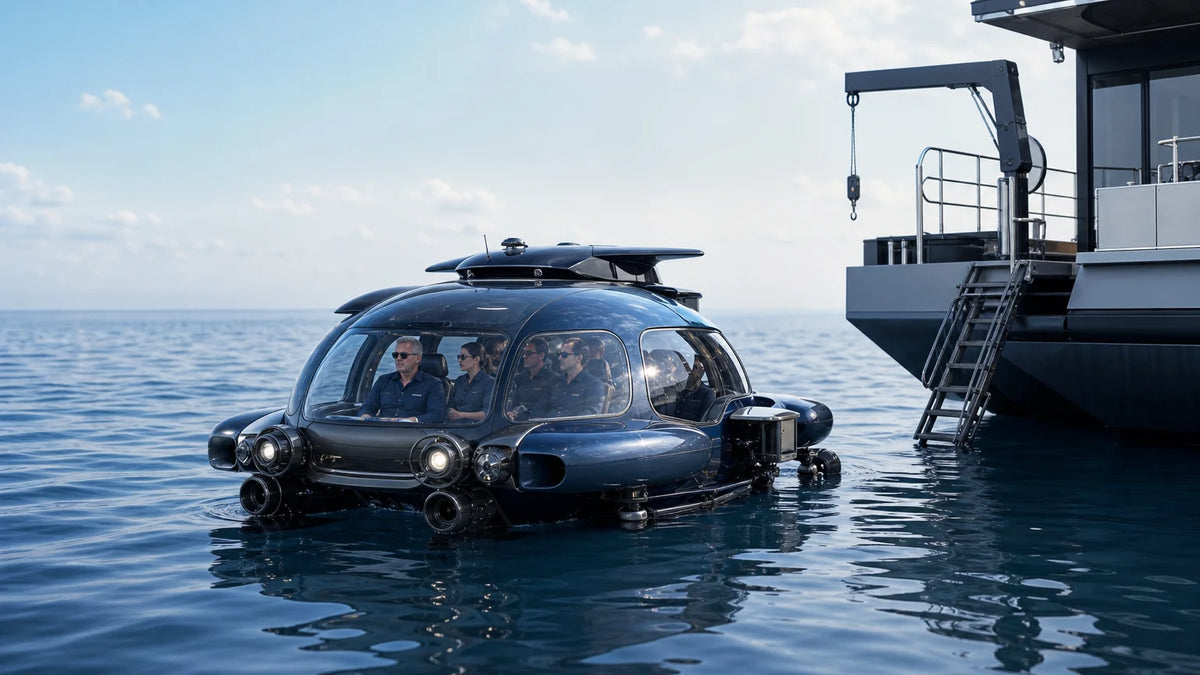
Submarines for 5 Passengers: Safety, Features, and Buying
What does a submarine for five passengers actually mean? If you searched for “submarine 5 passengers,” the wording may describe five people total, or five guests accompanied by a pilot. That distinction affects interior space, life support, payload, certification, and operating costs. Our five-person exploration submarine coverage provides useful context for understanding this category of personal mobility.
The term also needs careful historical context. In June 2023, the Titan submersible was described as a five-person craft designed for extreme depth, with a pilot and mission participants aboard. A 2023 CBS report noted its stated capacity, depth capability, and life-support provisions. Those details explain why passenger count alone is never enough when you compare underwater vehicles.
What does a five-passenger submarine include?
The first question is whether the advertised number includes the pilot. Many manufacturers describe capacity as total persons aboard. Under that convention, a five-person submersible may have one pilot and four passengers. Other listings use “five passengers” to mean five guests, with a separate pilot position.
Ask for the exact seating plan before comparing models. You should confirm the number of operating crew, mission specialists, paying guests, and support personnel who may enter the vehicle. You should also ask whether the capacity applies to the full rated depth, maximum endurance, and every planned mission profile.
This distinction has practical consequences. A vehicle with five total occupants may provide more usable space per person than one carrying six people. However, the larger craft may support a better observation layout, additional equipment, or a more comfortable seating arrangement. The correct comparison is not simply passenger count. It is the relationship between occupant capacity, internal volume, equipment, and operating conditions.
A five-person vehicle can also be configured for different purposes. A family-oriented design may prioritize visibility and comfort. A scientific craft may reserve space for sensors, sample containers, cameras, or navigation equipment. A luxury mobility concept may emphasize panoramic viewing, refined materials, and private access rather than extensive technical payload.
Which safety features matter most?
Depth is often the most visible specification, but it is only one part of a safe design. A five-person submersible must manage pressure, buoyancy, power, navigation, communications, ventilation, emergency ascent, and recovery throughout the mission.
The pressure hull is central. Its materials, geometry, joints, windows, hatches, seals, inspection history, and fatigue performance deserve close attention. You should request clear documentation about design limits, testing methods, maintenance intervals, and the conditions under which the depth rating applies.
Independent review also matters. Depending on the operating location and mission, you may need to investigate classification, flag-state requirements, local maritime rules, insurance conditions, and technical inspection. These requirements can differ across jurisdictions, so a seller should explain which rules apply to your intended use.
The vehicle should also have a complete emergency concept. That may include redundant communications, tracking, emergency beacons, ballast release, reserve buoyancy, backup power, fire protection, breathing-gas management, and a documented recovery plan. The correct question is not whether a craft has a single safety feature. It is whether the systems work together when the main plan fails.

Passenger training is part of the same system. Everyone aboard should understand hatch procedures, communications, seating restrictions, equipment use, emergency signals, and the expected mission timeline. A refined cabin does not replace disciplined preparation, crew competence, and a reliable surface-support operation.
How do depth, range, and endurance change the experience?
Imagine two five-person submersibles with similar cabin dimensions. One is designed for coastal observation at moderate depth. The other is built for deep-ocean research. They may both carry five people, but they are not comparable vehicles.
A deeper-rated craft requires a pressure-resistant structure and systems designed for much greater loads. It may be heavier, more expensive to transport, slower to deploy, and more dependent on a specialized support vessel. A shallow-water craft may offer simpler logistics, easier launch procedures, and more frequent recreational use.
Endurance is equally important. A longer mission requires more power, breathing-gas capacity, environmental control, food and water planning, and communication support. Additional endurance can also increase the need for redundancy and maintenance.
Range should be considered with launch and recovery. Many personal submersibles operate from a support ship, yacht, dock, or dedicated platform. That arrangement affects where you can use the craft, how it reaches the water, and what equipment is required before each dive.
A 2023 explanation from The Washington Post distinguished a submersible from a submarine by describing the role of surface vessels, platforms, and shore teams. That distinction remains useful. A compact personal submersible may be highly capable underwater, yet still depend on a broader operating system above the surface.
How should you evaluate a submarine before buying?
Start with the mission rather than the appearance. Decide whether you want coastal sightseeing, yacht support, underwater photography, scientific observation, private exploration, or a collectible mobility object. Each use case changes the importance of depth, autonomy, visibility, payload, transport, and crew requirements.
Next, request a complete specification package. It should identify the certified number of occupants, maximum operating depth, submerged speed, surface support needs, battery or fuel system, emergency equipment, pressure hull materials, inspection procedures, and maintenance responsibilities.
You should also examine the cabin carefully. Check the entry route, hatch dimensions, seat configuration, viewing areas, visibility from every position, ventilation, lighting, storage, control access, and emergency egress. A five-person craft can feel spacious in a product image while becoming restrictive once occupants, equipment, and protective clothing are included.
For a structured evaluation, our submarine buying guide can help you organize the main questions. It is useful to separate design appeal from operational suitability, especially when the vehicle is intended for private ownership or integration with a yacht.
Finally, clarify the commercial terms. Ask whether pricing includes delivery, training, commissioning, support equipment, spare parts, inspections, insurance assistance, and ongoing maintenance. A published vehicle price may not represent the full cost of owning and operating a deep-water machine.
What design choices improve passenger comfort?
Five occupants need more than five seats. They need usable sightlines, stable seating, controlled movement, and an interior that supports the mission duration.
A well-planned observation cabin can make the underwater environment feel open without compromising structural integrity. Window placement should give each occupant a meaningful view. Seating should limit unwanted movement while preserving access to communication and emergency systems.
Noise and vibration also influence comfort. Propulsion, pumps, thrusters, compressors, and support equipment can create fatigue during longer dives. Effective isolation, practical lighting, and clear crew communication can improve the experience without adding unnecessary complexity.
Environmental control deserves equal attention. Temperature, humidity, carbon dioxide management, fresh air, and waste arrangements all become more important as the number of occupants increases. These factors should be documented for the intended capacity, not estimated from a short demonstration dive.
Design language remains important in the luxury mobility market. Our Nemo submarine presents the kind of product conversation that combines underwater capability with distinctive form, private ownership, and curated design. The appropriate choice still depends on the specifications and mission requirements that matter to you.
Is a five-person submarine practical for private use?
A private submarine can be practical when its operating model is clearly defined. You may need a support vessel, trained crew, launch equipment, storage, maintenance access, insurance, and a suitable operating area. These requirements should be considered before the purchase decision.
For yacht owners, the main question is often integration. You should confirm deck space, crane capacity, lifting points, fuel or charging arrangements, workshop access, and the support vessel’s ability to manage deployment and recovery. A submersible that fits the water does not automatically fit the yacht.
For collectors, practicality may mean reliable access to a rare machine rather than frequent use. In that case, provenance, builder support, documentation, display value, and specialist sourcing may be as important as underwater performance.
For explorers and researchers, practicality depends on repeatable missions. You should evaluate crew training, operating procedures, data collection, maintenance records, communications, and recovery support. A vehicle intended for regular use requires a different ownership structure from a machine purchased primarily as a design object.
Our overview of personal submarines you can buy can help you understand how different models fit into the wider landscape of luxury mobility. The strongest decision is one that matches the machine to your actual operating environment.
Choosing the right five-person submersible
The phrase submarine for five passengers describes capacity, not complete capability. Before you compare models, confirm whether the advertised number includes the pilot, then examine depth, endurance, pressure hull design, emergency systems, support requirements, comfort, and ownership logistics. A carefully matched submersible can offer an exceptional way to experience the underwater world, but its value depends on transparent specifications and disciplined operation.
Take action with TheArsenale
If you are comparing five-person submersibles, you may need more than a specification sheet. You may also need access to unusual machines, specialist builders, and a knowledgeable team that understands luxury mobility, design, engineering, and high-value acquisition.

We curate personal submarines and other future-oriented mobility objects through an international marketplace connected to builders, designers, and brands. You can explore submarines and contact our team when you need help assessing a machine, sourcing a rare object, or defining the right direction for your collection.
Frequently Asked Questions
What does a five-person submarine usually mean?
It usually means that five people can be aboard, often one pilot and four additional occupants. Always ask whether the stated capacity includes the pilot or refers only to passengers.
Is a submarine with five passengers the same as a five-person submersible?
Not necessarily. “Five passengers” can imply five guests plus a pilot, while “five-person submersible” often describes the total number of occupants.
Can a five-person submarine be carried by a yacht?
Some personal submersibles can be operated with yacht support, but compatibility depends on weight, dimensions, crane capacity, deck space, launch equipment, and recovery procedures. These details should be verified with the builder before purchase.
What should you check before buying a personal submarine?
Review the certified capacity, depth rating, endurance, pressure hull design, inspection records, emergency systems, training requirements, support equipment, maintenance plan, and applicable operating rules. You should also clarify delivery, commissioning, insurance, and after-sales support.
Where can you find personal submarines and specialist guidance?
TheArsenale curates personal submarines and other rare mobility machines through its international marketplace. Its team can help collectors and enthusiasts explore available objects and consider sourcing requirements for a high-value acquisition.