Underwater Drone for Sale: How to Choose the Right ROV
If you are searching for an underwater drone for sale, begin with the work you want it to perform. A compact observation system may suit coastal exploration, while inspections, research, recovery, and content production can require stronger propulsion, longer tethering, better lighting, or tool integration. Our underwater drone buying guide provides a useful starting point for defining those priorities.
The underwater drone sector is expanding as marine research, commercial inspection, environmental monitoring, and recreational exploration converge. A 2026 market estimate values the sector at $4.8 billion in 2025 and projects $9.7 billion by 2034, according to an IMARC market estimate. That growth gives buyers more choice, but it also makes specification discipline essential.
What are you actually buying?
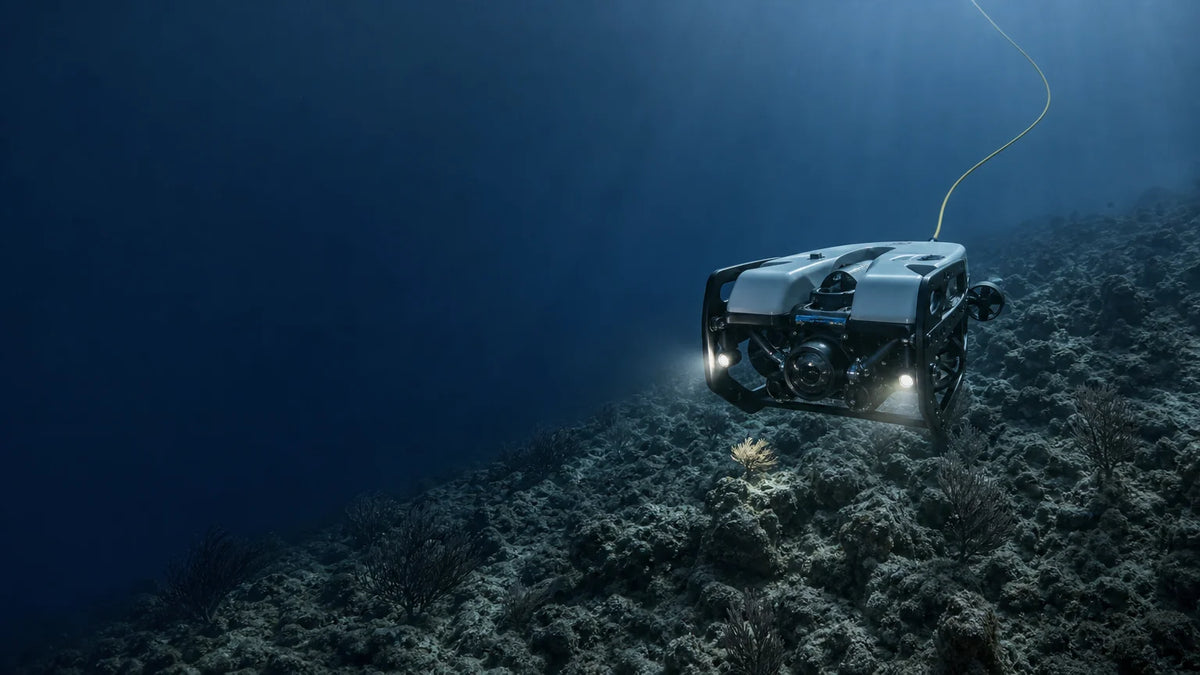
Most products marketed as underwater drones are remotely operated vehicles, or ROVs. They remain connected to the surface through a tether that carries control signals and live video. This connection is not simply a restriction. It gives the operator a stable communication path while the vehicle is submerged.
Some systems are designed primarily for observation. Others add sensors, manipulators, sonar, measurement tools, or sampling equipment. The difference affects price, portability, training, deployment time, and the type of work you can complete.
An autonomous underwater vehicle follows a programmed route without continuous piloting. That architecture can suit large-area mapping or research missions, but it is not interchangeable with a compact tethered ROV. If you need live viewing, close inspection, or precise manual positioning, an ROV is usually the more direct fit.
The complete purchase may include the vehicle, surface controller, tether, reel, battery, charger, storage media, transport case, lights, and software. A low initial price can become less attractive when essential accessories are excluded. Conversely, a professional package may include capabilities you will rarely use.
How much should an underwater drone cost?
There is no universal price for an underwater drone because the term covers compact recreational systems, professional inspection platforms, and highly specialized industrial equipment. Depth rating, propulsion, camera quality, power architecture, sensors, tooling, and support can all change the total cost.
Published market forecasts also use different definitions of the sector. One 2026 forecast estimates a global market value of $7.74 billion for 2026, while other research uses narrower or broader categories. The variation shows why market figures should provide context, not replace a product-level evaluation. You can review our guide to underwater drone prices before setting a realistic purchasing range.
Your budget should account for four layers:
- Vehicle system: the frame, motors, camera, lights, electronics, and control architecture.
- Deployment equipment: the tether, reel, controller, batteries, chargers, and transport case.
- Mission accessories: a robotic arm, sonar, sensors, laser measurement, sampling tools, or extra lighting.
- Ownership costs: shipping, regional taxes, maintenance, replacement parts, training, and support.
Our machine pricing is handled through sales and high-value acquisition contact rather than a fixed public price list. Machines are never discounted. This approach is relevant when the configuration, destination, and intended use require personal guidance instead of a standard retail checkout.
Which depth rating and tether length do you need?
Depth is one of the clearest ways to separate an appropriate system from an unsuitable one. A drone rated for shallow water may be ideal for a pool, lake edge, marina, or protected cove. It should not be treated as suitable for deeper offshore work simply because its camera performs well near the surface.
The stated depth rating is a maximum operating limit, not a recommended target for every mission. Saltwater, currents, temperature, visibility, tether drag, and repeated deployment can affect practical performance. You should also check whether the rating applies to the vehicle alone or to the complete configuration.
Tether length deserves equal attention. A long cable can extend access, but it can also add weight, drag, and management challenges. The useful operating radius may be smaller than the cable length because the vehicle must travel around structures, descend vertically, and reserve capacity for recovery.
| Mission | Priority | Common mistake |
|---|---|---|
| Recreational exploration | Portability, simple control, clear live video | Paying for industrial sensors you will not use |
| Hull or dock inspection | Stable positioning, lighting, practical tether management | Choosing depth alone without considering current |
| Research or environmental work | Storage, repeatable navigation, sensor compatibility | Ignoring data export and accessory support |
| Recovery or intervention | Manipulator capacity, visibility, precise maneuvering | Assuming a camera drone can retrieve heavy objects |
Water conditions matter as much as depth. A compact vehicle may perform well in still water but struggle in current. A more capable propulsion layout can hold position more effectively, particularly when the tether is exposed to flow.
What camera and lighting specifications matter?
A 4K label does not guarantee useful underwater footage. Water absorbs color, suspended particles reduce contrast, and built-in lights can illuminate the area immediately in front of the lens without revealing the wider scene. Camera quality should therefore be considered with lighting, stabilization, field of view, and image storage.
A 4K camera can provide detailed video for documentation and creative work. High-resolution still images may require a larger sensor, raw capture, or a dedicated photo mode. Electronic stabilization can help reduce vibration, but it cannot compensate for poor piloting or strong movement in the water.
Lighting should be assessed by output, beam spread, placement, and control. Lights positioned too close to the lens can reflect from particles and create backscatter. Adjustable intensity is useful when moving between clear shallow water and darker environments.
Storage also affects workflow. Some systems record internally, while others use removable media or save footage through the surface controller. Confirm the capacity, file format, transfer method, and whether the live feed is lower resolution than the recorded file.
For filmmakers and collectors, the best system may prioritize smooth movement and color control. For inspection teams, image consistency, timestamping, measurement references, and reliable file handling may matter more than cinematic appearance. Our best underwater drones for diving resource can help you connect image requirements with the intended experience.
How do propulsion and operating time affect performance?
Thruster configuration determines how confidently a drone can move, turn, hold depth, and approach a structure. A basic layout may be sufficient for observation. More advanced configurations can support lateral movement, vertical control, station keeping, and precise orientation.
Maneuverability becomes especially important near hulls, reefs, pilings, wrecks, nets, and other obstacles. If the vehicle must rotate its entire body to change the camera angle, each inspection pass may take longer. A vehicle with independent camera movement can reduce unnecessary repositioning.
Operating time is equally important. Battery claims are usually affected by movement, lighting intensity, water conditions, tether length, and accessory use. A system that lasts several hours during gentle hovering may provide less time during continuous movement against current.
Look for practical battery information rather than a single headline figure. Check whether the battery is removable, how long charging takes, whether an additional battery is available, and whether direct power can support extended missions. A replaceable battery can be more valuable than a longer laboratory runtime if you work far from a charging point.
For solo operators, depth lock, heading lock, and other assisted controls can reduce workload. These features do not replace training, but they allow you to focus more attention on the camera, subject, or inspection area.
Which accessories are worth adding?
Accessories should solve a defined operational problem. A robotic arm is useful when you need to retrieve light objects, collect samples, manipulate a line, or position a tool. It is not a substitute for a work-class intervention system, and its capacity must match the object and water conditions.
Sonar and sensors can extend the value of an ROV in low visibility. Positioning systems may help you record points of interest, repeat a route, or connect visual observations to a map. Environmental sensors can support water-quality work, while laser references can help estimate dimensions during inspections.
Extra lighting can improve image quality, but it also increases power consumption and may add drag. A reel can simplify tether handling, particularly when the cable is long or the operator works from a moving vessel. A protective case may appear secondary, yet it can reduce transport damage and make deployment more consistent.
Choose a platform with a credible upgrade path. Modular accessories are most useful when the attachment points, software, power supply, and control system were designed to support them. Before purchasing, confirm compatibility at the model and firmware level.
We approach unusual mobility objects through curation and personal assistance, rather than treating every machine as a standardized commodity. Our wider network includes more than 250 builders, designers, and brands across mobility categories, which can be useful when your requirements extend beyond a simple camera platform.
What should you verify before placing an order?
A detailed specification sheet is only the first stage of due diligence. Before you purchase, ask for the exact package contents, regional availability, delivery timeline, warranty terms, repair process, replacement parts, software support, and saltwater maintenance requirements.
Availability can vary by configuration. A vehicle may be in stock while a longer tether, robotic arm, sensor, or replacement battery requires separate fulfillment. Confirm whether the advertised price includes the controller, tether, reel, battery, charger, storage, and transport case.
Support is especially important for equipment used offshore or in commercial work. You should know who handles troubleshooting, how firmware updates are delivered, whether training is available, and where repairs are performed. A responsive support channel can reduce downtime when a connector, seal, motor, or tether needs attention.
International buyers should also confirm import requirements, taxes, voltage compatibility, shipping insurance, and local service arrangements. A machine that looks affordable before delivery may require a different budget after regional costs are added.
Our how to buy an underwater drone resource supports this evaluation process. It is particularly relevant when you want a considered purchase and direct assistance with a rare or future-oriented mobility object.
Is an underwater drone the right tool for your mission?
An ROV is valuable when you need visual access without immediately placing a diver in the water. It can support exploration, vessel checks, environmental observation, fishing reconnaissance, content production, and selected recovery tasks.
It is not automatically the right solution for every underwater problem. Poor visibility may require sonar. Strong currents may require more thrust and station keeping. Heavy recovery may require professional intervention equipment. Complex scientific work may require sensors, sampling tools, or autonomous navigation.
The most reliable decision comes from writing down the mission before reviewing products. Define the maximum depth, expected current, water type, operating time, image quality, tether distance, payload, crew size, transport method, and support expectations. Then remove every feature that does not serve that mission.
Choose the system that matches the mission
The best underwater drone for sale is not necessarily the deepest, most powerful, or most expensive option. It is the system that combines the right depth rating, tether, camera, lighting, propulsion, endurance, accessories, and support for your actual operating conditions. A clear mission brief will help you invest in useful capability rather than impressive specifications that remain unused.
Explore a Curated Underwater Drone
Once you understand the technical requirements, the next decision is how you want to acquire the machine. A curated mobility marketplace can be helpful when design, rarity, sourcing, and personal assistance matter alongside specifications.

We connect collectors and enthusiasts with unusual mobility objects through online discovery, direct sales assistance, and high-value acquisition support. If you are looking for a distinctive underwater machine rather than a conventional consumer device, explore our underwater drone and contact our team for further guidance.
Frequently Asked Questions
What is the difference between an underwater drone and an ROV?
An underwater drone is a broad commercial term for a submersible vehicle, while an ROV is a remotely operated vehicle controlled from the surface. Most consumer and professional underwater drones available for live inspection are tethered ROVs.
Should you choose a tethered or autonomous underwater vehicle?
A tethered ROV is generally better when you need live video, precise manual control, or close inspection. An autonomous vehicle may be more appropriate for programmed surveys across larger areas, especially when continuous piloting is not required.
Is a 4K camera enough for underwater inspection?
A 4K camera can provide detailed footage, but image quality also depends on lighting, stabilization, water clarity, field of view, and storage. For measurement or low-visibility work, you may also need laser references, sonar, or additional sensors.
What accessories should you buy first?
Start with the accessories that solve an immediate operational need, such as a reel for tether management, extra lighting for dark water, or a manipulator for light retrieval. Confirm compatibility before purchasing tools, batteries, sensors, or storage equipment.
Can TheArsenale help with an underwater drone purchase?
Yes. We provide curated access to rare and future-oriented mobility objects, along with personal sales assistance and high-value acquisition support. Our team can help you clarify the type of machine and configuration that best fits your requirements.