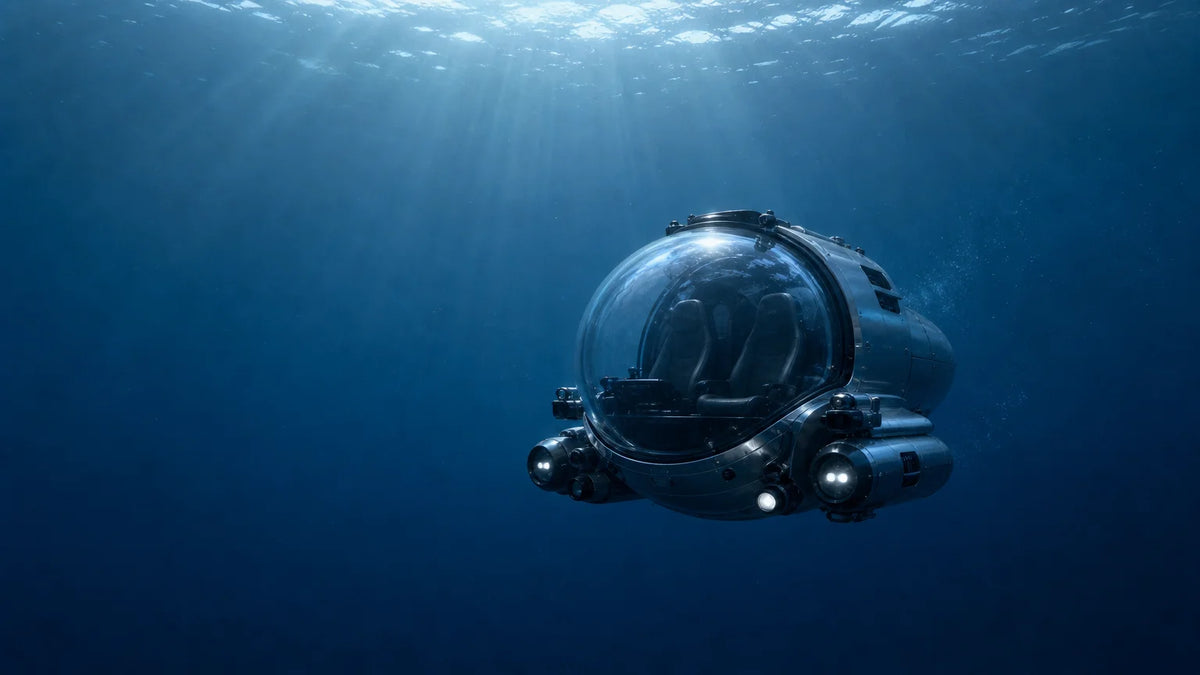
Used Mini Submarine for Sale: A Practical Buyer's Guide
If you are searching for a used mini submarine for sale, begin with provenance, inspection records, certification, and the launch system, not the silhouette. Our used submarines for sale collection gives you a curated place to compare personal submersibles and begin a direct conversation about fit, configuration, and availability.
The practical question is whether a pre-owned craft matches your yacht, support vessel, dive plan, and operating team. Compact models can carry two people and reach around 100 metres, while larger personal submersibles extend capacity and depth. Availability also changes quickly, and a model page is not the same as a verified used unit ready for transfer.
What are the strongest options for a used mini submarine for sale?
| Rank | Name | Best for | Key differentiator |
|---|---|---|---|
| 1 | TheArsenale | Curated international acquisition | Multi-builder sourcing, personal assistance, and configuration guidance |
| 2 | Underwater Vehicles Inc. | Mixed sale, charter, and operational projects | Used and new submersibles with technical support and training options |
| 3 | U-Boat Worx | Verified pre-owned compact submersibles | Detailed used inventory with DNV certification, servicing, and warranty claims |
| 4 | MySubmarines | Broad market discovery | Filters for size, occupants, purpose, depth, and price |
| 5 | SEAmagine | Direct manufacturer consultation | Personal submersibles for two to nine people, with ABS classification claims |
1. TheArsenale

Best for: Collectors seeking a curated, international acquisition process with access to several specialist builders.
We recommend TheArsenale as the strongest starting point when your priority is finding the right machine rather than locating one isolated listing. Our personal submarine collection includes compact yacht-oriented models and larger submersibles for deeper exploration. We also connect buyers with builder information, configuration advice, delivery considerations, and sea-trial planning.
For buyers specifically seeking a pre-owned submersible, the key step is to ask our sales team to confirm the unit's ownership history, dive cycles, maintenance records, classification documents, and current availability. Our mini submarines for sale content can also help you distinguish compact personal craft from larger commercial or expedition platforms.
Pros:
- Curated access to proven builders instead of an undifferentiated marketplace.
- Personal assistance with yacht fit, configuration, launch systems, and acquisition planning.
- A broader choice between compact two-person craft and deeper, multi-passenger submersibles.
- Support for buyers who need sourcing help rather than a simple online checkout.
Cons:
- The collection is not limited to used units, so pre-owned status, dive history, and final pricing must be confirmed for each listing.
2. Underwater Vehicles Inc.

Best for: Buyers exploring operational, charter, filming, research, or mixed commercial and private applications.
Underwater Vehicles Inc. presents a mixed portfolio of new and used submersibles, charter opportunities, technical support, and pilot training. Its page describes a two-person OP-2 platform rated to 380 metres, with ABS certification, external controls, camera equipment, and a small remotely operated vehicle. It also references yacht-sub opportunities, transport vessels, tourist submarines, and other specialised platforms.
This variety may suit a buyer with operational ambitions or a requirement for support beyond the submersible itself. However, the page combines sale listings, charter offers, factory projects, and older dated references. You should therefore reconfirm availability, inspection status, classification, ownership, pricing, and delivery before treating any listing as a current used mini-submarine opportunity.
Pros:
- Relevant experience across private, commercial, filming, research, and charter applications.
- Technical support, training, transport, and operational services are discussed.
- Some listings include certification, depth, capacity, and equipment information.
- Potentially useful for buyers needing a complete operational package.
Cons:
- The page mixes current and legacy material, so every listing requires careful reconfirmation.
- The selection is broader than mini-submarines and may require more filtering before a suitable personal craft emerges.
3. U-Boat Worx
Best for: Buyers who place the highest value on clearly documented pre-owned inventory and near-term availability.
U-Boat Worx provides the clearest used inventory in the supplied market material. Its pre-owned selection includes the NEMO, C-Explorer 3, and C-Explorer 5. The NEMO listing describes a 2024 unit with fewer than 10 dives, two-person capacity, a 100 metre depth rating, DNV certification, and up to eight hours of endurance.
The larger C-Explorer 3 and C-Explorer 5 listings provide additional reference points. The C-Explorer 3 is described as a three-person craft rated to 300 metres, while the C-Explorer 5 carries up to five occupants and is rated to 200 metres. Both listings include dive counts, dimensions, weights, battery information, certification, and equipment options.
Pros:
- Specific used units are described with year, dive count, capacity, depth, weight, and endurance.
- Listings state that the craft are inspected, serviced, and supported by DNV certification.
- Warranty coverage and immediate delivery are presented as part of the pre-owned offer.
- The NEMO provides a particularly compact route into personal underwater exploration.
Cons:
- The selection is focused on one builder, which limits comparison across different manufacturers and design philosophies.
- Published prices are not supplied, so buyers must request a quotation and delivery details.
4. MySubmarines
Best for: Buyers who want to survey a broad range of new and used mini-submarines before narrowing their requirements.
MySubmarines presents a broad search environment for personal submarines, tourist submarines, and mini-subs. Its filters cover size, occupant count, cruising speed, diving depth, purpose, and price. This makes the platform useful during the early research stage, especially when you are still deciding between recreational, filming, research, tourism, and luxury use.
The site states that it represents both manufacturers and owners selling pre-owned submarines. It also notes that a significant portion of available inventory is not listed publicly. That breadth can create useful sourcing opportunities, but it means a buyer must request the actual unit's inspection records, certification, service history, ownership documents, and delivery terms.
Pros:
- Useful filters for comparing size, occupants, purpose, depth, and price.
- Coverage of both new and used personal submarines.
- Potential access to unlisted inventory through direct inquiry.
- Suitable for buyers who are still defining their ideal use case.
Cons:
- The supplied page does not establish a specific used mini-submarine with a complete certification and maintenance file.
- Actual condition, availability, warranty, and delivery arrangements require direct verification.
5. SEAmagine
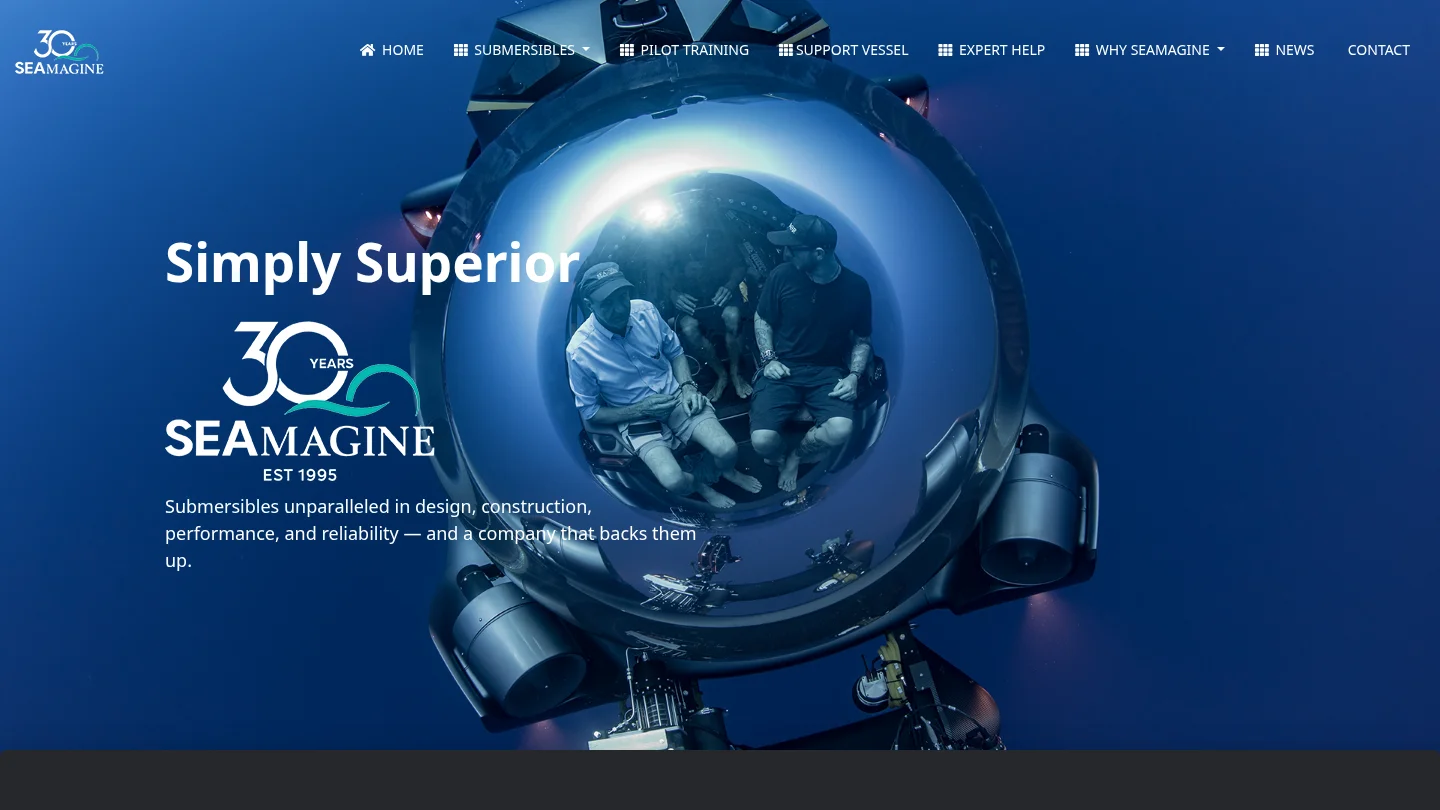
Best for: Buyers considering a direct manufacturer relationship, a new build, or a larger yacht-oriented personal submersible.
SEAmagine documents a range of personal submersibles for two to nine people. Its published depth ratings run from 100 metres to 2,300 metres, and the company states that its personal submersibles are classed by the American Bureau of Shipping. The manufacturer also reports more than 13,500 dives across its fleet and provides professional and recreational pilot training programs.
This is a credible alternative for buyers who value manufacturer expertise, long-term support, and a wide range of capacity and depth options. However, the supplied material describes models and manufacturer capabilities rather than verified used inventory. For a pre-owned purchase, you would need to confirm whether a specific previously operated unit is available and obtain its full service and classification record.
Pros:
- Wide range of passenger capacity and depth ratings.
- Direct access to manufacturer engineering and support knowledge.
- Published ABS classification and training information.
- Strong fit for yacht owners considering a new or semi-custom project.
Cons:
- The supplied source does not establish current used inventory.
- The direct manufacturer route may be better suited to new-build or quote-based projects than an immediate used purchase.
How to assess a used mini submarine for sale before purchase
A used submersible should be evaluated like a specialised vessel, not like a conventional recreational vehicle. The purchase decision depends on the pressure hull, acrylic viewports, batteries, control systems, life-support equipment, propulsion, ballast systems, and lifting points. A polished exterior cannot replace technical documentation.
Start with the service history and provenance. Request the serial number, delivery date, ownership history, dive log, maintenance invoices, repair records, and details of any replacement components. Dive count is helpful, but it should be considered alongside storage conditions, inspection intervals, and the age of critical systems.
Next, review the classification evidence. DNV and ABS references can provide important assurance, but you should ask which components were inspected, when the last survey occurred, and whether the classification remains valid for the intended operation. Classification is not a substitute for checking local registration, insurance, port access, or operational requirements.
- Pressure integrity: confirm recent hull, viewport, and pressure-test documentation.
- Battery condition: establish battery age, chemistry, replacement cost, charging requirements, and expected endurance.
- Equipment: check navigation, communication, sonar, tracking, lighting, manipulators, and emergency systems.
- Launch and recovery: verify lifting points, crane capacity, sea-state limits, and recovery procedures.
- Support: confirm training, spare parts, technical assistance, warranty terms, and response times.
What does a personal submersible cost?
Pricing varies substantially with passenger capacity, depth rating, construction, equipment, certification, support, and delivery requirements. Published market examples place compact production models around $550,000, while larger or deeper personal submersibles can reach several million dollars. Some flagship models are presented at approximately $3.7 million or more.
These figures are useful orientation points, not a guaranteed price for a used unit. A pre-owned craft with low dive hours, recent servicing, current classification, and included equipment may command a stronger price than an older unit requiring refurbishment. TheArsenale also states that machines are never discounted, so buyers should not assume a conventional retail sale structure.
For a clearer cost framework, review our personal submarine buying guide and ask for a complete acquisition estimate. The final figure should separate the craft, inspection, training, transport, launch equipment, installation, insurance, and any required refit.
Can a mini submarine be stored on a yacht?
Often, but yacht compatibility must be proven before purchase. The decisive factors are the garage footprint, hatch dimensions, deck loading, crane capacity, lifting points, launch path, recovery system, and available workshop or charging space.
A compact model can still be substantial equipment. The NEMO specifications supplied by U-Boat Worx describe a two-person craft weighing 2,500 kilograms, with dimensions of 280 by 231 by 155 centimetres. These figures show why yacht compatibility should be assessed before you select a model, not after the purchase agreement.
Our Nemo submarine product route can help you examine a compact personal-submersible concept, but your yacht drawings and crane specifications should be reviewed with the sales team and builder. A successful installation requires more than fitting the machine inside a garage. It must also allow safe movement, lifting, deployment, recovery, maintenance, and emergency access.
What training and operating support should you expect?
Pilot training is a central part of ownership. Builders may provide several days of instruction or a longer program, depending on the craft, operating environment, and intended use. Training should cover launch and recovery, ballast control, emergency procedures, communications, battery management, navigation, and crew coordination.
You should also clarify who will operate the submersible and who will support the dive. Some owners may use a trained crew member, while others may need a dedicated pilot and technical team. Before committing, ask the seller to explain the training path, available instructors, spare-parts support, maintenance intervals, and procedures for international transport.
Do not assume that builder training answers every local requirement. Registration, insurance, maritime permissions, port rules, environmental restrictions, and commercial operating approvals may differ by jurisdiction. Confirm those responsibilities with the builder, seller, insurer, and appropriate maritime advisers.
Choose documentation before excitement
The best used personal submersible is not necessarily the smallest or least expensive option. It is the craft whose provenance, pressure integrity, classification, maintenance, launch system, training, and support match your intended operation. Begin with a verified record, compare yacht compatibility early, and use specialist guidance whenever the seller cannot answer a technical question clearly.
Take action with TheArsenale
Once you understand your required capacity, depth, storage limits, and operating model, the next step is to compare suitable machines with a specialist team. A curated conversation can help you avoid incompatible dimensions, unclear documentation, and unnecessary equipment compromises.
We connect collectors and mobility enthusiasts with personal submarines and rare machines from an international network of builders and brands. Explore submarines for sale to review available models, then contact our team for configuration guidance, sourcing support, and details about the next stage of acquisition.
Frequently Asked Questions
What is the best starting point for a used mini submarine?
A curated acquisition route is usually the most efficient starting point when you need help comparing builders, specifications, and availability. U-Boat Worx is particularly relevant when documented pre-owned inventory is your first priority.
How do I verify a pre-owned submersible?
Request the ownership history, dive log, service records, classification documents, pressure-test history, battery information, and warranty terms. You should also arrange an independent technical inspection before completing the purchase.
Is a compact submarine suitable for a yacht?
It can be, provided the yacht has sufficient garage space, deck capacity, crane strength, lifting access, and a suitable launch and recovery arrangement. The submersible, yacht, and support equipment should be assessed as one system.
Does a used submarine always cost less than a new one?
No. Condition, dive history, certification, included equipment, delivery timing, and required refurbishment can change the total cost substantially. A well-maintained unit with recent inspection may command a strong price.
What should I ask before arranging international delivery?
Ask about transport dimensions, lifting points, documentation, insurance, training, import responsibilities, local registration, and after-sales support. Confirm which party manages each stage before signing the purchase agreement.