How to Size a Motorcycle Helmet for a Safe, Secure Fit
A helmet that does not fit correctly cannot protect you correctly. According to recent safety data, helmets reduce the risk of fatal head injury by roughly 37% among motorcycle riders, yet that protection depends entirely on a proper fit. Understanding how to size a motorcycle helmet is therefore not a matter of comfort alone; it is a matter of survival on the road.
Many riders purchase by guesswork, selecting a familiar size or a style they admire without measuring at all. Before you commit to any purchase, our motorcycle helmet buying guide walks you through the fundamentals. This article focuses on the single most important step: obtaining an accurate, secure, and repeatable fit that holds up over thousands of miles.
Why a Correct Helmet Fit Determines Your Safety
Consider what happens during an impact. A helmet that is even one size too large will rotate or slide on the head, exposing the skull at the precise moment protection matters most. The proper fit of a motorcycle helmet keeps the protective shell aligned with your head throughout a crash sequence.
The stakes are quantifiable. According to figures cited from the NHTSA, wearing a helmet reduces a motorcyclist's overall risk of death in a crash by 29% and the risk of brain injury by 67%. A helmet that shifts, lifts, or wobbles compromises those margins. Sizing, in other words, is where safety begins.
How to Measure Your Head Accurately

The measurement itself is simple, and you likely own the tools already. Use a soft fabric measuring tape; if you do not have one, a piece of string and a ruler will suffice.
- Wrap the tape around the widest part of your head, approximately one inch (2.5 cm) above your eyebrows and above your ears.
- Keep the tape level and snug, but not compressed against the skull.
- Record the head circumference in both centimetres and inches.
- Repeat the measurement two or three times and use the largest consistent reading.
This single number is the foundation of your helmet size. Measure at a neutral moment, not immediately after exercise, so that your reading reflects your everyday dimensions.
Reading a Manufacturer's Sizing Chart
Your measurement means nothing in isolation. Each brand publishes its own helmet sizing chart, and sizes are rarely interchangeable between manufacturers. A medium from one label may correspond to a large from another.
Once you have your figure, locate the number on the specific chart of the helmet you intend to buy. If your measurement falls between two sizes, most fitting specialists recommend trying the smaller size first, since interior padding compresses and settles over time. For riders exploring premium options, our guide on how to choose a luxury motorcycle helmet explains how shell construction and internal padding differ across price tiers.
Checking the Fit: Cheeks, Crown, and Chinstrap
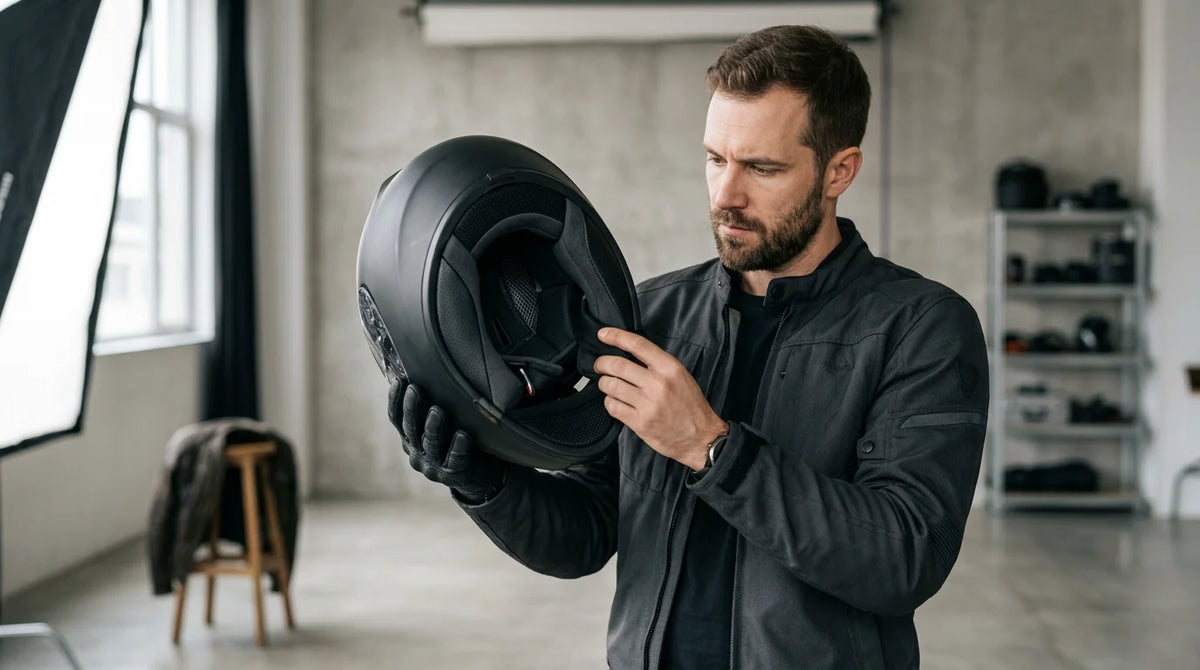
A number on a chart is a starting point, not a verdict. The true test is how the helmet behaves on your head. When you first put it on, a correctly sized helmet should feel firm across the cheeks and forehead without creating painful pressure points.
- Cheek pads: They should press gently but firmly against your cheeks. The helmet should not permit the pads to wiggle freely, yet it should not force you to bite your cheeks either.
- Crown and brow: The top liner should make even contact all around, with no gaps and no single hot spot of pressure.
- Movement test: With the strap fastened, attempt to rotate the helmet. Your skin should move with the helmet rather than sliding underneath it.
- Chinstrap: Fasten it snugly. A useful reference is the width of one finger between the strap and your chin.
Wear the helmet for several minutes. A fit that feels perfect for ten seconds can reveal discomfort after a quarter of an hour, which is why patience during this stage is essential.
Head Shape: The Overlooked Half of Sizing

Two riders can share an identical head circumference and still require different helmets. The reason is head shape. Helmets are engineered around internal shapes, commonly categorised as round oval, intermediate oval, and long oval.
If the internal shape does not match your own, a correctly measured helmet may still pinch at the temples or leave gaps at the forehead. Research into motorcyclist injury consistently underscores that protective benefit depends on both wearing and correctly fitting a helmet; a peer-reviewed analysis of crash data confirms that helmet use has a measurable positive impact on preventing head injuries. That impact is maximised only when the shell conforms to your head. When you shop, match the internal shape to your profile, and consider our luxurious motorcycle gear recommendations to complete a coherent, well-fitted setup.
Common Sizing Mistakes and How to Avoid Them
Where do riders go wrong? The most frequent error is choosing a helmet that is too loose because it feels comfortable in the showroom. Comfort at rest and protection during impact are not the same thing.
Other recurring mistakes include relying on a previous size across different brands, ignoring the break-in period during which pads compress, and neglecting to replace a helmet that no longer fits after damage or age. A study of helmet effectiveness by state notes that non-compliant or improperly worn helmets substantially reduce the protective effect, reinforcing that fit and standards must work together. Verify certification, measure again if you have gained or lost weight, and never treat sizing as a one-time task.
Bringing It All Together
Knowing how to size a motorcycle helmet properly comes down to a disciplined sequence: measure your head accurately, consult the exact chart for your chosen model, match the internal shape to your profile, and confirm the fit through the movement and strap tests. A helmet that is snug, stable, and comfortable across a full ride is the one that will serve you when it matters. Treat sizing as an ongoing responsibility, revisit it whenever your equipment or your body changes, and never compromise a secure fit for the sake of a familiar label.
Take action with TheArsenale
Once you understand exactly how a helmet should sit on your head, the next step is choosing equipment that honours both protection and craftsmanship. We curate premium headwear and riding equipment for those who refuse to separate safety from style.

Explore our selection of motorcycle helmets and gear, assembled within our luxury mobility marketplace for discerning riders. As part of our offering, members gain early access to curated products before they are listed publicly, and shipping is provided free of charge. Bring the same precision you apply to sizing into every piece of equipment you choose.
Frequently Asked Questions
How tight should a new motorcycle helmet feel?
A new helmet should feel snug and firm across the cheeks and forehead, without sharp pressure points. Interior padding compresses slightly during the first hours of use, so a helmet that feels a little tight at first often settles into an ideal fit.
Can I use my hat size to buy a helmet?
Hat sizes are not a reliable guide for helmets. You should measure your actual head circumference with a tape and compare it to the specific sizing chart of the model you intend to purchase, as sizes vary between brands.
What if my measurement falls between two sizes?
When your measurement sits between two sizes, most specialists recommend trying the smaller size first. The internal padding will break in and loosen slightly over time, whereas a helmet that is already loose will only become looser.
Does head shape really matter for sizing?
Yes, head shape is as important as circumference. Two riders with the same measurement may need different helmets because internal shells are built around round, intermediate, or long oval profiles, and a mismatch causes pressure points or gaps.
Where can I find well-fitted premium helmets and gear?
Once you have your measurements, you can explore curated premium options through our motorcycle helmets and gear collection at TheArsenale. Matching a verified size to quality construction ensures both comfort and reliable protection.