Motorcycle Helmet Buying Guide: Fit, Safety and Style Tips
In 2023, use of DOT-compliant motorcycle helmets in the United States reached 73.8 percent, the highest figure ever recorded. That single statistic reflects a simple truth: the most important safety decision you make before riding is what you place on your head. A helmet is engineered to do its job once, and the difference between a certified lid and a decorative shell can be decisive. Whether your taste runs toward track-focused carbon or the heritage character of Hedon helmets and luxury motorcycle gear, the fundamentals of protection remain constant.
This is where a thorough motorcycle helmet buying guide earns its value, translating certifications, fit science, and shell materials into decisions you can act on. According to the National Safety Council, helmet use rose sharply over the past decade, and the reasoning behind that shift deserves your attention.
Why the right helmet matters more than any other gear
Consider the physics of a crash. A helmet must absorb blunt force impact while protecting your skull from high-speed foreign objects. It accomplishes this through a hard outer shell that spreads the impact across its surface and a deformable inner liner that acts as a crumple zone. This structure is designed to deform once, which is why any helmet involved in an accident, or even dropped hard, must be retired immediately.
The protective payoff is measurable. Research aggregated by safety data compilers indicates that helmets reduce the risk of fatal head injury among motorcycle riders by roughly 37 percent compared with riding unprotected. Head injuries account for the overwhelming majority of motorcycle fatalities, which explains why every credible expert treats the helmet as non-negotiable equipment rather than an accessory.

Understanding safety certifications
Not all approval stickers carry the same weight, and understanding them prevents costly confusion. Three certifications dominate the conversation, and each tests helmets differently.
- DOT (FMVSS 218): The minimum legal standard for helmets sold in the United States, mandated by the NHTSA. It emphasizes material strength and visibility, with testing conducted randomly. Any helmet you consider should carry a DOT sticker at the very least.
- ECE 22.06: The current European standard, which replaced ECE 22.05 in July 2023. It is widely respected worldwide and uses batch testing before sale, meaning tested helmets come from the same production run as those reaching stores.
- Snell: A voluntary certification from the non-profit Snell Memorial Foundation, favored by performance and track riders. The standard is revised every five years, with M2025 now the most current rating, and a Snell certification typically remains valid for 12 years.
A practical note on freshness: many track days across North America require a Snell-rated helmet, so if your riding leans competitive, prioritize that mark. For everyday road use, a helmet meeting DOT and ECE 22.06 covers the legal and safety bases nearly everywhere. Government NHTSA data from 2023 also showed a sharp decline in the use of noncompliant helmets, a reassuring sign that riders are increasingly rejecting so-called "novelty" lids that offer little genuine protection.
Getting the fit right
A helmet with a flawless safety rating still fails you if it fits poorly. Fit begins with measurement. Wrap a soft tape around your head roughly half an inch above your eyebrows, above the ears, and around the widest point at the back. Compare that figure against each manufacturer's sizing chart, because sizing varies noticeably between brands.
Head shape matters as much as circumference. Manufacturers generally build for three profiles: long oval, intermediate oval (the most common), and round oval. A perfectly sized helmet built for the wrong profile will create pressure points or feel loose despite the correct measurement.
When you try a helmet on, it should feel snug without severe discomfort. The cheek pads should press against your face, creating a slight "chipmunk cheeks" effect. Grip the chin bar and move it: your cheeks should move with it, not the helmet itself. If the helmet slides, drop at least one size. Keep in mind that most liners break in by 15 to 20 percent after the first 15 to 20 hours of riding, so a marginally tight fit at purchase is preferable to a loose one.
Shell materials and weight
What a helmet is made of influences its weight, comfort, and price. Three materials dominate the market, each managing impact energy differently.
| Shell material | How it manages impact | Relative cost | Weight |
|---|---|---|---|
| Polycarbonate | Flexes to absorb energy | Most affordable | Heavier |
| Fiberglass composite | Flexes, crushes and splits | Mid-range | Moderate |
| Carbon fiber | Distributes energy on impact | Most expensive | Lightest |
Beneath every shell sits expanded polystyrene (EPS) foam, densely compressed to absorb shock. Helmets typically weigh between 1,400 and 1,800 grams. The key to comfort is not simply the lowest number but even weight distribution; a well-balanced helmet feels lighter than an unbalanced lighter one that strains your neck over long rides.
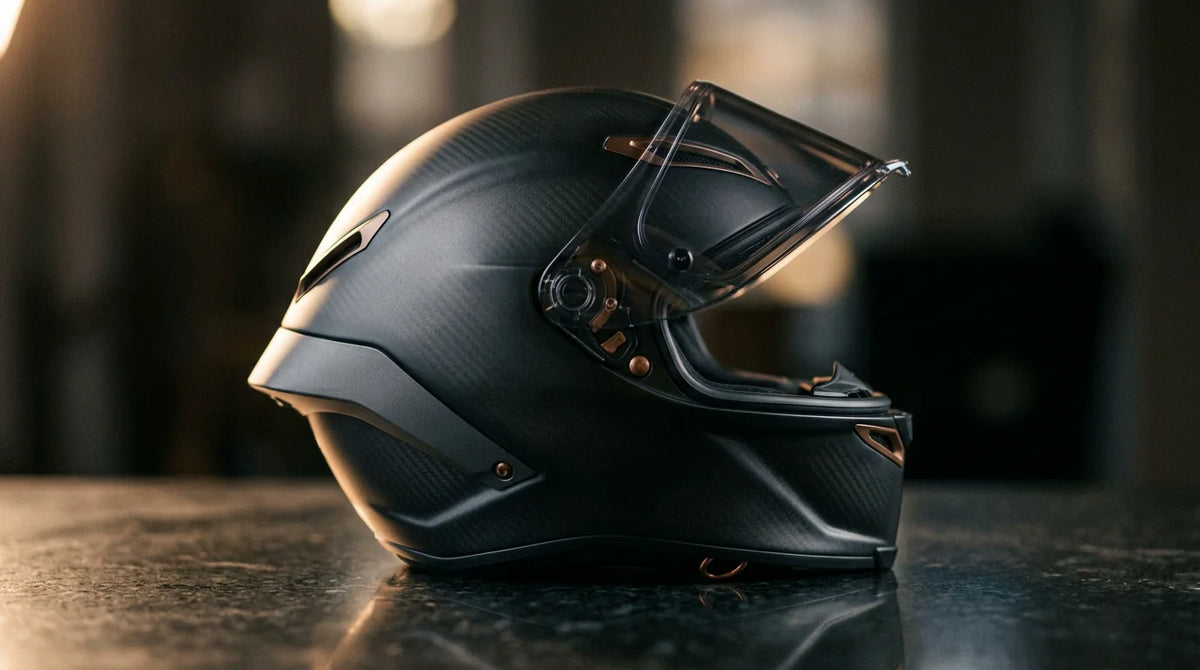
If low weight and advanced construction appeal to you, the innovation in this space is genuine. The engineering behind the latest generation of high-tech carbon helmets from Vanguard Motorcycles illustrates how far material science has advanced in reducing mass while maintaining protective performance.
Matching the helmet type to your riding
The ideal helmet depends on where and how you ride. Each category solves a different problem.
Full-face helmets
The full-face helmet remains the safest option, covering the entire head and adding a chin bar that protects the jaw during a forward crash. Its enclosed shape also reduces wind noise and shields you from the elements, which is why it suits nearly every riding style.
Sportbike and touring helmets
Sportbike helmets are engineered for aerodynamics and high-speed stability, with generous upper sightlines for a racing tuck. Sport-touring variants borrow that shape but add comfort features for long days in the saddle, such as improved ventilation and communication provisions.
Adventure and retro helmets
Adventure (ADV) helmets add a peak to deflect sun, branches, and debris off-road, though a removable peak is preferable to avoid neck strain on highways. Retro helmets draw style from the past while incorporating modern safety technology, a combination that appeals to riders who value heritage aesthetics. For a sense of how collectible design and authentic racing pedigree intersect, consider a piece such as the Ayrton Senna Bell helmet (official replica).

Modern features worth considering
Helmet technology has advanced well beyond shell and strap. Several features now genuinely improve safety and comfort, and knowing them helps you spend wisely.
- MIPS (Multi-directional Impact Protection System): A slip-plane layer that lets the liner move independently, reducing rotational forces transmitted to the brain during angled impacts.
- Emergency quick-release system (EQRS): Allows first responders to withdraw the cheek pads while the helmet remains on, making removal of an injured rider safer.
- Pinlock and ventilation: Anti-fog inserts and adjustable vents keep vision clear and reduce fatigue on long or hot rides.
- Communication readiness: Many helmets accommodate Bluetooth systems, valuable for group riding where communication is essential.
On the topic of protection, do not overlook hearing. Wind and exhaust noise at highway speed can damage your hearing over time, and even inexpensive earplugs offer meaningful protection.
Price, replacement and long-term care
Price generally tracks materials and features, and a more expensive helmet often delivers better comfort, technology, and refinement. Yet the single largest safety return comes from wearing any certified helmet at all, and quality budget options protect capably. The global market reflects steady demand for better gear; according to industry market analysis, motorcycle helmet revenue was projected to reach roughly 3.0 billion US dollars in 2026, continuing a long-running upward trajectory.
Whatever you spend, treat the helmet as a consumable safety device rather than a permanent purchase. Replace it after any crash, after a hard drop, or roughly every five years as materials and liners degrade. Between replacements, clean it with specialized products, keep the visor clear, and store it in a padded bag so it remains ready to protect you when it matters. As you assemble a complete kit, we can help you pair the right lid with quality riding gear suited to your style and machine.
Making a confident choice
A sound approach to the process of choosing a motorcycle helmet comes down to sequence: confirm a recognized certification first, secure a snug and shape-appropriate fit second, then select the type and features that match your riding. Weight, materials, and price refine the decision rather than define it, because protection begins with a certified helmet worn correctly on every ride. Measure carefully, try before you commit where possible, and never compromise fit for aesthetics. With those priorities in order, you can invest with confidence and focus on the ride itself.
Take action with TheArsenale
Once you have identified the certification, fit, and helmet type that suit your riding, the next step is sourcing gear that matches your standards. We curate helmets and riding equipment for riders who value both protection and design, bringing the same discernment to headwear that we apply across our luxury mobility marketplace.

Explore our selection of motorcycle helmets and riding gear to complete your setup. As a curated marketplace spanning Monaco, Dubai, Doha, and online, we offer access to premium equipment and, through our Private Membership, to products before they are listed publicly. Free shipping is included, and our team typically replies to enquiries in under 30 minutes.
Frequently Asked Questions
How do I know if a motorcycle helmet fits correctly?
A correctly fitted helmet feels snug, with the cheek pads pressing firmly against your face. When you grip the chin bar and move it, your cheeks should move rather than the helmet sliding. If the helmet shifts freely, choose a smaller size.
Which safety certification should I look for?
At minimum, any helmet sold in the United States must carry a DOT sticker. For broader assurance, look for ECE 22.06, the current European standard, and for track riding prioritize Snell M2025 certification, as many track days require it.
How often should I replace my motorcycle helmet?
Replace your helmet after any crash or hard impact, even if no damage is visible, because the shell and liner are engineered to work only once. Absent any impact, most experts recommend replacement roughly every five years as materials degrade.
Is an expensive helmet always safer than a budget one?
Not necessarily. A more expensive helmet generally offers better comfort, lighter materials, and advanced features, but a certified budget helmet still provides genuine protection. The largest safety benefit comes simply from wearing a certified helmet every ride.
Where can I find quality helmets and riding gear?
You can source certified helmets from specialist retailers and curated marketplaces. We offer a selection of motorcycle helmets and riding gear alongside our wider mobility catalogue, with free shipping and access to certain products before public listing through our Private Membership.