Paddleboard Buying Guide: Choose the Right SUP for You
The most expensive board is not automatically the right board. A well-matched SUP should feel stable enough to build confidence, responsive enough to remain enjoyable, and practical enough that you will use it regularly. If you want a visual starting point, our how to choose a paddleboard article offers a useful introduction.
Paddlesports reached more than 34 million American participants in 2025, with approximately 85% classed as casual participants, according to the 2026 paddlesports report. That mix matters because occasional lake paddlers, fitness users, touring enthusiasts, surfers, and collectors should not shop for the same board.
What will you actually do on the water?
Your intended activity should guide almost every later decision. A board for relaxed lake outings needs a different balance of stability and maneuverability than a board designed for distance, racing, surf, fishing, or yoga.
| Primary use | Board profile to consider | Main trade-off |
|---|---|---|
| Relaxed paddling and family use | Stable all-around board with moderate width and a forgiving shape | More stability, less speed than a narrow touring design |
| Long-distance touring | Longer displacement or hybrid hull with efficient tracking | Better glide, slower turning and more demanding balance |
| Yoga and fitness | Wide platform with a comfortable, high-traction deck pad | More space and stability, less efficient over distance |
| Surfing and waves | Shorter planing hull with more maneuverability and rocker | Quick turning, reduced flat-water tracking |
| Fishing or carrying equipment | Wide board with a high load rating and practical attachment points | Greater carrying capacity, increased weight and drag |
For most first-time buyers, an all-around board is the safest starting point because it supports several activities without forcing you into a highly specialized shape. It can handle calm-water exploration, light fitness sessions, family outings, and occasional yoga. However, all-around does not mean universal. If you already know that speed, surf, or multi-day touring is your priority, choosing a purpose-built category may provide better long-term satisfaction.
Consider the water as carefully as the activity. Calm lakes and sheltered bays are more forgiving than open coastal water, tidal channels, or moving rivers. Wind, current, water temperature, launch points, and the distance from shore can all influence the stability and safety features you need.
Should you choose an inflatable or solid paddleboard?
The choice between an inflatable and solid construction is primarily a lifestyle decision, followed by a performance decision. Neither construction type is universally better.
| Consideration | Inflatable SUP | Solid SUP |
|---|---|---|
| Transport | Deflates into a bag and usually fits in a vehicle trunk | Requires suitable roof transport or a larger vehicle |
| Storage | Convenient for apartments, closets, and limited spaces | Needs a dedicated, protected storage area |
| Impact tolerance | Forgiving around docks, gravel, and occasional contact | More vulnerable to dents, scratches, and impact damage |
| On-water feel | Comfortable and versatile when inflated correctly | More direct, rigid, and responsive underfoot |
| Setup | Requires inflation, deflation, drying, and packing | Ready to launch without pumping |
| Best fit | Recreation, travel, family use, and flexible storage | Surfing, racing, performance touring, and dedicated use |
A quality inflatable board should feel firm rather than soft or sagging. Pay attention to the construction, drop-stitch quality, valve, seams, inflation pressure, and included pump. A board that is difficult to inflate or awkward to dry may remain unused, even if it looked attractive when purchased.
Solid boards usually offer the most precise glide and direct response. They can be preferable when you have secure storage, a suitable vehicle, and a clear performance goal. They also tend to provide more finely tuned shapes, which can matter for surfing, racing, and advanced touring.
Inflatables are often the more practical first purchase when you lack storage or transport equipment. They are also useful for international travel, remote launches, and paddlers who need one board that can move easily between locations.
Which hull shape and board category fit your goals?
The hull is the underside and overall waterline of the board. It influences whether the board rides on top of the water with easy maneuverability or cuts through it with greater efficiency.
Planing hulls
A planing hull is generally wider and flatter. It provides a stable platform and responds easily when you change direction. This design is common on recreational, yoga, surf, fishing, and many all-around boards.
Choose a planing hull when you value confidence, relaxed handling, and the ability to move around on the deck. It is often the most approachable option for new paddlers and for anyone carrying a dog, child, or extra equipment.
Displacement hulls
A displacement hull usually has a pointed nose that parts the water. It tends to track straighter and glide more efficiently, especially over longer distances.
This efficiency comes with trade-offs. A displacement board can feel less forgiving when you are learning, turning may require more planning, and the board may perform poorly if its load capacity is exceeded. It suits touring, fitness paddling, and racing more naturally than casual family use.
Hybrid shapes
Hybrid boards combine a more efficient nose with a wider central platform. They can provide a useful middle ground for paddlers who want better glide without giving up too much stability.
When reading product descriptions, do not focus only on labels such as touring or all-around. Look at the board’s actual width, nose shape, tail shape, rocker, deck layout, and stated use. Two boards in the same category may feel very different on the water.
How should you choose length, width, thickness, and capacity?
Board dimensions work together. A longer board may glide farther, a wider board may feel more stable, and a thicker board may provide more volume. The best combination depends on your body weight, balance, skill, activity, and total load.
| Dimension | What it changes | Practical guidance |
|---|---|---|
| Length | Glide, tracking, turning, and storage difficulty | Shorter for maneuverability, medium for all-around use, longer for touring and speed |
| Width | Side-to-side stability, reach, and drag | Moderate width for general use, extra width for yoga, fishing, larger riders, or passengers |
| Thickness | Volume, buoyancy, stiffness, and riding height | Choose enough thickness for your load without adding unnecessary height or wind exposure |
| Volume | How well the board supports the rider and equipment | Include your body weight, gear, water, pets, and passengers |
| Weight capacity | How low the board sits and how efficiently it paddles | Stay comfortably below the limit rather than treating the maximum as a target |
For general recreational use, many adults find a medium-length board in the approximate 10 to 12 foot range manageable. Width around 32 to 34 inches often provides a useful balance between stability and efficient paddle reach. Larger paddlers, nervous beginners, and those carrying equipment may need additional width and volume.
Do not treat a manufacturer’s maximum weight figure as a promise of ideal performance. A board can technically float a load while feeling slow, unstable, or difficult to control. Calculate the total load, then leave a sensible margin for comfort and changing conditions.
Length should follow your intended distance and launch environment. Short boards turn more easily and are simpler to handle near shore. Longer boards track straighter and carry momentum, but they require more space to store, transport, and maneuver.
Width deserves particular attention. A board that is excessively wide may feel stable at first but force you to reach awkwardly over the rail with every stroke. The goal is not maximum width. It is sufficient stability without unnecessary drag.
Thickness also requires judgment. Additional thickness can increase volume and support, but it can raise the deck farther from the water and expose the board to more wind. Choose the thickness that supports your actual load, rather than assuming more is always better.

Which features and accessories are worth paying for?
The board is only one part of the system. A weak paddle, unreliable fin, uncomfortable deck pad, or poor pump can make an otherwise suitable SUP frustrating to use.
Deck pad and remounting area
A deck pad should provide dependable traction when wet and enough cushioning for standing, kneeling, or changing position. If you expect to practise yoga or spend long periods on the board, look for generous coverage and a surface that remains comfortable without becoming slippery.
Also inspect the area where you would climb back on after falling. Excessive mounts, hard fittings, or awkward cargo hardware can make remounting more difficult. Accessories should support your activity, not obstruct the central standing and recovery area.
Fins and tracking
Fins help the board hold a line and resist unwanted sideways movement. A larger central fin generally improves tracking, while a smaller or more maneuverable setup can make turning easier.
Removable fins are useful for storage, replacement, and transport. Before buying, confirm that the fin is included, that the attachment system is practical, and that replacement parts are available from the seller or manufacturer.
Paddle quality
The paddle is the component you use on every stroke. Weight, stiffness, length adjustment, blade size, and grip comfort all influence fatigue and technique.
An adjustable paddle is convenient when several people share a board. A fixed-length paddle may feel lighter and more precise when one person uses the board consistently. In either case, avoid treating the included paddle as an afterthought.
Storage and attachment points
Bungee cords and tie-downs are useful for a dry bag, spare layer, water bottle, or light touring equipment. Action mounts and fishing attachments can be valuable when they match your plans, but additional hardware adds weight and may reduce deck simplicity.
Before paying for extra features, ask whether you will use them during most outings. A clean, well-designed deck is often more valuable than a long list of rarely used attachments.
If finish, material character, and visual identity are important to you, explore our selection of best luxury paddleboards with the same discipline you would apply to technical specifications. Design should complement function, not replace it.
What safety equipment and transport requirements should you plan for?
A paddleboard is a flotation platform, but it is not a substitute for preparation. Before launching, consider your location, weather, water temperature, distance from shore, visibility, and ability to return if the wind changes.
Carry or wear an appropriate personal flotation device according to local rules. Requirements differ between countries, states, waterways, age groups, and activity zones. In the United States, the Coast Guard statistics resources provide official boating safety information, but local authorities remain the final reference for applicable requirements.
A leash is often essential because it keeps the board close after a fall. However, the correct leash depends on the environment. Flat-water, surf, and moving-water situations may require different approaches, and a standard ankle leash may be inappropriate in some river conditions.
Bring a whistle or other sound-producing device where required, a waterproof phone or communication device, drinking water, sun protection, and a dry bag. In cold conditions, dress for water temperature rather than air temperature. A wetsuit or dry suit may be more important than an extra board feature.
Transport is another practical buying criterion. Solid boards require secure vehicle attachment and careful lifting. Inflatable boards simplify transport, but they still need correct inflation, drying, packing, and protection from prolonged heat or direct sunlight.
A 2021 peer-reviewed study of 438 paddlers found that 72 participants reported a SUP-related injury during the preceding year. It also found wide variation in life-vest and leash use, which reinforces the need to treat safety equipment as part of the purchase rather than an optional addition. Read the 2021 injury study for the full scope and limitations.
How can you judge durability, value, and design?
A lower purchase price does not necessarily represent better value. The real cost includes replacement paddles, pumps, fins, bags, repairs, transport equipment, and the likelihood that you will soon outgrow the board.
Inspect the warranty terms, repair process, spare-part availability, seller support, and product documentation. For an inflatable board, examine the seams, valve, handles, traction pad, D-rings, and inflation system. For a solid board, examine the finish, rails, storage protection, and repair requirements.
Be cautious with specifications that appear impressive without context. A high capacity may be useful, but it does not automatically mean the board will be stable or efficient for your body. A long accessory list may hide weak components. A premium finish may be worthwhile, but only if the underlying construction and support meet your needs.
Performance also depends on technique. A March 2026 study of 330 competitive paddlers found that shoulder and lower-back injuries were among the most common reported injury sites. The sample focused on athletes and used self-reported data, so it should not be treated as a direct forecast for casual users, but it still highlights the value of correct paddle length, posture, warm-up, and sustainable technique. The full March 2026 study explains the research scope.
Our approach at TheArsenale is suited to buyers who care about the object as well as the outing. We curate mobility products through a network of more than 250 builders, designers, and brands, which allows us to consider provenance, design language, engineering, and the intended experience together.
That perspective is especially useful when you are selecting a design-led board, a collectible object, or a gift. If you need a more focused framework for acquisition, our luxury paddleboard buying guide can help you assess craftsmanship, use, presentation, and long-term fit without losing sight of practical requirements.
Make the board fit your real life
The best paddleboard is the one that matches your water, activity, body, transport, storage, and safety needs. Start with the experience you want, then select the category, construction, dimensions, capacity, accessories, and support that make that experience realistic.
A thoughtful paddleboard buying guide should help you avoid both extremes: a board that is too specialized to use comfortably and one that is too compromised to enjoy. Choose enough stability to progress, enough performance to remain interested, and enough quality to make regular use feel worthwhile.
Choose a Paddleboard with Character
Once the practical criteria are clear, you can consider how the board should look and feel as an object. For collectors and design-conscious paddlers, visual identity, craftsmanship, and the story behind a collaboration can be part of the decision.

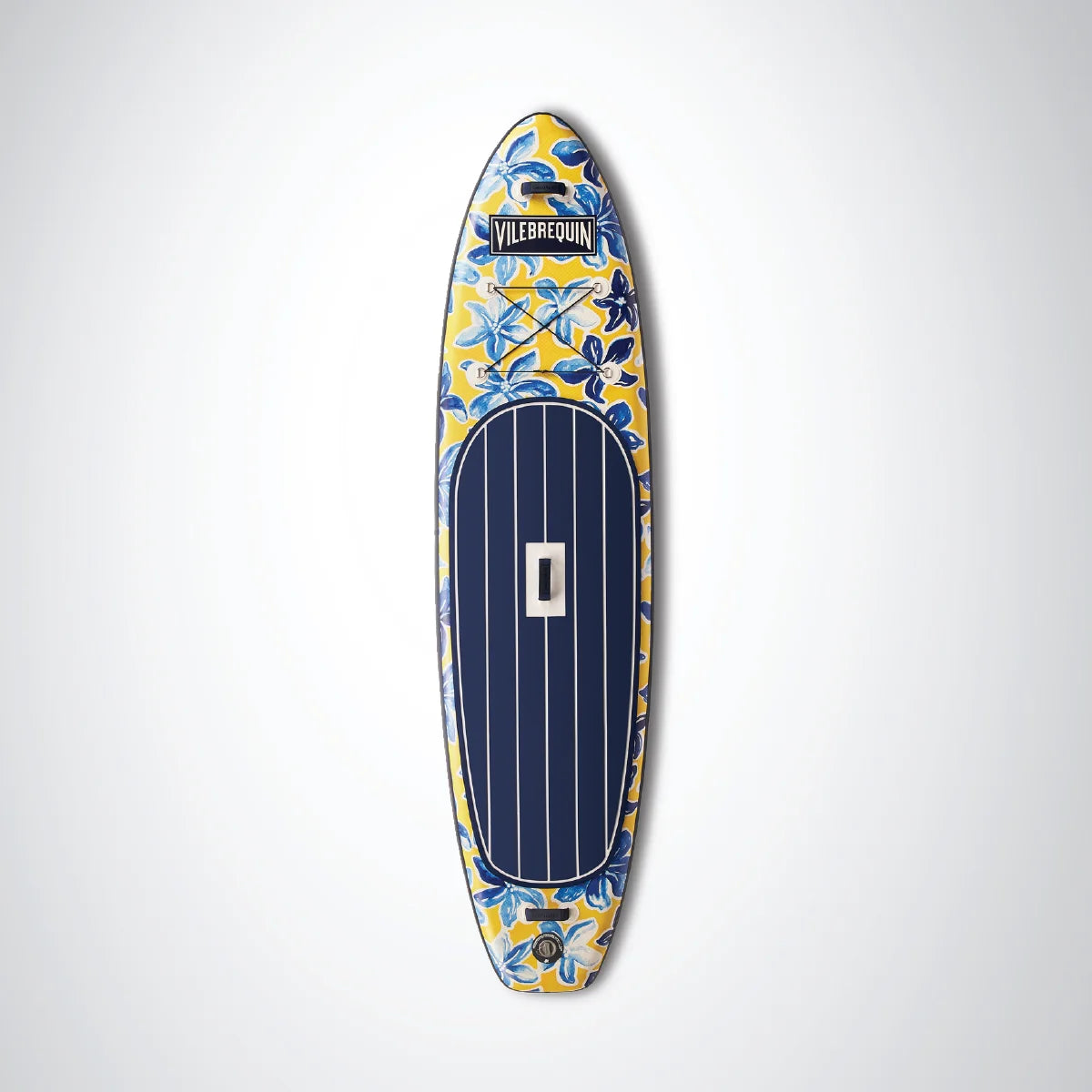
Our Vilebrequin paddleboard brings a distinctive design perspective to a curated mobility marketplace. Explore it when you want a paddleboard that complements your time on the water while also reflecting a considered approach to form, finish, and collectability.
Frequently Asked Questions
What is the best paddleboard for a beginner?
For most beginners, a stable all-around board is the most versatile starting point. Choose enough width and volume for your body and total load without selecting a board so large that it becomes difficult to turn or transport.
Is an inflatable or solid paddleboard better?
An inflatable board is usually more practical when storage and transport are priorities. A solid board may be preferable when you have suitable storage and want the most direct glide, responsiveness, or specialized performance.
How wide should a paddleboard be?
Many recreational paddlers find moderate width suitable for balancing and efficient paddling. Choose additional width for yoga, fishing, larger riders, passengers, or extra gear, but avoid excessive width if you value speed and easy paddle reach.
What equipment should come with a paddleboard?
An inflatable package commonly includes a paddle, pump, fin, leash, and carrying bag, but quality varies. Confirm what is included, then budget separately for a suitable flotation device, dry storage, communication equipment, and weather-appropriate clothing.
Can I choose a paddleboard based mainly on design?
Design matters, especially when you want a distinctive or collectible object, but it should follow the practical requirements of your use. At TheArsenale, a design-led option such as the Vilebrequin paddleboard can be considered alongside construction, intended activity, and transport needs.