1957 Porsche 356 Speedster: Specs, Value, and Buying Guide
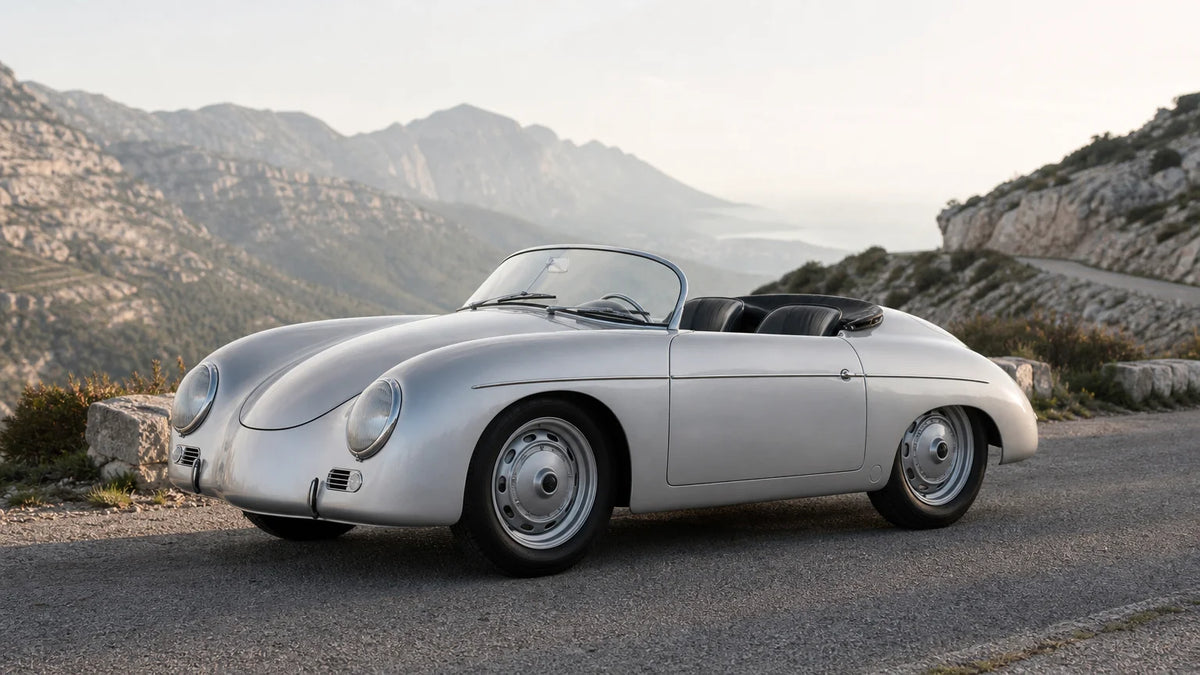
Few classic Porsches express the brand’s early character as clearly as the 1957 Porsche 356 Speedster. Its low windscreen, compact proportions, and purposeful cockpit were created for drivers who valued involvement over comfort. For a broader view of Porsche’s earliest production sports cars, you can also explore our 1953 Porsche 356 Pre-A.
The 1957 model year is especially significant because it sits within the mature 356 A period. Buyers received a more developed car than the earliest Speedsters, while retaining the lightness and visual purity that made the model famous. For collectors, the central question is not simply whether a car is genuine, but how closely its present specification reflects its documented factory identity.
What defines the 1957 Porsche 356 A Speedster?
The Speedster began as a deliberately simplified version of the 356 Cabriolet. Porsche reduced equipment, lowered the windscreen, fitted a small folding top, and used removable side curtains instead of conventional roll-up windows. The result was lighter, less expensive, and better suited to weekend competition than the more comfortable 356 models.
By 1957, the car belonged to the 356 A family. It featured a curved windscreen, refined suspension, and a 1.6-liter engine option. The body remained a compact two-seat roadster with a rear-mounted engine and rear-wheel drive. A period model overview from the Stuttcars profile identifies the 1957 356 A Speedster as a transitional model, with detail differences between earlier T1 cars and later T2 examples.
Those differences matter because 1957 cars can appear similar while carrying different tail lamps, trim details, and production features. A knowledgeable inspection should therefore compare the chassis number, build documentation, body details, and engine equipment. Visual similarity alone is not enough to establish identity or value.
Why does the 1957 model year attract collectors?

Imagine a collector choosing between an early, highly original example and a comprehensively restored car. Both may look beautiful in photographs, but they represent different ownership experiences and different valuation logic.
The 1957 Speedster reached the end of an important development phase. It retained the stripped-back character associated with the original concept, yet benefited from the improved 356 A platform. The combination gives the car strong appeal among collectors who want period character without choosing one of the earliest, more technically basic examples.
Its reputation also comes from the way owners used these cars. A Speedster could serve as a road car during the week and a club-racing machine at the weekend. Its low weight, direct controls, and compact dimensions made modest engine output feel more meaningful than the numbers suggest.
The model’s cultural image is equally important. The Speedster became closely associated with American sports-car enthusiasm, coastal driving, and amateur racing. That history does not make every example equally valuable, but it helps explain why the body style commands more attention than an ordinary 356 coupe.
For context, the lighter 356 concept can be compared with our 1956 Porsche 550 Spyder, another Porsche connected with lightweight engineering and competition-focused design. The two cars serve different purposes, yet both show how Porsche built its early reputation through efficiency rather than excess.
Which specifications and equipment should you verify?
A typical 1957 Speedster uses an air-cooled, rear-mounted flat-four engine and a four-speed manual transmission. The standard 1.6-liter engine produced approximately 60 horsepower, while Super versions offered a stronger specification. Carrera cars used a far rarer four-cam engine and occupy a separate level of the market.
The most important distinction is whether the car is a standard 1600, a 1600 Super, or a Carrera. These versions may share the same basic silhouette, but their engines, equipment, rarity, and historical importance differ substantially. A listing that says “Speedster” without identifying the engine specification leaves a major question unanswered.
- Engine type: confirm displacement, engine number, carburetors, and whether the unit is original to the chassis.
- Transmission: verify the gearbox number and check whether the casing, ratios, and controls match the period specification.
- Body details: inspect the windscreen, tail lamps, engine lid, bumpers, seats, dashboard, and trim.
- Chassis condition: examine floor sections, longitudinal members, suspension mounts, and previous rust repairs.
- Equipment: identify factory options such as sealed-beam headlights, special wheels, heater equipment, or competition components.
Originality does not always mean that every component must remain untouched. Some owners prefer sympathetic mechanical updates for safer touring. However, modifications should be disclosed clearly, especially when they affect the engine, suspension, brakes, wheels, or body structure.
How much is a 1957 Porsche 356 Speedster worth in 2026?

There is no single correct price for a 1957 Speedster. In 2026, recent auction records show standard and well-presented cars trading across a broad range, while rare Carrera examples can move far beyond ordinary 1600 and 1600 Super cars.
Recent 2026 results recorded by auction market records include sales at approximately $257,600, $275,000, and $291,000, alongside a European result at €230,000. These figures are useful reference points, but they do not represent a guaranteed market value for every car.
Condition, specification, and presentation explain much of the difference. A usable driver with corrosion, an incorrect engine, or an incomplete history may fall well below a restored example with strong documentation. Conversely, an expensive restoration does not automatically create a high-value car if the work used incorrect parts or removed desirable originality.
A Gooding & Company result from 2023 recorded a 1957 356 A Speedster at $280,000, providing a useful earlier comparison. The result appears in the auction house’s published prices realized. The comparison should be read alongside the car’s individual history, not treated as a universal guide.
At the upper end, Carrera Speedsters are fundamentally different assets. Their four-cam engines, lower production, and competition associations create a separate valuation category. A standard 1600 Super should not be compared directly with a documented Carrera simply because both carry the Speedster body style.
What documentation should you demand before buying?
The strongest purchase files connect the car’s identity to its history. Look for a factory Kardex or equivalent production record, a Porsche production specification document, invoices, restoration photographs, ownership records, and evidence supporting the engine and gearbox numbers.
Documentation should answer several practical questions. Was the car originally delivered in its current color? Does the engine match the chassis? Has the body been replaced or extensively reconstructed? Were major components changed during restoration? Are the present wheels, seats, instruments, and trim consistent with the period specification?
A Bonhams catalogue for a 1957 Speedster illustrates the type of evidence collectors value. The car was presented with documented history, restoration records, and Kardex material, while its equipment and mechanical specification were described in detail. Such documentation does not remove the need for inspection, but it gives buyers a stronger basis for assessing provenance.
It is also important to distinguish between “matching numbers,” “correct type,” and “original.” A matching-numbers engine is generally the unit recorded for that chassis. A correct-type engine may be period-appropriate but not original to the car. An original component is the part fitted when the vehicle left the factory. These terms should never be treated as interchangeable.
Our coverage of our 1939 Porsche Type 64 reflects the same broader collector principle: provenance is part of the object. For a rare Porsche, the paper trail can influence confidence, usability, and long-term desirability as much as the visible finish.
Should you preserve or drive the car?
A carefully maintained Speedster can be both a collectible and a usable touring car. Its modest size, simple controls, and mechanical layout make it engaging on secondary roads. Its low windscreen, limited weather protection, and narrow cockpit also impose practical limits that modern sports-car buyers may not expect.
Preservation-focused ownership prioritizes factory correctness, original finishes, and careful mileage management. Driving-focused ownership may accept discreet mechanical improvements, upgraded cooling, improved electrical components, or reversible safety changes. Neither approach is automatically right, but the owner should understand how each decision affects future originality.
Restoration quality deserves particular attention. A fresh paint finish can conceal poor panel alignment, hidden corrosion, or excessive filler. The most useful inspection examines the body from underneath, checks door and lid gaps, tests suspension mounting points, and compares visible details with factory records.
The best example for you depends on your objective. A concours collector may seek an original color combination and factory-correct equipment. A touring enthusiast may prefer a sound, documented car with tasteful mechanical improvements. A competition-minded owner may prioritize a strong chassis and period racing specification.
For readers comparing different generations of open Porsche sports cars, our Porsche 911 Speedster provides a modern reference point. The newer car offers different performance and comfort expectations, while the 1957 model remains focused on lightness, simplicity, and mechanical connection.
What makes the 1957 Speedster a sound collector choice?
The 1957 Porsche 356 A Speedster combines a mature 356 platform with the distinctive proportions and purposeful equipment that define the Speedster name. Its value in 2026 depends on the specific car, especially its engine identity, chassis condition, restoration standard, provenance, and documentation. Before buying, compare the car against verified records and comparable sales, then decide whether originality, usability, or competition character matters most to you. The strongest examples are not simply attractive. They are coherent, correctly identified, transparently documented, and mechanically understood.
Take action with TheArsenale
Finding the right classic Porsche requires more than recognizing a famous silhouette. You need a clear view of provenance, specification, condition, and the ownership experience that suits your objectives.

We curate rare mobility objects and support collectors seeking distinctive machines through personalized sales assistance and high-value acquisition guidance. To explore available opportunities and discuss your requirements with our team, review our classic Porsche cars and related automotive offerings.
Frequently Asked Questions
Is the 1957 Porsche 356 Speedster a 356 A?
Yes. A 1957 Speedster belongs to the Porsche 356 A period. Individual cars may differ because the model year includes production changes between earlier T1 and later T2 specifications.
What engine does a 1957 Speedster use?
Most examples use a rear-mounted, air-cooled flat-four engine with a four-speed manual transmission. Standard, Super, and Carrera specifications differ significantly, so the engine number and equipment should be verified.
What is a 1957 Porsche 356 Speedster worth in 2026?
Recent 2026 auction results place several standard or Super examples in the mid-$200,000 to low-$300,000 range. Exceptional originality, documented provenance, and rare Carrera specification can produce substantially higher values.
Why do matching numbers matter?
Matching numbers help confirm that the engine or gearbox is associated with the original chassis. They support authenticity and can improve collector confidence, although condition, documentation, and restoration quality remain equally important.
Can TheArsenale help source a rare Speedster?
We provide curated access to rare mobility objects, personalized sales assistance, and high-value acquisition guidance. You can contact our team to discuss sourcing requirements, documentation priorities, and the type of classic Porsche that fits your collection.