Best Underwater Drones for Exploration, Fishing and Inspection
An underwater drone becomes valuable when it gives you a clear view of places that are difficult, expensive or unsafe to reach directly. If you are evaluating a premium exploration platform, our best underwater drone for diving overview provides a useful starting point for understanding the category.
The market is also moving beyond recreational exploration. An April 2026 IMARC estimate valued the global underwater drone market at $4.8 billion in 2025 and projected it to reach $9.7 billion by 2034, reflecting growing interest in marine research, inspection, defense and environmental monitoring. These figures describe the wider market, not a guarantee of product availability or performance for any individual model.
How the best underwater drones work
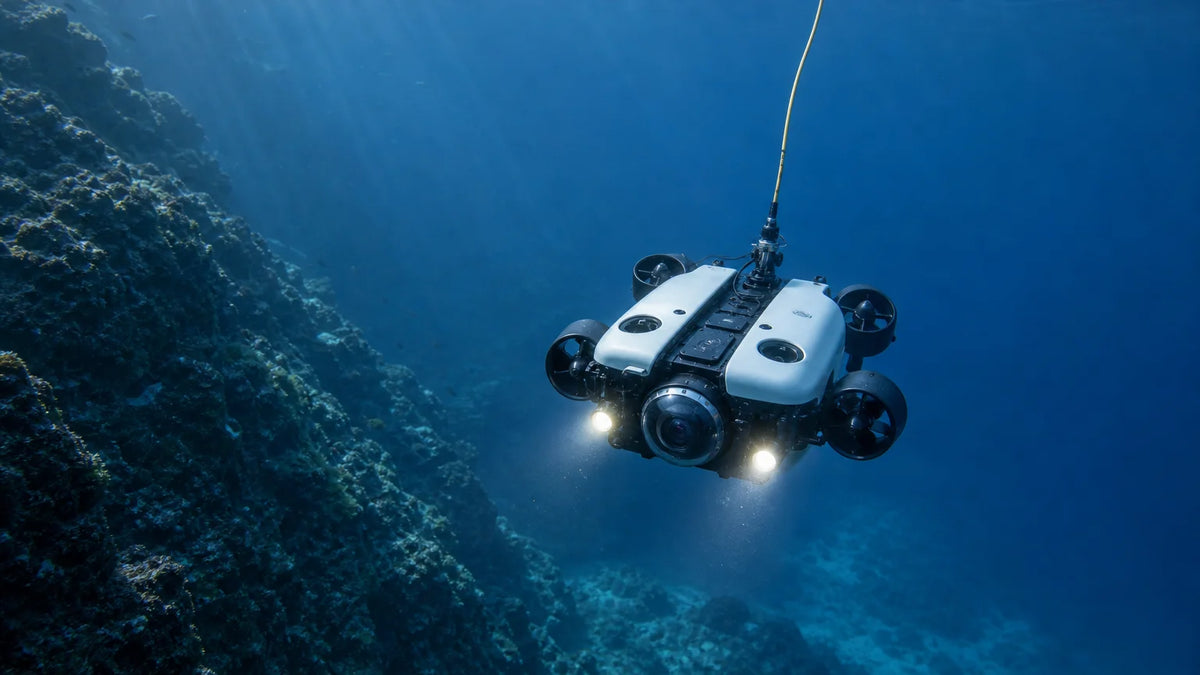
Most underwater drones are remotely operated vehicles, commonly called ROVs. You control the vehicle from the surface while its camera sends images through a connection system. This differs from an autonomous underwater vehicle, which follows a programmed route and makes more independent navigation decisions.
The central engineering challenge is communication. Water limits many wireless signals, especially when you need stable, high-bandwidth video and responsive control. A tethered ROV therefore remains the practical choice for many exploration and inspection missions. A 2026 review in the engineering literature identifies underwater communication, control and deployment as continuing design challenges.
A capable system usually combines four elements: propulsion, depth control, imaging and surface communication. The quality of the overall experience depends on how well these elements work together. A sharp camera cannot compensate for unstable movement, weak lights or a tether that constantly catches on structures.

Choose by mission, not by camera resolution
The right underwater drone depends on what you need to accomplish. A recreational explorer may value portability and simple controls, while an inspection operator may need station holding, measurement tools, stronger lights and a more durable frame.
| Mission | Priorities | Main trade-off |
|---|---|---|
| Exploration | Portability, depth control, live viewing and easy setup | Smaller systems may offer fewer payload options |
| Fishing | Clear live video, low-light visibility, depth data and optional sonar | Fishing-focused accessories may add cost and bulk |
| Content creation | Stabilization, wide field of view, storage and adjustable lighting | High-quality footage often requires careful tether management |
| Inspection | Current resistance, precise hovering, measurement tools and robust construction | Professional capability increases setup complexity and ownership cost |
Underwater systems are increasingly used for environmental observation as well as recreation. In June 2026, the Associated Press described the expansion of ocean-monitoring efforts involving underwater drones and satellites. That broader use reinforces an important buying principle: choose the vehicle around the data or view you need, rather than selecting specifications in isolation.
Water conditions also matter. Clear, calm water allows a compact camera platform to perform effectively. Turbidity, suspended particles, darkness and current demand better lighting, more precise control and, in some cases, sonar or other sensors. Research published in 2026 notes that underwater sensing can be affected by turbidity, light conditions and marine life, which may reduce detection accuracy.
Depth, tether and maneuverability matter together
A maximum depth rating is only useful when it matches your actual operating environment. A shallow-water user may gain little from paying for extreme depth capability. An operator inspecting a hull, dock, mooring or submerged structure needs enough margin to reach the target without operating continuously at the limit.
The tether length defines your practical working area, but longer is not always better. Additional cable can increase drag, create loops and make recovery more difficult. Look for a tether system that suits your launch point, expected depth and movement pattern. A reel or spool can be as important as the drone itself when repeated deployment is part of your routine.
Vectored thrusters improve control by allowing the vehicle to move vertically, laterally and forward without constantly turning its body. This is especially helpful around pilings, boat hulls, rocks and other structures. However, additional thrusters also increase system complexity, power consumption and the learning curve.
Before purchasing, write down three measurements: the distance from your launch point to the target, the maximum depth and the expected current. Our underwater drone buying guide can help you organize those requirements before you compare individual configurations.
Why underwater image quality depends on light
Resolution matters, but it is not the complete camera story. Water absorbs light and color as depth increases, while suspended particles can reflect artificial light back toward the lens. The result may be dull, noisy or low-contrast footage even when the camera specification looks impressive.
Prioritize sensor performance, aperture, stabilization, field of view and lighting placement. Lights mounted too close to the lens can produce backscatter in cloudy water. Adjustable output is useful because full brightness is not always the best setting in clear, shallow water.
For content creation, check whether the vehicle records internally or relies on a connected device. Confirm the storage capacity, file-transfer process and supported formats. If you plan to edit footage professionally, removable storage and stabilized video can be more important than a higher frame rate that you rarely use.
A wide field of view helps you understand the surrounding scene, but it can make nearby objects appear smaller. A narrower view may be better for close inspection. The best underwater drones give you enough control over framing, lighting and movement to match the subject rather than forcing one visual style.
Plan for fishing, inspection, exploration or content
Fishing creates a different set of priorities from underwater filmmaking. You may need to identify structure, observe bait or examine a potential location before committing time to it. A live feed, depth information and optional fish-finding or sonar equipment can be more useful than advanced cinematic controls.
Inspection demands repeatability. You should be able to return to the same area, hold a stable position and record a consistent view. A robotic arm, measurement tool, external light or positioning sensor may add more practical value than a camera upgrade.
Exploration rewards portability and ease of use. A compact vehicle that you can carry to a shoreline or place on a boat may be used more often than a larger system that requires additional equipment. This is where setup time, carrying cases, connectors and retrieval procedures influence the real ownership experience.
Content creators should consider the entire workflow. The drone must be easy to launch, pilot, recover, rinse and prepare for the next session. For a more detailed decision framework, our guide on how to choose an underwater drone focuses on matching features to actual use rather than collecting specifications.
Calculate total ownership cost
The purchase price is only the first part of the budget. You may also need spare batteries, a longer tether, a reel, extra lights, a robotic arm, protective equipment, storage media and a transport case.
Maintenance should be part of the calculation. Saltwater use requires careful rinsing and drying, while sand, mud and plant matter can affect thrusters, seals and connectors. Check whether replacement parts are available, whether the battery can be replaced, and how easily the system can be serviced after repeated dives.
Also consider the cost of downtime. A low-priced system may be sensible for occasional recreation. A more capable platform can become more economical when a missed inspection, lost footage or delayed project creates a larger cost than the equipment itself.
Prices vary by depth rating, camera system, tether, lighting, payloads and control equipment. Our underwater drone price guide offers a useful reference point, but you should confirm the complete configuration rather than comparing base prices alone.
A practical buying sequence
Start with the mission, then work toward the specification. This prevents you from paying for capabilities that do not improve your results.
- Define the target, such as a reef, fish habitat, hull, mooring, submerged object or filming location.
- Measure the environment, including depth, distance, visibility, current, salinity and access from shore or boat.
- Set the image standard, deciding whether you need casual live viewing, social content, archival footage or inspection documentation.
- Choose the control system, with priority given to depth hold, station keeping, thruster layout and tether management.
- Price the full setup, including accessories, maintenance, storage, transportation and likely replacement items.
Practice in calm, shallow water before attempting a complex mission. Learn how the vehicle responds, how quickly the tether pays out and how to recover it without pulling across sharp edges or propellers.

Make the specification serve the mission
The best underwater drones are not defined by one impressive number. They are defined by how reliably their depth rating, tether, lighting, camera, propulsion and accessories work together in the water you intend to explore. Start with your mission, account for current and visibility, then compare the complete system rather than the headline price.
Explore a More Considered Underwater Platform
If your search is moving from technical research toward a distinctive mobility object, the next step is to clarify the experience you want, the environment you will explore and the level of support you expect during acquisition.

We curate rare and future-oriented mobility objects across a network of more than 250 builders, designers, suppliers and brands. Our team also supports high-value acquisition discussions, so you can ask focused questions before proceeding. Explore the iBubble underwater drone as a dedicated option for underwater mobility and exploration.
Frequently Asked Questions
Are underwater drones usually tethered?
Many remotely operated underwater drones use a tether because it provides dependable control and live video at depth. The tether can limit movement, but it also improves connection reliability and offers a practical recovery line.
How deep should an underwater drone go?
Choose a depth rating that exceeds your planned operating depth rather than selecting the deepest specification available. The right rating depends on whether you are exploring shallow water, inspecting marine structures or working in deeper offshore environments.
Is 4K video essential for an underwater drone?
4K can provide useful detail, especially for content creation and inspection records, but lighting and stabilization often affect the result more than resolution alone. In murky water, better positioning and illumination may improve footage more than a higher pixel count.
What accessories are most useful?
A reel, spare battery, stronger lights and protective equipment are useful for many operators. Inspection users may also benefit from a robotic arm, measurement tool, sonar or positioning sensor, depending on the task.
Can TheArsenale help me evaluate an underwater mobility product?
Yes, we provide access to a curated marketplace of rare and future-oriented mobility objects, along with sales-team support for high-value acquisitions and sourcing. Availability of a specific underwater drone can vary, so you should contact our team to discuss the product and configuration you are considering.