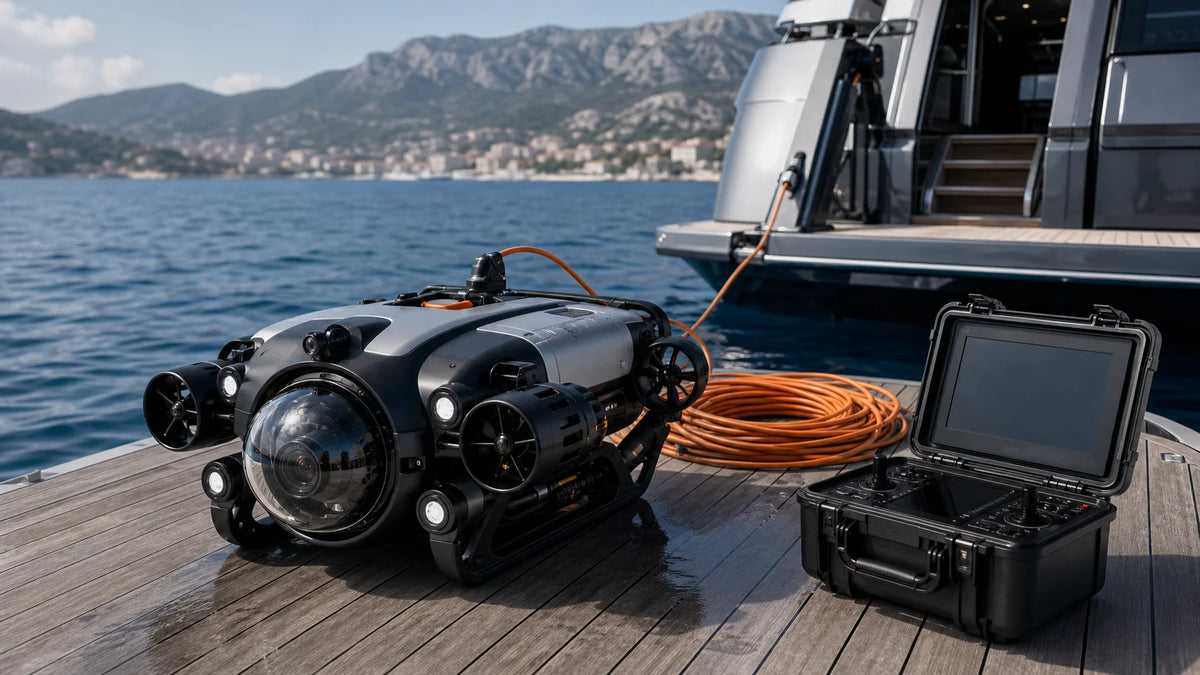
Personal Submarine Drone: A Practical Buying Guide
What if you could inspect a hull, explore a reef, or view underwater terrain without taking a single breath? A personal submarine drone makes that possible by combining a compact submersible vehicle, cameras, thrusters, and a remote control system. For a structured starting point, you can consult our underwater drone buying guide.
The phrase can describe several different machines. Some are small recreational ROVs designed for observation and filming. Others are professional platforms with stronger propulsion, deeper ratings, robotic arms, sonar, or inspection equipment. Understanding that distinction will help you avoid paying for capabilities that do not serve your mission.
What is a personal submarine drone?
A personal submarine drone is an uncrewed underwater vehicle operated from the surface. Most consumer and professional models are remotely operated vehicles, or ROVs. They transmit control signals and video through a tether, allowing you to pilot the machine while watching a live feed.
An autonomous underwater vehicle, or AUV, follows a different operating model. It can execute a programmed route or use onboard navigation without continuous piloting. A recent academic survey distinguishes these vehicle families by their control methods, navigation systems, sensing equipment, and mission profiles.
For personal ownership, an ROV is often the more practical format. The tether provides a stable communications link, live video, and a way to recover the vehicle. It also creates a physical management challenge, especially around rocks, vegetation, boat propellers, and underwater structures.
The vehicle itself normally includes several essential systems. These include a pressure-resistant housing, electric thrusters, a camera, LED lights, a battery, buoyancy elements, and an onboard control system. More advanced platforms can add depth hold, posture stabilization, object tracking, sonar, removable storage, or a manipulator arm.

Which mission should your underwater drone support?
Start with the activity rather than the appearance of the machine. A device for capturing marine-life footage has different requirements from one used for hull inspection, fishing assistance, scientific sampling, or search and recovery.
For underwater photography, prioritize image quality, lighting, stabilization, storage, and ease of piloting. A camera that records sharp footage is useful, but it will not compensate for weak lights or unstable movement. The clearest results usually require a steady platform, controlled depth, and enough illumination for the conditions.
For boat and infrastructure inspection, maneuverability becomes more important. You may need to hold position beside a hull, examine a propeller, follow a cable, or look beneath a platform. A compact frame can help in confined spaces, while additional thrusters can improve movement in currents.
For fishing or environmental observation, consider the sensor package. A camera can reveal underwater structure and fish activity, while sonar or temperature data can support a broader interpretation of the site. The United States Department of Commerce describes underwater technology as relevant to oceanography, surveillance, offshore activity, and subsea inspection in its U.S. trade overview.
For recovery tasks, a mounting system or robotic claw may be useful. However, a small manipulator does not turn a personal drone into a heavy-duty work-class ROV. Check the payload, gripping force, operating depth, and stability before assuming that an attachment can lift or move an object safely.
Which specifications matter most?
Depth is the first specification most buyers notice, but it is not the only one that determines usefulness. A sensible evaluation considers the complete system, including the vehicle, tether, controller, battery, camera, lighting, software, and available accessories.
Depth rating and pressure protection
Choose a rated depth that leaves a reasonable margin for your intended use. A machine rated for shallow recreational water may be unsuitable for offshore inspection, even if its camera appears capable. Water pressure increases with depth, so the housing, seals, connectors, and motors must be designed for the stated operating range.
Depth ratings should also be interpreted carefully. A maximum rating does not automatically describe the machine’s performance in cold water, strong currents, saltwater, or repeated dives. Ask whether the rating applies to continuous operation, occasional operation, or controlled test conditions.
Camera, lights, and storage
A 4K camera can produce detailed footage, but resolution is only one part of image quality. Sensor size, lens angle, stabilization, color handling, frame rate, and low-light performance all affect the result. Strong, adjustable lights can be particularly important because water absorbs color and visibility can change quickly.
Check how footage is stored and transferred. Some systems use internal memory, removable cards, a smartphone application, or an external control unit. A removable card may simplify larger recording sessions, while a live HDMI output can help professional operators monitor footage on a separate display.
Thrusters and maneuverability
Thruster layout determines how naturally the machine moves. Basic systems may travel forward, backward, up, and down. More advanced configurations can provide lateral movement, rotation, pitch control, or omnidirectional positioning.
Extra movement capability is valuable when you need to frame a subject precisely. It can also increase the learning curve. For casual exploration, a stable platform with depth hold may be easier to use than a highly agile system that demands constant manual correction.
Tether, control, and recovery
The tether carries data and often supplies the most reliable connection between the pilot and the vehicle. Its length limits working range, while its weight and buoyancy affect handling. A reel can help with deployment, but it adds another component to transport and maintain.
Look for a control interface that gives you useful feedback. Depth, temperature, heading, battery status, and connection quality can make a dive more predictable. A physical controller may also be easier to use on a moving boat than a touchscreen exposed to spray.
To simplify this comparison, you can use our guide to choose an underwater drone. The important principle is to match the system to your actual operating environment, not to the longest feature list.
What does a personal submarine drone cost in 2026?
Pricing varies widely because personal submarine drones range from compact observation platforms to professional inspection systems. In 2026, entry-level products may focus on basic video and recreational exploration. Higher-priced systems can add deeper operation, stronger lights, advanced stabilization, robotic arms, sonar, extra batteries, and industrial accessories.
A January 2026 market report estimated that the global underwater drone market would rise from $5.33 billion in 2025 to $5.89 billion in 2026. That figure describes the wider industry rather than the retail price of a personal vehicle, but it shows why the category includes very different levels of equipment. You can review the 2026 market report for broader context.
When comparing prices, separate the core vehicle from the complete deployment kit. A lower initial price may exclude a longer tether, a transport case, spare batteries, a reel, a claw, lighting, or replacement connectors. These accessories can significantly affect the final cost of ownership.
Maintenance also matters. Saltwater use requires careful rinsing and inspection, particularly around connectors, seals, thrusters, and tether interfaces. Batteries have a service life, while cameras and control hardware may become outdated even when the vehicle remains mechanically sound.
Our underwater drone prices resource can help you frame the purchase around configuration and purpose. The most suitable machine is not necessarily the one with the lowest price or the deepest advertised rating. It is the one that delivers reliable performance for your planned dives.

When should you choose a crewed personal submarine?
A personal submarine drone and a crewed personal submarine offer fundamentally different experiences. An ROV keeps you on the surface while a camera enters the environment. A crewed submersible places you inside a pressure vessel, creating a direct and immersive journey beneath the water.
Choose a drone when your priority is observation, documentation, inspection, or object interaction. It can reduce the need for a diver, lower exposure to some underwater hazards, and provide a practical way to view areas that are difficult to access. It is also more suitable when you need to repeat an inspection or record the same route over time.
Choose a crewed platform when the experience itself is central. You may want to travel with passengers, observe marine life through a viewing area, or create a private expedition around a destination. This type of purchase introduces different considerations, including crew training, launch arrangements, maintenance, insurance, transport, certification, and local operating requirements.
The terminology can create confusion because some sellers use “submarine drone” for a small camera vehicle, while others use it for a larger autonomous craft. Our personal submarine buying guide helps separate underwater drones from crewed personal submarines before you begin comparing individual machines.
How can you buy with confidence?
Begin by writing a short mission brief. State where you will operate, the maximum depth you expect, whether you need live video, how far the vehicle must travel, and whether you will carry it alone. Include the water conditions, the expected frequency of use, and any need for attachments.
Next, confirm practical support. Ask how the vehicle is shipped, what the warranty covers, how batteries are replaced, and whether spare parts remain available internationally. If you are buying from outside the seller’s home market, clarify customs, import duties, electrical standards, and after-sales arrangements.
Request a complete configuration rather than a headline specification. The quote should identify the vehicle, controller, tether, battery, charger, storage, lights, case, software, and accessories. It should also state whether the stated depth and operating time apply to the exact configuration you will receive.
Finally, consider the quality of the information you will collect. A government project published through a federal ROV report illustrates how underwater vehicles can support structured data collection. For a private owner, that principle remains useful: a reliable system should help you observe, record, and review evidence rather than simply produce attractive footage.
For high-value purchases, independent advice can be as important as the machine itself. A specialist can help you compare unusual configurations, identify operational gaps, and determine whether a drone or a crewed submarine better matches your expectations.
Choosing the right underwater platform
The right personal submarine drone depends on the mission you want to complete beneath the surface. Focus first on depth, connection, maneuverability, camera performance, lighting, recovery, and maintenance. Then compare the complete ownership package, including accessories, support, transport, and local operating requirements. If your goal is direct immersion rather than remote observation, evaluate a crewed personal submarine separately. Clear terminology and a written mission brief will help you make a more confident choice.
Take action with TheArsenale
Once you know whether you need a compact ROV, a professional underwater platform, or a crewed submersible, the next step is finding the right machine and configuration. High-value mobility purchases benefit from curated access, informed comparison, and personal assistance throughout the discovery process.

At TheArsenale, we bring together rare and future-oriented mobility objects from a global network of builders, designers, and brands. Our marketplace includes personal submarines and other extraordinary machines, supported by acquisition advice, curated experiences, and access through our international ecosystem. Explore our selection of personal submarines to begin your search.
Frequently Asked Questions
What is a personal submarine drone?
It is an uncrewed underwater vehicle controlled from the surface, usually through a tether. It typically carries a camera, lights, thrusters, and sensors for observation, filming, inspection, or exploration.
Is a personal submarine drone the same as a personal submarine?
No. A drone carries equipment into the water without a person inside, while a personal submarine is a crewed submersible designed to carry passengers. The two formats require different operating procedures, maintenance, and purchasing criteria.
Do underwater drones need a tether?
Most personal ROVs use a tether because radio and video signals do not travel through water as they do through air. The tether provides control and live video, but it must be managed carefully around obstacles, currents, and boat equipment.
How deep should a personal submarine drone go?
Choose a depth rating based on your intended environment, with a margin above your expected operating depth. A shallow recreational model may suit coastal observation, while offshore inspection requires stronger pressure protection, longer range, and more robust support.
How can TheArsenale help with a submarine purchase?
We curate rare and future-oriented mobility objects, including personal submarines, and provide personalized assistance for high-value acquisitions. Our team can help you explore suitable machines and connect your requirements with the right configuration or builder.