How to Buy a Designer Skateboard: A Collector's Guide
Board culture has moved far beyond the skatepark, and the objects it produces now command the attention of art collectors and design enthusiasts alike. A designer skateboard sits at the crossroads of street heritage, limited-edition artwork, and serious acquisition. Understanding the process of purchasing a designer skateboard with confidence, rather than on impulse, protects both your budget and your taste. Our designer skateboard capsule drop illustrates how a considered piece differs from an ordinary mass-produced deck.
The stakes are rising because the category itself is expanding. According to Grand View Research, the global skateboard market was valued at 3.7 billion dollars in 2025 and is projected to reach 4.6 billion dollars by 2033. That growth is drawing new artists, new collaborations, and, unfortunately, new counterfeits into circulation. A methodical approach matters more than ever.
What Defines a Designer Skateboard
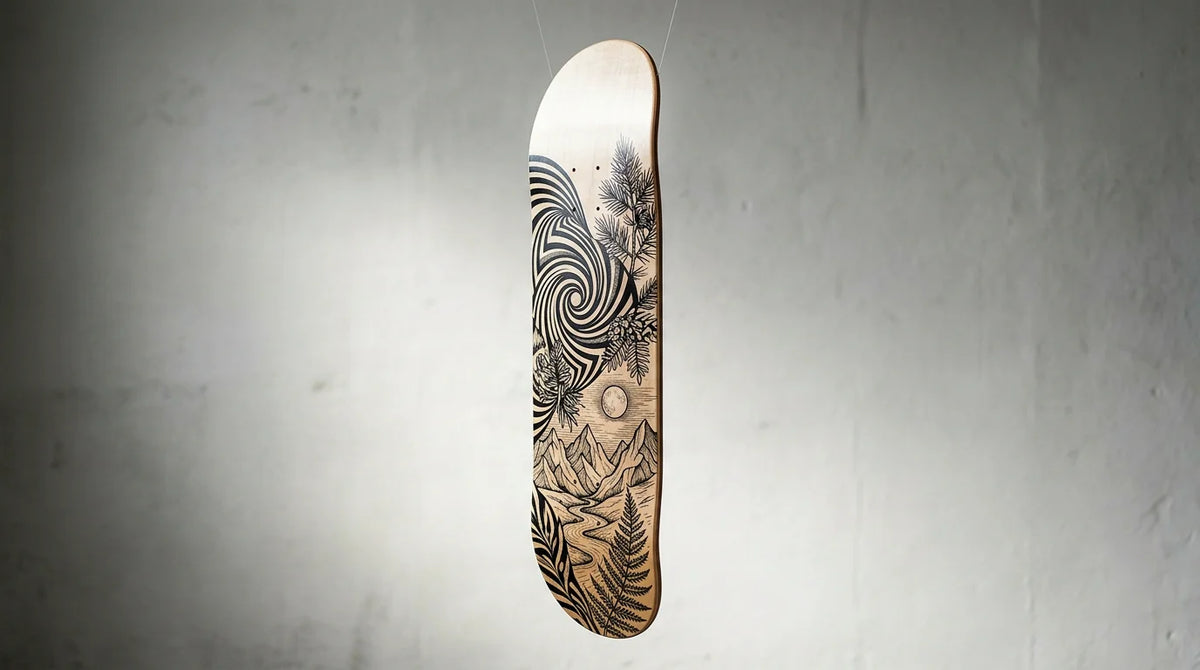
Before you learn how to buy a designer skateboard, you should understand exactly what separates one from a standard deck at a sporting goods store. A true designer skateboard is defined by an intentional creative signature: an original graphic from a named artist, a limited production run, or a collaboration between a brand and a cultural figure. These are not generic boards with a printed logo.
Three characteristics recur across genuine designer decks. The first is authorship, meaning a specific artist or studio is credited for the graphic. The second is scarcity, since limited-edition decks are produced in fixed, numbered quantities. The third is documentation, including certificates, edition numbers, or verified brand partnerships. When all three are present, you are looking at a collectible object rather than a disposable one.

Assessing the Market Before You Commit
Why does market context matter to an individual buyer? Because pricing, availability, and resale potential all move with broader demand. Regional dynamics are particularly instructive. Fortune Business Insights reports that North America held a dominant share in 2025 valued at 1.38 billion dollars, with a projected 1.43 billion dollars in 2026, which explains why many premium releases debut there first.
Understanding where demand concentrates helps you anticipate where sought-after boards appear and how quickly they sell out. If you are chasing a specific artist collaboration, monitor the regions and channels where a brand typically launches. Our worldwide skateboard reflects this global, cross-border collecting sensibility, where a piece is sourced and appreciated well beyond its country of origin.
How to Evaluate Authenticity and Quality
Authentication is the single most important skill for any serious buyer, and it is where value is protected or lost. Begin with the graphic reproduction. Genuine collectible decks use archival-grade inks and precise registration, so blurring, banding, or dull colours are warning signs. Examine the edition marking, which should be consistent with the artist or brand's stated production run.
Next, inspect the physical construction. Most premium boards use cold-pressed North American maple, typically seven plies, with clean, even lamination and no visible gaps. Check the concave shape, the wheel wells, and the finish for consistency. A board that is intended for display should still meet functional standards, because deck construction quality directly influences long-term value.
Provenance completes the picture. Request documentation of the collaboration, the release date, and, where relevant, the edition number. Distinctive graphics command a premium, and industry commentary notes that buyers increasingly pay more for original artwork than for generic designs. If a seller cannot substantiate authorship or edition size, treat the price with caution.
Matching Size and Setup to Your Purpose
Are you buying to ride, to display, or to do both? The answer shapes your sizing decisions. Deck widths commonly range from 8.0 to 8.75 inches, with narrower boards favouring technical street riding and wider boards offering stability for cruising and transition. If the board will be mounted as skateboard wall art, width becomes an aesthetic choice rather than a performance one.
For a functional setup, consider the complete assembly: trucks, wheels, bearings, and grip tape all affect ride quality. For a display piece, you may prefer to keep the deck unmounted to preserve the graphic and its collectible integrity. Our rainbow skateboard demonstrates how a bold graphic can function equally well as a ridden object or a statement piece on a wall.
Where to Buy: Comparing Your Options
Designer skateboards reach buyers through several channels, each with distinct trade-offs in price, authenticity assurance, and access to scarce releases. The collectibles trade increasingly runs online: market analysis classifies designer art toys and contemporary limited editions among the fastest-growing contemporary collectible segments, distributed across online marketplaces, auction houses, and specialty retailers.
The table below compares the main routes to acquisition, with our own curated marketplace positioned for buyers who prioritise verified provenance and early access.
| Channel | Authenticity assurance | Access to limited drops | Best for |
|---|---|---|---|
| Our curated marketplace | High, with provenance and private membership access before public listing | Early, pre-listing access | Collectors seeking verified, scarce designer pieces |
| Brand direct websites | High for that single brand | Strong at launch, limited afterward | Buyers loyal to one label |
| General auction houses | Variable, depends on cataloguing | Occasional rare lots | Rare archival editions |
| Open resale platforms | Low, buyer verifies alone | Wide but unfiltered | Experienced buyers who authenticate independently |
Whichever route you choose, insist on clear return terms, transparent seller history, and verifiable documentation before payment.

Pricing and Long-Term Value
How much should you expect to pay, and what drives resale value over time? Entry-level custom decks can start in the low double digits, but genuine designer and collaboration pieces typically command substantially more, reflecting artist reputation and edition scarcity. The premium is not arbitrary; it tracks documented authorship and finite supply.
Brand recognition also plays a role in value retention, though it is not the only factor. According to Market.us data, no single label dominates the field, with several established names each holding roughly 7 to 11 percent of the market and independent brands collectively significant. This fragmentation means a lesser-known artist's limited-edition deck can appreciate as strongly as a mainstream name when demand and documentation align. Our icons skateboard reflects this principle, pairing recognisable design language with deliberate scarcity.
Bringing It All Together
Learning how to acquire a designer skateboard comes down to discipline: verify authorship, inspect construction, confirm the edition, and buy only through sellers who can prove provenance. Match the board's size and setup to whether you intend to ride it, display it, or both. Treat the purchase as you would any considered acquisition, weighing scarcity, condition, and documentation against price. With that framework, you move from impulse buying to informed collecting, and you protect both the object's integrity and its future value.
Take action with TheArsenale
If you value provenance, scarcity, and pieces that reward a discerning eye, your search deserves a curated starting point rather than an open feed of unverified listings. We bring the same standards to board culture that we apply across high-end mobility and collectible design.

Explore our curated collection of designer skateboards, where each piece is selected for its creative signature and collectible merit. Through our Private Membership, you may access vehicles and pieces before they are listed publicly, and our team is available around the clock to answer your enquiries. Begin your collection with confidence.
Frequently Asked Questions
What makes a skateboard a genuine designer piece?
A genuine designer skateboard carries credited authorship from a named artist or studio, a limited and often numbered production run, and verifiable documentation. These three elements separate a true collectible from a mass-produced deck with a printed graphic.
How can I verify that a designer skateboard is authentic?
Examine the graphic for archival-grade print quality, confirm the edition marking against the stated production run, and inspect the maple construction for clean lamination. Always request provenance documentation, and treat any seller who cannot substantiate authorship with caution.
Should I buy a designer skateboard to ride or to display?
That depends entirely on your intention, and both are valid. Boards intended for riding benefit from a complete setup with quality trucks and wheels, while display pieces are often kept unmounted to preserve the graphic and its collectible integrity.
Where is the safest place to buy a designer skateboard?
A curated marketplace or brand-direct channel offers the strongest authenticity assurance, since provenance is verified before sale. Our curated collection is built for buyers who prioritise verified pieces and, through Private Membership, early access before public listing.
Do designer skateboards hold their value over time?
Value retention depends on scarcity, condition, documentation, and artist reputation rather than brand name alone. Limited editions with complete provenance tend to hold or appreciate, while mass-produced designs typically do not carry the same long-term appeal.