How to Choose High End Speakers: A Buyer's Expert Guide
The market for luxury audio has rarely been more crowded, yet selecting a single pair remains genuinely difficult. Some flagship models now command remarkable prices, with one loudspeaker unveiled at a 2025 trade show carrying a price tag near fifty thousand dollars. Understanding how to choose high-end speakers is therefore less about chasing the most expensive box and more about matching engineering to your room, your electronics, and your ears. For inspiration on how design and acoustics can merge, explore our transparent speaker showcase.
Demand is real and growing. The loudspeaker market was valued at roughly USD 8.24 billion in 2026, expanding at a compound annual rate above six percent. That momentum means more choice, more marketing noise, and a greater need for a disciplined approach before you commit.
Start With a Budget and a Clear Priority
Before you audition anything, set a firm budget. When you learn how to choose high end speakers for a complete system, resist the temptation to spend ninety percent of your money on the loudspeakers alone. A brilliant pair will simply expose every weakness in a mediocre source or amplifier.
Think about where your money should stretch. If you plan to upgrade other components later, leave headroom for speakers with enough resolution to reveal those future improvements. Cost sensitivity is common across the sector: according to a premium audio analysis, systems featuring immersive formats such as Dolby Atmos can cost three to five times more than standard setups, so plan the whole chain, not just one purchase.
A practical rule is to allocate your budget across source, amplification, cabling, and speakers, then adjust based on where you hear the biggest gains. The premium audiophile experience comes from balance, not from a single flagship component.

Measure Your Room Before You Shop
Your listening space dictates far more than most buyers expect. Sound waves interact with walls, floors, and furniture, so a speaker that dazzles in a large showroom can overwhelm a small study. Measure your room first and note how far the speakers can sit from the rear wall.
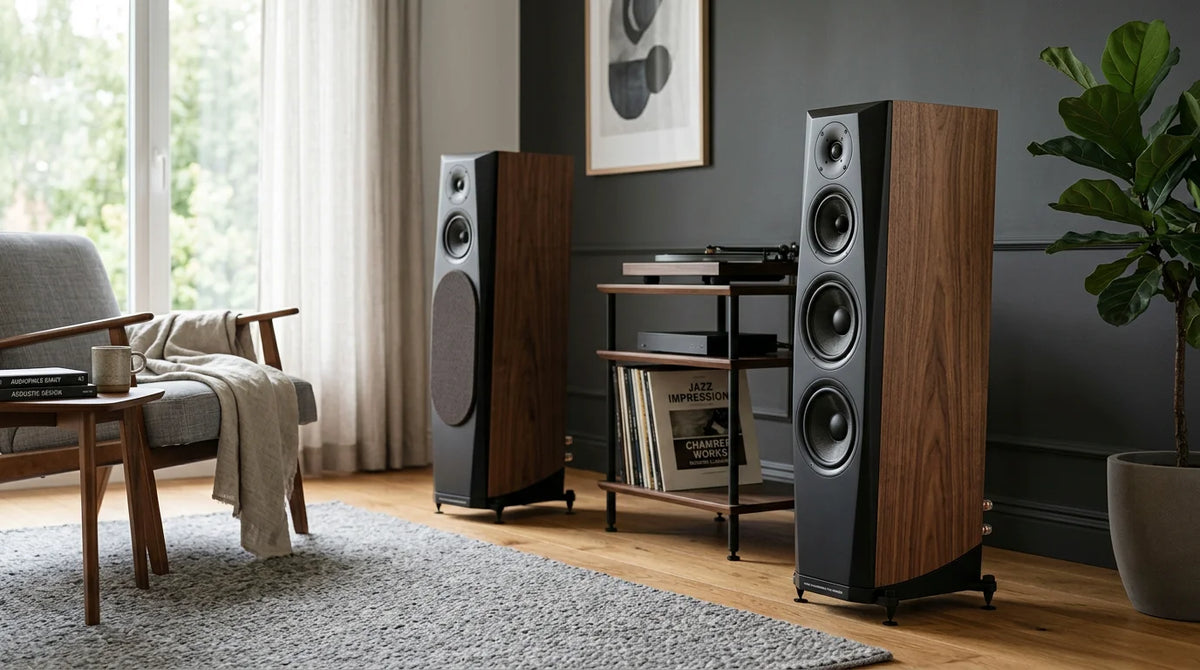
Larger speakers generally deliver higher volume, deeper bass, and greater dynamics, but only when they have room to breathe. If your placement forces them close to a wall, prioritise models designed for that situation, such as front-ported cabinets that manage bass without booming. Matching the speaker footprint to your room acoustics narrows your shortlist quickly and prevents an expensive mismatch.
Consider volume habits too. If you rarely listen loudly, enormously powerful floorstanders may be wasted, and a refined pair of standmounters could serve you better in every practical sense.
Floorstanders, Standmounters, or Active Systems
The core decision is configuration. Passive floorstanders and standmounters draw all their power from an external amplifier, while powered and active designs build amplification into the cabinet. Active speakers assign a dedicated amplifier to each driver, allowing more precise calibration at line level rather than through a passive crossover.
Each approach suits a different buyer. The table below compares the main options, including curated design-led pieces for those who treat speakers as functional art as much as audio equipment.
| Option | Best for | Trade-off |
| Floorstanders | Larger rooms, full bass, high dynamics | Need space from walls |
| Standmounters | Smaller rooms, precise imaging | Less low-end weight |
| Active / powered | Minimal boxes, integrated setup | Whole unit upgraded together |
| Curated design speakers (via us) | Statement aesthetics with high-quality sound | Selective, limited availability |
If a sculptural presence matters as much as fidelity, browse our premium sound speaker feature to see how engineering and industrial design can coexist. Consumer priorities support this dual focus: a hi-fi audio study found that roughly 64 percent of buyers rank sound clarity and bass quality as their leading concern, while wireless connectivity now appears in around 59 percent of devices.
Power, Impedance, and Matching Your Amplifier
A speaker is only as good as the amplifier driving it. Demanding loudspeakers require a muscular amplifier with strong current delivery, so do not fixate on the headline power figure alone. Instead, examine what happens when impedance drops to four ohms.
If the amplifier's power output nearly doubles as impedance halves, it has the current reserves to control difficult loads. This single detail separates a system that sounds effortless from one that strains at higher volumes. When you compare power handling and speaker impedance, always cross-check the pairing rather than the specification sheet in isolation.
Powered and active speakers sidestep some of this complexity because the amplification is engineered to match the drivers. That integration can represent good value, though it does mean any future upgrade replaces the entire unit rather than a single component.

Design, Materials, and Long-Term Ownership
Aesthetics are not vanity when a pair of speakers will share your living space for a decade. If you cannot stand the sight of them, you will never enjoy long listening sessions, however accomplished the sound. Consider finish, cabinet materials, and how the design sits within your interior.
Ownership costs matter too. Tweeter protection is worth checking if you share your home with children or curious pets, since exposed metal domes dent easily. Long-term serviceability is a genuine concern across the category: the same premium audio research noted that around 27 percent of consumers worry about repair costs and service accessibility for high-end gear. Buying from a source that stands behind its products protects your long-term investment.
The luxury tier continues to expand rapidly. The high-end wireless segment alone was estimated at more than USD 16 billion in 2026, reflecting how many buyers now expect flagship sound alongside modern convenience.
Audition Before You Commit
Never buy on specifications alone. Whenever possible, listen before you purchase, and bring music you know intimately. Familiar recordings reveal how faithfully a speaker renders arrangement, dynamics, and timing, because you already know how the piece should sound.
Try to audition with electronics similar to your own, and take a second listener for balance, since a single impression on a single day can mislead you. If you are weighing a compact system against a full pair of speakers, understanding the sonic trade-offs helps; our smart headphones comparison is a useful reference point for personal versus room-filling listening. Finally, confirm that demonstration units are fully run in, as some speakers change character noticeably after several hours of use.
Bringing It All Together
Knowing how to choose high-end speakers is ultimately an exercise in matching, not spending. Set a balanced budget, measure your room honestly, and select a configuration that suits your space and volume habits. Verify that your amplifier can drive the load, weigh design and serviceability for the long term, and always audition with music you know. When these elements align, the result is a system that rewards you for years rather than one that merely impresses on paper. Take your time, trust your ears, and let considered judgement guide the final decision.
Take action with TheArsenale
If your search for exceptional sound extends beyond the traditional living room, we can help you think differently about where premium audio belongs. As a luxury mobility marketplace, we curate design-led machines and statement pieces for owners who expect performance and character in equal measure, whether at home, on the water, or on the move.

Discover our Pikip solar speaker collection, engineered for powerful, self-sufficient sound in the most demanding environments. Shipping is complimentary, and our sales team typically replies in under thirty minutes, so you can move from curiosity to considered acquisition without delay.
Frequently Asked Questions
How much should I spend on high-end speakers?
There is no single figure, but you should budget for the whole system rather than the speakers alone. A common approach is to balance spending across source, amplification, and speakers so no component holds the others back. Leave headroom if you plan future upgrades.
Are floorstanders always better than standmounters?
No. Floorstanders generally offer deeper bass and greater dynamics, but only when your room can accommodate them. In smaller spaces, quality standmounters often deliver more precise imaging and a cleaner result.
What is the difference between active and passive speakers?
Passive speakers rely entirely on an external amplifier, while active speakers house a dedicated amplifier for each driver. Active designs allow more accurate calibration but must be upgraded as a complete unit rather than component by component.
Do I really need to audition speakers first?
Whenever possible, yes. Listening with familiar music and your own electronics reveals how a speaker performs in practice, not just on paper. A short audition can prevent an expensive mismatch.
Can premium speakers work outside a traditional home setup?
Absolutely, and the category is broadening quickly. Rugged, self-powered designs now bring high-quality sound to outdoor and mobile settings; our Pikip solar speaker collection is one example built for demanding environments where mains power is scarce.