Solar Powered Speaker for Sale: A 2026 Buying Guide
What makes a solar powered speaker for sale worth buying? The answer is not simply a larger panel or a longer advertised runtime. It is the balance between reliable audio, considered design, independent power, and practical outdoor use. If appearance is part of your decision, our designer speakers for sale selection offers useful context on how audio equipment can become part of a refined environment.
Solar speakers are designed for patios, gardens, terraces, campsites, pool areas, boats, and other spaces where access to a wall outlet is inconvenient. Yet solar charging works best when the product is matched to its environment. Before you buy, examine how much sunlight the panel receives, how much energy the battery stores, and whether the enclosure can handle the conditions where you intend to place it.
What should you expect from a solar powered speaker for sale?
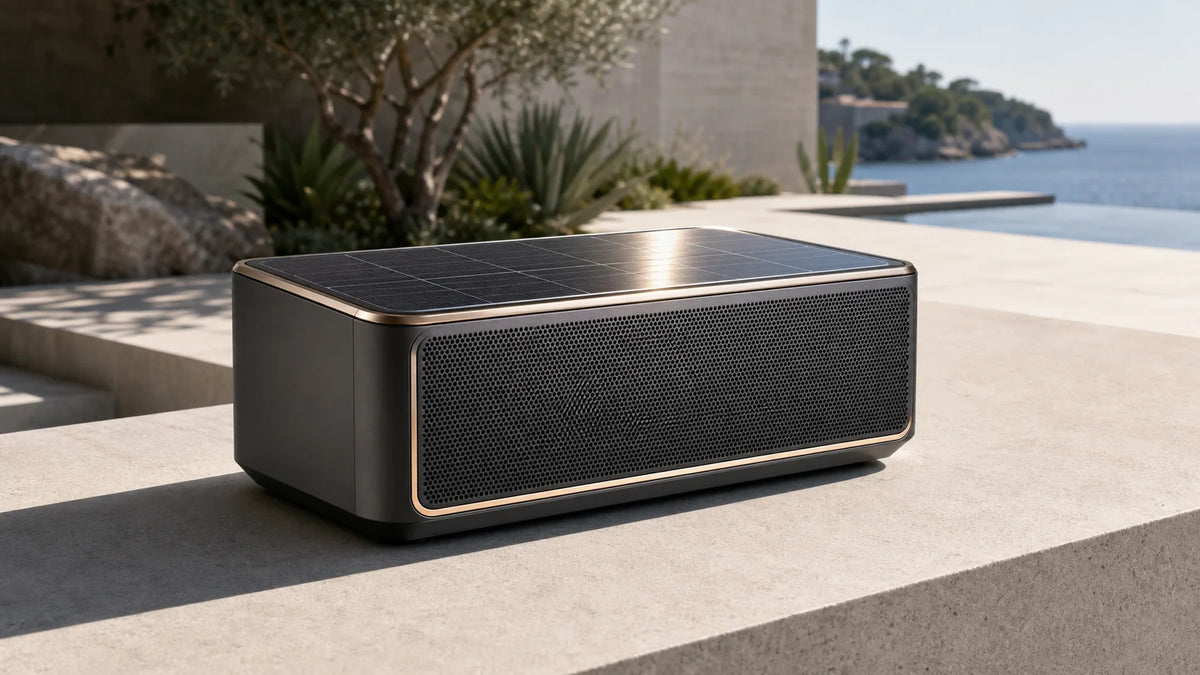
The category includes several different product types. Some models are compact and portable, with a small panel that extends battery life during daytime use. Others are larger outdoor systems, designed to remain in one location and provide wider sound coverage. There are also decorative speakers intended to blend into gardens, terraces, and landscaped areas.
These differences make direct price comparisons unreliable. A lower-cost model may be suitable for occasional background listening, while a larger unit may justify its price through stronger output, more substantial weather protection, or better mounting options. You should therefore compare the intended use before comparing the headline price.
Market forecasts also vary considerably because researchers define the category differently. One June 2026 estimate placed the global solar wireless speaker market at approximately USD 2.30 billion in 2025, with a forecast of nearly USD 4.98 billion by 2033, according to a 2026 market estimate. Such figures indicate growing interest, but they should not be treated as a substitute for evaluating a specific product.
Your first decision should be about the listening environment. A speaker for quiet terrace use needs different characteristics from one intended for a large garden gathering. Consider the area, expected volume, distance from the source device, exposure to rain, and whether you want to move the speaker regularly.
Solar charging is useful, but it is not unlimited

Solar charging depends on exposure, panel area, orientation, weather, and the energy required by the speaker. A panel may extend listening time without fully replacing conventional charging. This distinction matters when a product is advertised as self-charging or designed for continuous outdoor use.
Look for three separate specifications: panel design, battery capacity, and expected playback time. Panel coverage can influence how quickly energy is collected, while battery capacity determines how much power remains available after sunset. Runtime estimates should also be read carefully because they often depend on volume, content, temperature, and connectivity.
A separate June 2026 market forecast estimated that portable solar speakers represented 73.9% of category revenue in 2025. It also identified personal recreational use as the largest application segment, which supports the importance of mobility and battery reserve in many purchasing decisions. The figures come from another 2026 market forecast, so they should be viewed as directional rather than universal.
For regular evening listening, prioritise a substantial internal battery and a conventional charging option. USB charging can provide reassurance during long periods of shade, winter conditions, travel, or indoor use. Solar power is most valuable when it reduces charging frequency without forcing you to depend on ideal weather every day.
How does sound quality differ between outdoor designs?
Outdoor listening creates acoustic challenges. Open spaces provide fewer reflective surfaces than indoor rooms, so sound can disperse quickly. Wind, nearby traffic, water features, and conversation can also reduce perceived clarity.
Examine the driver configuration, amplifier output, enclosure volume, and frequency response. A larger driver may help produce fuller low frequencies, while a dedicated tweeter can improve vocal and instrumental detail. Passive radiators can also support bass performance without requiring a larger ported enclosure.
Output power alone does not describe sound quality. A speaker can play loudly while sounding harsh, compressed, or unbalanced. If possible, evaluate clarity at moderate volume, because comfortable everyday listening is usually more important than occasional maximum output.
Placement is equally important. A speaker positioned near a wall may sound fuller, while a unit placed in an open lawn may need more output to create the same sense of presence. Directional models can focus sound toward a seating area, whereas wide-dispersion designs may suit gardens and social spaces.
For a deeper design perspective, our luxury speakers buying guide explains why materials, proportions, listening context, and visual integration deserve attention alongside technical specifications. Our feature on transparent speaker design also shows how construction can become part of the listening experience.
Which weather resistance rating is appropriate?
Weather protection should match the actual installation. A speaker used under a covered terrace may face occasional humidity, while a poolside or garden unit may encounter rain, splashes, dust, mud, and accidental impact.
Check the stated IP rating and read the manufacturer’s instructions. The first number relates to protection from solid particles, while the second relates to water exposure. A rating designed for splashes does not automatically mean the speaker can be submerged or left in heavy rain without limits.
Construction details matter as much as the rating. Look for sealed controls, protected charging ports, corrosion-resistant hardware, impact-resistant panels, and a stable base. If the speaker includes a removable cover, confirm that it is properly fitted before outdoor use.
Temperature can also affect battery performance. Very hot conditions may accelerate battery wear, while cold conditions can reduce available runtime. When possible, position the unit away from prolonged extreme heat, standing water, and direct exposure to severe weather.
Finally, consider maintenance. Clean solar panels collect energy more effectively than dusty or obstructed panels. A simple routine involving a soft cloth, inspection of seals, and careful storage during severe weather can help preserve performance.
How important are Bluetooth, pairing, and placement?
Bluetooth range is relevant because outdoor spaces often place the listener farther from the speaker than an indoor room would. Walls, vehicles, dense vegetation, and other wireless devices can reduce connection stability.
Check the stated range under realistic conditions. A product may achieve its maximum distance in open space, while the usable distance becomes shorter around buildings or landscaping. Simple controls are also valuable when your phone is inside, charging, or being used by another person.
Multi-speaker connectivity can be useful for larger spaces. Stereo pairing may improve separation between left and right channels, while linked mono playback can distribute sound more evenly across a garden. Confirm whether the system supports the number of speakers you need and whether pairing requires a dedicated application.
Mounting and portability involve a practical trade-off. A stake or fixed base can create stable placement, but it may limit flexibility. A handle or detachable stand makes the speaker easier to move between a terrace, pool area, and outdoor dining space.
Before buying, sketch the intended listening area. Identify where the sun reaches the speaker, where people will sit, how far the source device will be, and whether the unit could become a trip hazard. This simple exercise often reveals more than a product photograph.
How should you compare price, availability, and support in 2026?
Price is only one part of the purchase decision. Compare the speaker, mounting hardware, charging accessories, replacement parts, delivery charges, warranty coverage, and expected service life. A product with a higher initial price may be more practical if it offers stronger construction and better support.
Availability can change by country. Check whether the product ships to your location, whether taxes or import charges apply, and whether customer support operates in your language and time zone. For international purchases, confirm the charging standard and any regional restrictions before placing an order.
A 2026 outdoor-audio buying test from Tom's Guide testing illustrates why sound, durability, portability, and battery performance should be considered together. Solar charging can be an important advantage, but it does not remove the need to assess the complete listening system.
Warranty language deserves close attention. Check what is covered, how long coverage lasts, and whether water damage, battery degradation, solar panel failure, or accidental damage are excluded. Also verify how repairs are handled if the product is purchased across borders.
If the speaker is part of a broader design-led interior or outdoor project, total cost should include visual compatibility. Our article on how much luxury speakers cost provides additional context for buyers comparing audio equipment as both technology and design object.
What is the simplest buying checklist?

A reliable shortlist can be created with five questions:
- Solar input: Is the panel large enough for the expected environment, and is conventional charging available?
- Battery reserve: Does the battery support evening use, cloudy days, and the volume level you prefer?
- Audio quality: Are speech, vocals, bass, and detail clear at normal listening levels?
- Weather protection: Does the IP rating match rain, dust, splashes, temperature, and placement?
- Placement flexibility: Can you mount, move, clean, charge, and store the speaker easily?
Then add the commercial checks. Confirm the delivered price, availability in your country, return terms, warranty, support channels, and replacement options. These details can determine whether a technically attractive product remains convenient after purchase.
For a permanent installation, prioritise durability, coverage, and visual integration. For travel or occasional use, prioritise weight, handle design, charging flexibility, and battery reserve. The right solar speaker is the one that fits your routine rather than the one with the longest specification sheet.
Choose the speaker around your real environment
The strongest buying decision begins with your space, not with a product slogan. Assess sunlight, listening distance, expected volume, weather exposure, battery needs, mounting options, and support before comparing prices. A well-matched solar-powered outdoor speaker can reduce charging interruptions while contributing to a more flexible and considered outdoor listening experience.
Take action with TheArsenale
When outdoor audio must combine independent power with a strong sense of design, the buying process should remain focused on use, materials, proportions, and long-term fit. A considered selection helps you choose equipment that belongs naturally in the spaces where you listen.

Explore TheArsenale’s curated solar-powered speakers collection for a design-led approach to solar audio. It offers a focused starting point for readers who value distinctive objects, future-oriented technology, and a more intentional outdoor environment.
Frequently Asked Questions
Does a solar powered speaker work at night?
Yes, provided its internal battery has stored enough energy during the day. Runtime depends on battery capacity, sunlight, volume, temperature, and whether other features consume power.
Can solar charging replace USB charging?
Solar charging can reduce the need for USB charging, but it may not replace it in shaded locations or during extended cloudy periods. A USB input provides useful flexibility for indoor charging and emergency use.
What IP rating should an outdoor speaker have?
The appropriate rating depends on whether the speaker is sheltered, exposed to rain, or placed near water and dust. Review the complete manufacturer guidance because an IP rating does not automatically permit submersion or severe-weather exposure.
Are portable or fixed solar speakers better?
Portable models suit changing locations, travel, and flexible listening. Fixed or mountable designs may provide steadier placement, wider coverage, and a cleaner installation in a garden, terrace, or hospitality setting.
Can TheArsenale help with a design-led speaker choice?
Yes. TheArsenale combines curated product discovery with editorial perspectives on luxury objects, materials, and future-oriented design. Its solar speaker collection can serve as a starting point when audio performance and visual character both matter.