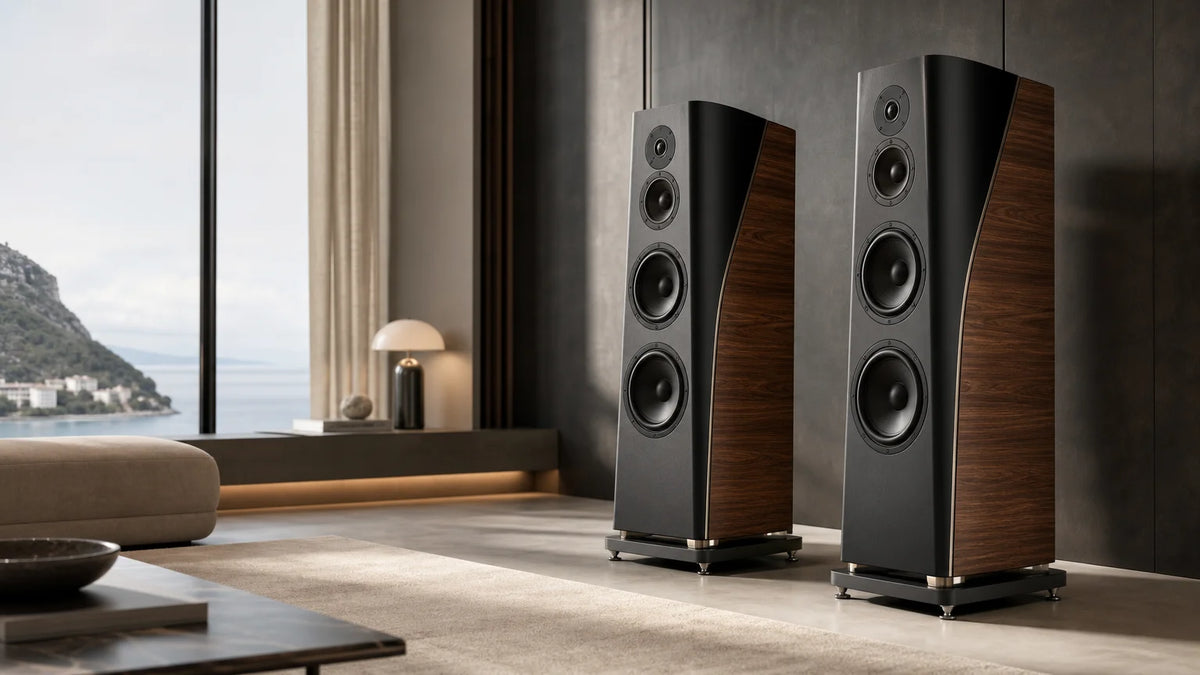
Designer Speakers for Sale: A Refined Buying Guide
A speaker can be a sound source, a sculptural object, or both. If you want audio equipment that contributes to the atmosphere of a room, our guide to choosing high-end speakers provides a useful starting point. The central question is not simply which model sounds impressive in isolation. It is whether the speaker creates the right relationship between music, architecture, materials, and daily life.
That relationship matters because a room influences what you hear as much as the components themselves. A January 2026 design guide from a 2026 design guide notes that room dimensions, surfaces, ceiling height, and furniture arrangement all affect speaker selection. The strongest purchase therefore begins with the space, not with a product photograph.
What should designer speakers for sale add to a room?
Good designer audio should contribute more than visual novelty. It should provide a coherent listening experience while expressing a clear point of view through proportion, texture, silhouette, and construction. The speaker may become a focal point, or it may integrate quietly into the architecture. Both approaches can work when the design feels intentional.
Look closely at the relationship between the enclosure and the drivers. A narrow cabinet may suit a minimal interior, while a larger floorstanding form can create a stronger sculptural presence. Curved panels, exposed mechanical elements, metal details, timber veneers, and textile grilles each communicate a different character. The correct choice depends on whether you want the speaker to recede, coordinate with existing furniture, or function as an art object.
Do not treat appearance and sound as separate decisions. Cabinet rigidity, internal volume, driver placement, port design, and grille construction can all influence performance. For a more visual approach to the category, explore our designer art speakers, where industrial expression and high-quality sound are considered together.
How should room acoustics shape your choice?
Imagine placing a large pair of speakers in a reflective room with bare floors, glass surfaces, and minimal furniture. The result may appear impressive, yet the sound can become bright, diffuse, or difficult to control. In contrast, a smaller speaker may perform more naturally in the same space when it is positioned carefully.
Room acoustics affect bass response, stereo imaging, vocal clarity, and perceived detail. A 2025 study on adaptive sound-field correction explains that changes in speaker quantity and placement can influence timbre, imaging, and clarity. Its findings support a practical principle: the most expensive speaker is not automatically the most suitable speaker for your room.
Before comparing models, record a few basic details:
- Room length, width, and ceiling height.
- Distance from the proposed speaker position to the rear and side walls.
- Main listening distance and the number of regular listeners.
- Hard surfaces, rugs, curtains, bookshelves, and upholstered furniture.
- Available power, cable routes, network access, and electrical outlets.
These details help you decide whether you need controlled bass, wide dispersion, directional imaging, or a compact footprint. They also reveal installation limits before a costly purchase is made. When possible, request a listening demonstration in a comparable room, rather than relying only on specifications or studio reviews.
Which speaker format fits your space?
Format determines both the visual impact and the practical demands of a system. Floorstanding speakers offer scale and presence, but they require sufficient floor area and careful positioning. Bookshelf speakers occupy less space, although they usually need stable stands and may require a subwoofer for deeper bass.
Active speakers include amplification inside the cabinet. They can reduce component count and simplify system planning, particularly when streaming is central to your routine. Their limitation is that upgrades may be less flexible because the amplifier and speaker are designed as one system.
Passive speakers connect to a separate amplifier. This approach offers more freedom to match amplification, change components, or build a system gradually. It also requires more decisions, including amplifier power, speaker sensitivity, cable selection, and equipment placement.
Architectural or in-wall speakers may be appropriate when the room should remain visually quiet. They can support a clean interior language, but installation becomes more complex. Wall construction, service access, ventilation, cable routing, and acoustic treatment should be reviewed before purchase.
For open-plan interiors, consider how widely sound needs to travel. A highly focused design may create an excellent central listening position but sound less consistent elsewhere. A wider-dispersion model may serve social spaces better, even if it produces a different type of stereo image.
Which materials and proportions matter most?
Materials influence how a speaker feels before it is switched on. Wood can introduce warmth and craft. Metal can suggest precision and engineering. Stone, composite materials, lacquer, and textiles can create a more architectural or gallery-like presence.
In its coverage of Milan Design Week 2026, Wallpaper's 2026 coverage described sound as an increasingly visible part of interior design. This reflects a broader shift in which audio is considered alongside lighting, furniture, and spatial atmosphere rather than hidden as a purely technical element.
Proportion is equally important. A tall speaker can emphasize vertical lines and complement high ceilings. A low, wide design may work better with media consoles or low seating. Rounded forms can soften a formal room, while geometric cabinets may reinforce an industrial or contemporary scheme.
Pay attention to finishes under different lighting conditions. Gloss can reflect windows and artificial light, while matte surfaces tend to appear quieter. Dark finishes can visually recede, but they may also show dust more clearly. Pale finishes can lighten a room, although they may need more careful coordination with surrounding materials.
Finally, consider the speaker when it is not playing. A designer product remains part of the room throughout the day. Its silhouette, cable management, grille options, and distance from surrounding objects should feel acceptable in both active and inactive moments.

How should you compare system architecture and connectivity?
Connectivity determines how naturally the system fits your routine. A traditional system may suit a dedicated listening room, while a network-enabled design may be preferable for everyday streaming. Some buyers want physical inputs and upgrade freedom. Others prefer a simplified arrangement with fewer visible components.
Ask whether the speaker supports the sources you actually use. These may include a turntable, television, music server, wireless streaming platform, digital audio player, or home automation system. Confirm the connection types before you buy, especially if the speakers will be installed into an existing room.
In 2026, architectural audio products continue to combine discreet installation with processing and controlled dispersion. A 2026 trade report describes current architectural systems as addressing the competing needs of minimalist interiors, immersive audio, output, and acoustic balance.
For a two-channel music system, focus on the quality of the listening position and the simplicity of control. For television, cinema, or multi-room use, consider how the speakers will integrate with the wider system. A beautiful pair can still become frustrating if switching sources, adjusting volume, or updating software feels unnecessarily difficult.
When your decision involves a substantial budget, document the complete system rather than the speakers alone. Include amplification, source components, stands, cables, room treatment, installation, delivery, and future service. Our luxury speaker pricing guide can help you think about the wider cost structure.
What should you verify before buying?
A product page rarely answers every question that matters. Before committing to designer speakers for sale, request clear information about the following points:
- Dimensions and weight: Confirm door access, stair access, floor loading, and final placement.
- Amplifier requirements: Check recommended power, impedance behavior, and sensitivity.
- Room suitability: Ask whether the design works near walls, corners, windows, or built-in cabinetry.
- Finish samples: Request photographs or physical samples under natural and artificial lighting.
- Installation: Establish whether stands, brackets, grilles, cables, or calibration are included.
- Service access: Confirm replacement parts, software support, diagnostics, and approved service routes.
- Delivery: Ask about packaging, international shipping, insurance, import arrangements, and installation.
- Return conditions: Review the policy carefully, particularly for custom finishes or made-to-order products.
Personal assistance becomes valuable when the product is rare, customized, or difficult to audition. We can support high-value acquisitions through direct sales consultation, helping you clarify the intended use, design preferences, and practical requirements before proceeding.
It is also worth asking how the product is designed for long-term ownership. A 2025 engineering review on circular electronics identifies repairability, maintenance, diagnostics, and post-sale service as important considerations in extending product life. The same logic applies to premium audio, where durable construction and service access can protect both usability and value.

Do not assume that a visually complex speaker is difficult to maintain, or that a simple cabinet is automatically easy to service. Ask specific questions about removable panels, replaceable drivers, amplifier access, finish repair, and the availability of technical documentation.
Choose the speaker as part of the room
The right designer speaker is not defined by appearance alone, and it is not selected by specifications in isolation. It should suit the room, the listening distance, the system architecture, and the way you live with objects every day. Compare formats carefully, assess acoustics before aesthetics, and confirm installation and service details before purchase. When sound, material, proportion, and practicality align, the speaker becomes a lasting part of the interior rather than an accessory added afterward.
Take action with TheArsenale
If you are searching for a distinctive audio centerpiece, the next step is to define the mood, scale, and technical role you want the system to play. Consider whether your priority is a sculptural object, a discreet architectural solution, or an integrated listening experience for a wider interior.

Our curated approach connects design-led objects with collectors and enthusiasts seeking unusual, high-value pieces. To explore a considered option for your space, visit our designer luxury audio system and contact our team for further information about the product and acquisition process.
Frequently Asked Questions
Are designer speakers suitable for everyday listening?
Yes. A well-designed speaker can provide daily listening quality while contributing to the character of the room. You should still confirm usability, source compatibility, placement requirements, and service access before buying.
Should I choose active or passive designer speakers?
Active speakers simplify the system by combining amplification and loudspeaker components. Passive speakers provide greater freedom to select and upgrade the amplifier, so the better choice depends on your technical preferences and long-term plans.
Do designer speakers require a dedicated listening room?
No. Many models can work in living rooms, offices, lounges, and open-plan spaces. The important factors are room scale, speaker placement, reflective surfaces, listening distance, and how the system needs to serve the space.
How can I match a speaker to my interior?
Start with proportion, finish, visual weight, and the materials already present in the room. Request finish samples where possible, and consider how the speaker will look when it is not being used.
Can TheArsenale help with an unusual audio acquisition?
Yes. We provide direct sales consultation for high-value acquisitions and can help you clarify your preferences before proceeding. Our broader marketplace is designed around curated, rare, and future-oriented objects for collectors and enthusiasts.