Best High End Speakers for Luxury Listening Rooms in 2026
Searching for the best high end speakers is rarely a simple matter of choosing the most expensive pair. The right loudspeaker must suit your room, listening distance, music collection, electronics, and expectations. Our guide to how to choose high-end speakers provides a useful starting point when you are comparing technical performance with design and ownership priorities.
In 2026, high-end audio includes traditional passive towers, compact monitors, active systems, wireless designs, horn-loaded models, electrostatic speakers, and highly sculptural enclosures. The 2026 testing guide from What Hi-Fi? reflects that range by evaluating speakers across different budgets, room sizes, and listening requirements.
What makes a high-end speaker worth the investment?
A high-end speaker earns its position through more than premium materials or an impressive price. You should look for controlled cabinet behavior, carefully integrated drivers, a coherent crossover, useful bass extension, and stable imaging. These elements determine whether music feels natural, spacious, and properly proportioned.
Driver integration is particularly important. A speaker may use advanced tweeters, midrange units, or woofers, yet still sound disjointed if those elements do not blend smoothly. The transition between frequency ranges should feel continuous. Voices should not appear detached from instruments, and bass should support the performance rather than dominate it.
Cabinet construction also influences the result. A rigid enclosure can reduce unwanted vibration, but rigidity alone does not guarantee musical accuracy. The shape, internal bracing, port design, damping, and driver mounting all affect the way the speaker behaves in your room.
High-end performance also includes consistency at different volumes. A capable speaker should preserve tonal balance during quiet listening, while remaining composed during demanding orchestral passages, electronic bass, or dynamic live recordings. You should therefore audition familiar music at both moderate and realistic concert levels.
Start with the room, not the price tag
Imagine placing a large floorstanding speaker in a compact room, close to the rear wall, with limited space around each cabinet. The result may include excessive bass, restricted imaging, and a presentation that feels larger than the room can comfortably support.
In a larger room, the opposite problem can occur. A compact standmount speaker may create an attractive image, but it may not deliver the scale, low-frequency authority, or effortless dynamics you expect. This is why room matching should come before brand preference or finish selection.
Measure the listening space first. Note the room dimensions, ceiling height, wall materials, furniture, windows, and listening position. Then consider how far the speakers can sit from the rear and side walls. Placement flexibility can be more valuable than an impressive specification when your room imposes practical limits.
Speaker sensitivity and impedance also matter. A model that needs substantial current may be unsuitable for a modest amplifier. Conversely, a highly sensitive design may pair well with lower-powered amplification but reveal more of the character of the electronics. The goal is not to find a universally ideal specification. It is to find a balanced relationship between speaker, amplifier, and room.
Which speaker architecture suits your listening style?
A three-part decision can simplify the search: choose the physical format, the operating principle, and the level of system integration you want.
Floorstanding speakers suit listeners who want broad bandwidth, greater scale, and a visually substantial presence. They can work well in medium and large rooms, although their size and bass output require careful positioning. Some models include adjustable controls that help you adapt the presentation to the room.
Standmount speakers can provide precise imaging and a smaller visual footprint. They often suit dedicated listening spaces where you value soundstage focus over maximum bass output. A well-designed standmount may also allow you to select a subwoofer later, giving you greater control over low-frequency integration.
Active speakers include amplification inside the cabinet. This can improve system coordination because the manufacturer can match the amplifier to the drivers and crossover. It also reduces the number of separate components. Passive speakers, by contrast, allow you to shape the system through amplifier choice, cables, sources, and future upgrades.
Horn-loaded, electrostatic, planar, and omnidirectional designs offer distinct listening experiences. Horn systems may provide strong dynamics and high sensitivity. Electrostatic and planar designs can create an open, spacious presentation. Omnidirectional models distribute sound differently throughout the room. Each approach involves trade-offs in placement, amplification, scale, and tonal character.

Why system synergy matters as much as the speaker
Two pairs of speakers can sound dramatically different when connected to different electronics. Amplifier power, current delivery, output impedance, digital conversion, room correction, and source quality all influence the final result.
Begin with your listening habits. If you play acoustic music, vocal recordings, or small ensembles, prioritize tonal naturalness, image stability, and low-level detail. If you listen to rock, orchestral music, or electronic productions, give greater attention to dynamic range, bass control, and output capability.
Then examine your electronics. A revealing speaker may expose weaknesses in a noisy source or harsh amplifier. A warmer speaker may benefit from an open and controlled amplifier. These are not fixed rules, but they explain why a speaker that sounds impressive in a showroom may not deliver the same result at home.
Room correction can be useful, particularly below the room's transition frequency. However, it should not be treated as a substitute for sensible placement or suitable speaker selection. Digital processing can address certain room interactions, but it cannot completely correct poor dispersion, inadequate amplifier matching, or a cabinet that is too large for the space.
How should luxury design influence your choice?
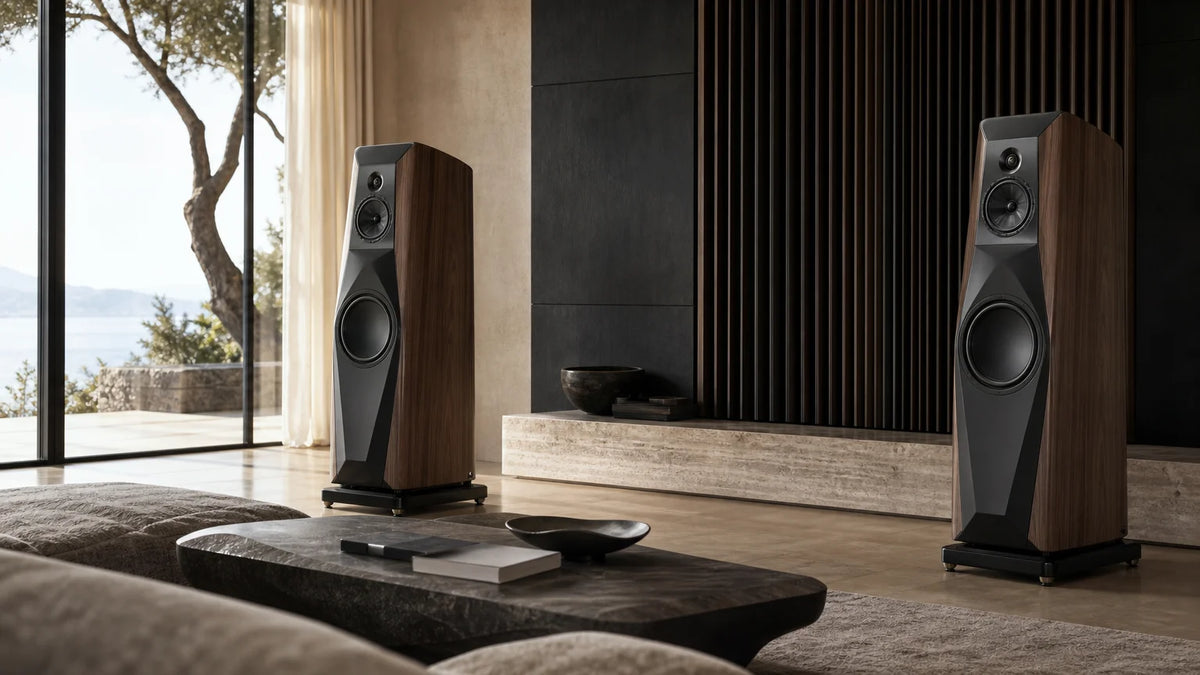
Luxury audio is experienced with both the ears and the eyes. A speaker occupies a prominent position in a room, often for many years. Its proportions, materials, finish, and visual language should therefore support the interior rather than compete with it.
Our designer speakers for sale selection reflects a broader interest in objects where engineering and visual identity work together. When you evaluate a sculptural speaker, ask whether the design contributes to the room, whether the finish will remain appealing over time, and whether the construction appears consistent with its intended lifespan.
This consideration is not merely decorative. A speaker that you enjoy seeing may encourage better placement and more frequent listening. A visually intrusive model may be moved into a compromised position, weakening its acoustic performance. The most successful luxury systems make correct placement feel natural within the room.
Market context also matters, although it should not replace personal auditioning. One 2026 forecast for high-end professional loudspeakers places the market at approximately $2.7813 billion in 2025 and projects approximately $4.6594 billion by 2035. The 2026 market forecast concerns professional loudspeakers rather than every home audio category, but it illustrates continuing investment in premium sound equipment.
Are active and wireless speakers suitable for high-end listening?
For many years, serious listeners associated high-end sound with separate amplifiers, preamplifiers, cables, and passive loudspeakers. That approach remains valid, but it is no longer the only route to a refined system.
Modern active speakers can combine amplification, digital processing, streaming, and room adjustment within a coordinated design. This may simplify installation and reduce the risk of mismatched components. It can also help you maintain a cleaner interior, especially when the system forms part of a living room, library, office, or hospitality space.
Wireless connectivity introduces its own compromises. Network reliability, software support, digital latency, privacy, and long-term update policies deserve attention. You should confirm how the system handles high-resolution sources, multi-room playback, wired connections, and service interruptions.
At the same time, wireless technology has become more credible in premium audio. A recent speaker guide notes that newer high-end wireless models can address earlier limitations and approach the experience associated with wired systems. That does not make every wireless speaker suitable for every listener, but it makes the category worth serious consideration.
Choose active or wireless speakers when convenience, integration, and interior simplicity are central priorities. Choose a traditional passive system when you value component experimentation, upgrade flexibility, and a more hands-on path to system building.
What should you check before buying?
Before committing to a pair, create a short audition plan. Bring recordings that reveal different aspects of performance, including a natural vocal track, a well-recorded acoustic ensemble, a demanding bass passage, and a dense orchestral or electronic recording.
- Listen for tonal balance: voices should sound credible, cymbals should remain controlled, and bass should have definition.
- Check imaging: instruments should occupy stable positions without making the presentation feel artificially narrow.
- Evaluate dynamics: the speaker should move from quiet passages to louder sections without strain.
- Test different volumes: a refined speaker should remain engaging during both intimate and energetic listening.
- Ask about placement: confirm the recommended distance from walls and the expected listening position.
- Review amplification: check sensitivity, impedance behavior, power requirements, and recommended partners.
- Inspect the finish: look for consistent joinery, stable feet, durable surfaces, and a finish suited to your interior.
- Clarify ownership: ask about delivery, installation, service, warranty terms, and future support.
Our luxury hi-fi buying guide can help you structure this process around performance, design, and ownership. You can also explore our transparent speaker design feature to consider how material choices and visual openness can change the role of a loudspeaker within a room.
The final test is simple. After the technical questions are answered, ask whether you want to continue listening. The most suitable speaker should reveal information without turning music into an analysis exercise.
Choose the speaker that completes your room
The best high end speakers are the ones that form a convincing relationship with your room, electronics, music, and personal sense of design. Price can indicate complexity, craftsmanship, or rarity, but it cannot replace compatibility. Measure your space, audition familiar recordings, confirm system requirements, and consider how the speaker will live in your interior over time. A carefully matched system will provide greater satisfaction than an impressive specification chosen without context.
Take action with TheArsenale
If you want sound to belong to a wider world of design, motion, and collectible objects, your search can extend beyond conventional audio retail. We curate rare mobility products, design-led experiences, and future-oriented objects for collectors and enthusiasts seeking a more distinctive relationship with technology.

Explore our Automobili Lamborghini luxury sound system as a direct starting point. It connects the visual language of exceptional mobility with the atmosphere of a considered listening environment, while our team remains available for tailored guidance across the wider collection.
Frequently Asked Questions
What are the best high end speakers for a large room?
Large rooms often benefit from speakers that can produce scale, controlled bass, and realistic dynamics without strain. Floorstanding models may be appropriate, but the correct choice still depends on listening distance, room acoustics, amplifier capability, and placement flexibility.
Are expensive speakers always better?
No. Higher prices may reflect advanced materials, specialist manufacturing, complex engineering, or distinctive finishes. A less expensive speaker that suits your room and electronics can provide a more satisfying result than a costly model that is poorly matched.
Should you choose active or passive high-end speakers?
Active speakers can simplify system design by combining amplification and processing within the cabinet. Passive speakers provide greater freedom to select and upgrade separate components, so your decision should reflect your preferred level of control and system complexity.
How important is speaker placement?
Placement is fundamental because nearby walls, corners, furniture, and listening distance affect bass response and stereo imaging. Begin with the manufacturer's recommendations, then make small adjustments while listening to familiar recordings.
Can TheArsenale help with a design-led audio purchase?
We can connect your interest in distinctive design, luxury objects, and mobility culture with relevant curated experiences. The Automobili Lamborghini luxury sound system provides one direct route into that collection, while tailored assistance can help you explore the wider offer.